Your phone bill shows up every month, whether you think about it or not. Most people look at the price on the plan page and stop there. But the number on your actual bill is often much higher. Taxes, fees, phone payments, and add-ons all pile up.
So, what does the average American really spend on a cell phone plan? The honest answer is that it depends on how you count. Some reports say $141 a month. Others say closer to $157. At the same time, millions of people pay less than $30 by choosing a budget provider.
In this blog, we explain the numbers in plain words. You will learn why the average looks so high, what single lines and family plans cost, and how much you could save by switching. We will also show how Infimobile annual plans compare, so you can see what a low-cost option looks like in real dollars.
The Short Answer: What the Average American Pays
According to J.D. Power data that many finance sites repeat, the average American cell phone bill in 2026 is about $141 per month. That adds up to roughly $1,700 a year. A report from WhistleOut, shared by Mint Mobile, puts the average bill with a major carrier at about $157 per month. That is close to $1,900 a year.
Why do the numbers differ? Each survey asks different people and counts different things. Some include phone payments. Some include taxes and fees. Some include every line on a family account. Because of this, it is best to treat these numbers as a range, not as one exact figure.
A fair way to think about it is this. If you use a big carrier, a typical account may land somewhere between $140 and $160 per month. If you use a budget provider, your bill can be a small fraction of that.
Why the Average Looks So High
The average bill is not just the price of your plan. It is a mix of several costs. Here are the main ones.
- Number of lines. Many bills cover two, three, or four people. The average includes all of them, so it looks bigger than what one person pays.
- Phone payments. Many people pay for their phone in monthly installments. Reports say a phone upgrade can add about $30 to $45 to your bill each month.
- Phone insurance. Protection plans often add $10 to $15 per line each month. Over a year, that is $120 to $180 for one phone.
- Taxes and fees. Some estimates say these add $10 to $30 per month. Many people forget about them when they compare prices.
- Premium unlimited plans. Big carriers often charge $50 to $100 per month for one line, depending on the carrier and the amount of data.
- Extras. Add-ons like extra hotspot data can cost another $10 to $15 each month.
Put these together, and it is easy to see how a plan that looks like $60 on a website turns into a $100 bill. This is why it helps to look at the total, not just the headline price.
Average Cost by Type of Plan
Not every phone plan costs the same. Here is a simple look at what people typically pay per line, based on public estimates from 2026. Prices vary by provider and by what is included.
| Plan type | Typical cost per line per month | What to know |
| Big carrier, single line | $50 to $100 | Often unlimited data. Phone payments and fees are extra. |
| Big carrier, family plan | $30 to $50 per line | Cheaper per person when you share four or more lines. |
| Budget provider or prepaid | $15 to $45 | Often runs on a big network. Fewer extras. |
| Infimobile annual plans | $6.25 to $12.50 | Paid once a year. See the plan table below. |
Mint Mobile reports that about 47% of cell phone users already use a budget provider, and that these plans cost about $30 per month on average. Mint Mobile is a budget provider itself, so keep that in mind when you read its numbers. Still, the gap between a big carrier plan and a budget plan is clear in almost every source.
Single Line vs Family Plan
If you live alone, your bill is the plan price plus fees. A single line on a major carrier often costs $50 to $100 per month for service alone. That goes up if you add phone payments and insurance.
Family plans spread the cost across more people. Public estimates show that two lines on a major carrier may cost $100 to $140 in total. Three lines may cost $120 to $165. Four lines often cost $120 to $200, which is roughly $30 to $50 per person.
The tradeoff is that everyone is tied to one account. If one person wants to leave, the savings can change for the rest of the group. Budget plans give each person their own line and their own price, which can be easier to manage.
What It Adds Up to Over a Year
Monthly numbers can feel small. Yearly numbers show the real picture. Here is what the numbers look like over 12 months.
- At $141 per month, you spend about $1,692 per year.
- At $157 per month, you spend about $1,884 per year.
- At $30 per month on a budget plan, you spend $360 per year.
Mint Mobile estimates that moving from the $157 average to a $30 plan could save more than $1,500 a year. That is a big number, but it compares a full average bill with one budget plan. Your own savings will depend on how many lines you have and whether you still pay off a phone.
Here is a simple one-line example. Say you pay $70 per month for one line. That is $840 a year. An Infimobile Freedom Unlimited plan costs $150 for 12 months. That is a difference of $690 in a year. Your numbers may be different, but the example shows how fast the gap grows.
How Much Should You Spend on a Phone Plan?
A simple rule can help. MoneyLion suggests that your phone bill may be too high if it is more than about 3% to 5% of your take-home pay, or if it is above the $141 national average.
Here is the math. If you take home $3,000 a month, 3% is $90 and 5% is $150. If you take home $2,000 a month, the same range is $60 to $100. For many households, a smaller bill is easy to reach and leaves more room for rent, food, and savings.
This rule is only a guide. A family with four lines will pay more than a single person. But it is a quick way to check if you might be paying too much.
How Much Data Do You Actually Need?
Most price differences between plans come from data. Many people pay for unlimited data but use only a small part of it. The best way to know is to check your own usage. Open your phone settings and look at how many gigabytes you used in the last few months.
If you mostly use Wi-Fi at home and at work, a plan with 5GB to 10GB may be enough for texts, maps, music, and some video. If you stream a lot on mobile data or share a hotspot, you may want 15GB, 20GB, or unlimited data. Paying for the right size, and not the biggest size, is one of the easiest ways to cut your bill.
How to Lower Your Phone Bill
You do not need to give up good service to pay less. These steps work for most people.
- Check your real data use. Pick a plan that fits what you use, not what sounds safe.
- Pay off your phone. Once a phone is paid off, you can remove the monthly payment. Reports say this can cut $30 to $40 from your bill.
- Skip insurance you do not need. If your phone is older or you use a strong case, you may not need to pay $10 to $15 per line.
- Use Wi-Fi calling. It works well indoors and helps in places where the signal is weak.
- Share a plan if it makes sense. Family plans can bring the cost per line down to about $30 to $50.
- Pay for a full year at once. Paying for several months in advance often lowers the monthly price a lot.
- Compare budget providers. Many run on major networks and cost much less than big carrier plans.
Infimobile Plans: A Low-Cost Option
Infimobile offers annual plans for people who want solid data at a low price. The 5GB, 10GB, 15GB, and 20GB plans use a 5G and 4G LTE network. They include WiFi calling and texting and come with a 3-in-1 SIM card kit. Hotspot is available as an add-on. Here is how the main plans compare.
| Plan | Price | Per month | Data | Talk and text |
| 5GB (Pro Plus) | $75 for 12 months | $6.25 | 5GB of 5G/4G data per month | 2,500 minutes and 2,500 SMS nationwide |
| 10GB (Unlimited Plan) | $75 for 12 months | $6.25 | 10GB of 5G/4G data per month | Unlimited nationwide talk and text |
| 15GB (Promotional) | $108 for 12 months | $9.00 | 15GB of 5G/4G data per month | Unlimited nationwide talk and text |
| 20GB (Premium) | $120 for 12 months | $10.00 | 20GB of 5G/4G data per month | Unlimited nationwide talk and text |
| Freedom Unlimited | $150 for 12 months | $12.50 | Unlimited 5G/4G data per month | Unlimited voice and SMS |
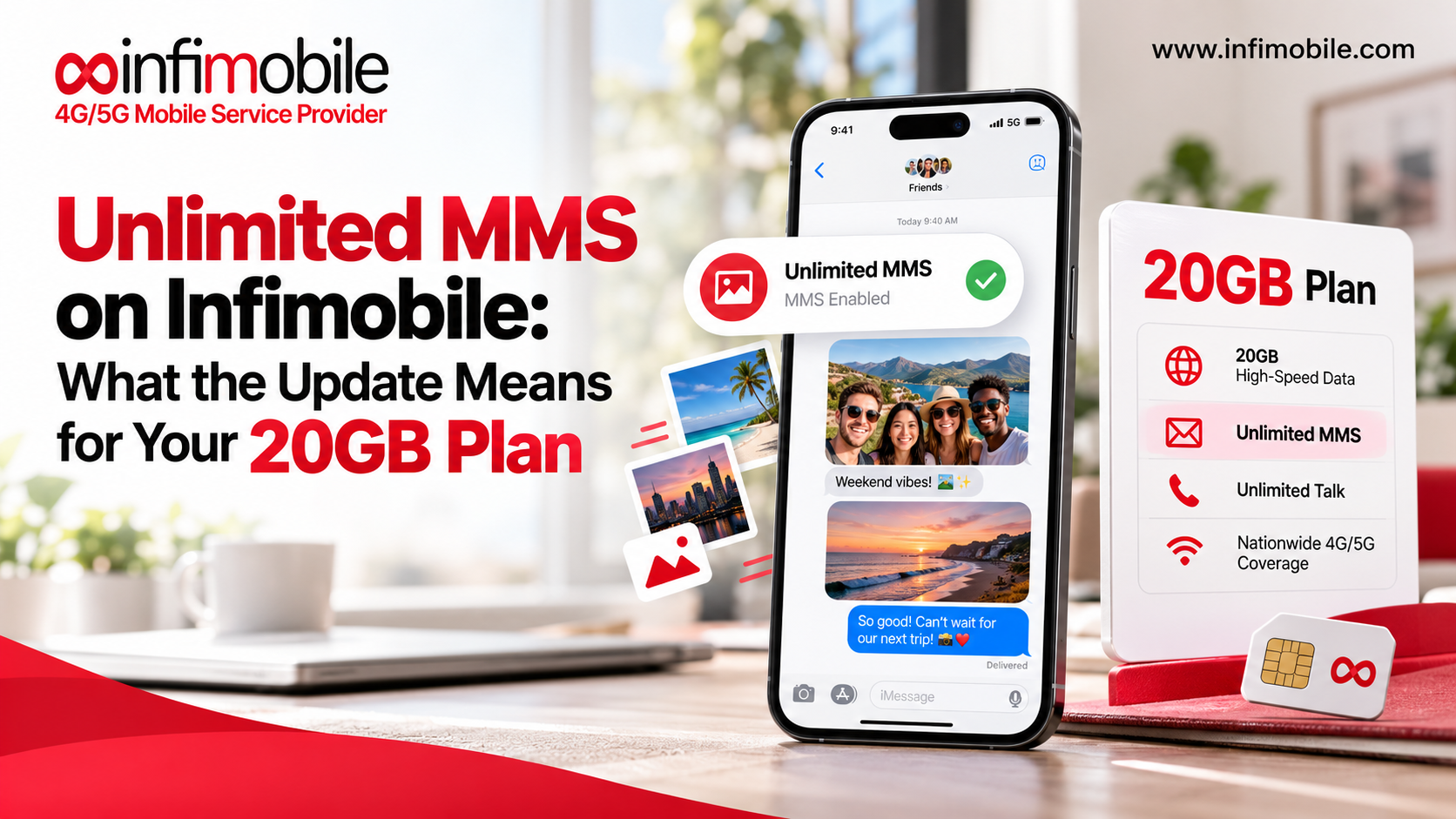
The 5GB, 10GB, 15GB, and 20GB plans each include 500 MMS messages. On the 10GB, 15GB, and 20GB plans, speeds are reduced once you use your monthly high-speed data.
The Freedom Unlimited plan gives you unlimited 5G and 4G data, unlimited voice, and unlimited SMS. It also includes free digital delivery and WiFi calling and texting. If you port in your number, you can get 1 month free by using the code FREEMONTH during activation.
There is also a new 20GB High-Speed Data Plan for people who want a longer term. It costs $192 upfront for 24 months, which works out to $8 per month. It includes unlimited data with 20GB of high-speed data each month. After 20GB, speeds are reduced for the rest of the monthly cycle. Voice, SMS, and MMS are unlimited, and MMS is for personal use only. New and existing customers can use this plan, and new customers get a free promotional hotspot. This offer is valid until October 31, 2026, and taxes are additional.
All Infimobile plans are non-refundable, so it helps to pick the data size that fits you before you buy.
Now compare these prices with the $141 average. Even the top 12-month plan, Freedom Unlimited, works out to $12.50 per month. The average bill includes multiple lines, phone payments, and fees, so the two numbers are not a perfect match. Still, it shows how far a low-cost annual plan can bring your monthly spend down.
Who Should Consider a Lower-Cost Plan?
A low-cost annual plan is not only for people on a tight budget. It can be a smart choice for many types of users.
- Light and moderate data users who spend most of their day on Wi-Fi.
- People who want a second line for work, travel, or backup.
- Parents who want a simple and low-cost plan for a first phone.
- Gig workers and drivers who need steady data without a big monthly bill.
- Anyone tired of surprise fees who wants to know the cost for the whole year.
Before you switch, check that your phone works with the plan, and think about how much data you use. If you stream video all day away from Wi-Fi, a higher data tier or the Freedom Unlimited plan may fit you better.
Frequently Asked Questions (FAQs)
Reports for 2026 put the average at about $141 per month, based on J.D. Power data. A WhistleOut report puts it near $157 per month with a major carrier. These numbers often include phone payments, taxes, fees, and more than one line.
It depends on your income and how many lines you have. A simple guide is that your bill may be too high if it is more than 3% to 5% of your take-home pay. For one person, $100 is higher than what many budget plans cost.
Public estimates show that family plans from major carriers usually cost about $30 to $50 per line each month. The total for four lines is often $120 to $200. The exact price depends on the carrier and the plan.
Your bill may include taxes, fees, phone payments, insurance, and add-ons like extra hotspot data. Each of these can add $10 or more to your monthly total. Check your bill line by line to see what you are paying for.
Yes. Infimobile annual plans are paid once for 12 months. The 5GB and 10GB plans cost $75 for the year, which is $6.25 per month. The 15GB plan costs $9 per month, the 20GB plan costs $10 per month, and the Freedom Unlimited plan costs $12.50 per month. Taxes and add-ons such as hotspot may cost extra.
Final Thoughts
The average American spends somewhere between $141 and $157 per month on a cell phone bill, which is close to $1,700 to $1,900 a year. That number includes phone payments, taxes, fees, and often more than one line. The plan itself may cost much less.
The good news is that you have choices. You can check your data use, pay off your phone, drop extras you do not need, and compare budget providers. Infimobile annual plans start at just $6.25 per month on a 12-month term, and the Freedom Unlimited plan is $12.50 per month. Take a few minutes to review your bill this month. The savings can add up fast.