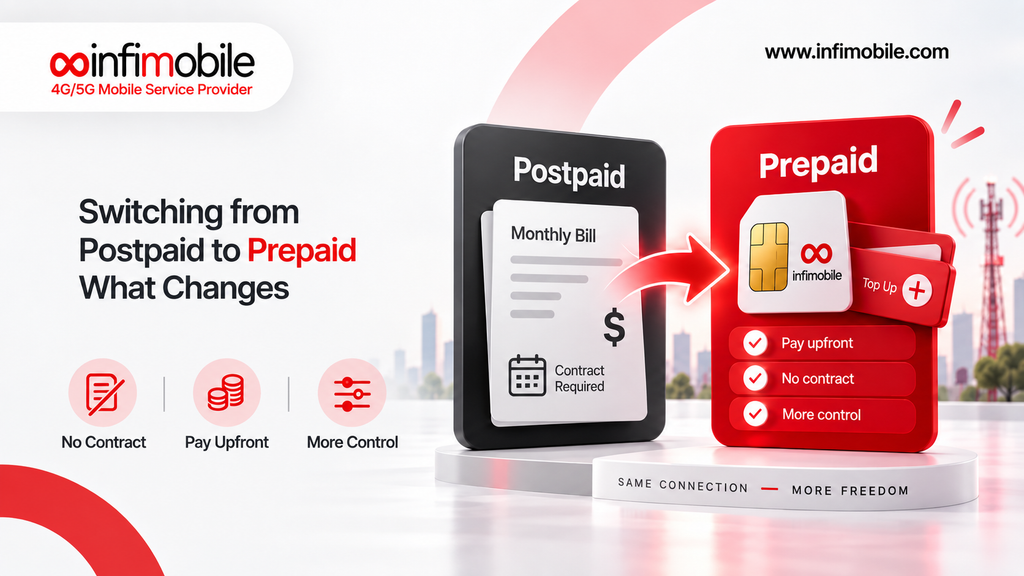
Switching from postpaid to prepaid mainly changes how and when you pay, whether a credit check and contract are involved, and how much control you have over your monthly cost. You pay upfront instead of after the fact; there’s no long-term commitment to break, and your service simply pauses if you don’t renew rather than racking up a bill. A lot of people consider the switch after a contract ends, after paying off a financed phone, or simply because they want a lower, more predictable monthly cost without giving up coverage. If you’re considering the switch, this guide walks through exactly what changes, what you give up, and how to move over without losing your number or running into surprises along the way.
What “Postpaid” and “Prepaid” Actually Mean
The difference comes down to when you pay for service. With a postpaid plan, you use your phone throughout the month and get billed afterward, similar to a utility bill. With a prepaid plan, you pay for your service period, whether that’s a month or a longer term, before you start using it.
That single difference is what drives almost every other distinction between the two. Because postpaid carriers are extending you service on credit, they typically run a credit check and often ask you to sign a contract. Because prepaid carriers are paid before service starts, there’s no credit risk on their end, which is why prepaid plans generally skip the credit check and the contract altogether.
Here’s a quick side-by-side look at how the two models generally compare:
| Feature | Postpaid | Prepaid |
| Payment timing | Billed after you use the service | Paid upfront before service starts |
| Credit check | Usually required | Not required |
| Contract | Common, often 24 to 36 months | None, month to month or fixed term |
| Early termination fee | Often applies | Doesn’t apply |
| Overages | Possible extra charges | Service slows or pauses instead |
| Device financing | Commonly available | Rarely offered |
| Credit bureau reporting | Sometimes reported | Generally not reported |
This table reflects general industry patterns across major carriers and MVNOs rather than any single provider’s exact terms, so it’s worth double-checking the specifics with whichever carrier you’re comparing.
The Biggest Changes You’ll Notice After Switching
Once you move from postpaid to prepaid, a few things change almost immediately.
- No more credit check. Postpaid activations typically involve a credit check, and in some cases a security deposit if your credit is limited. Prepaid plans don’t require either, since you’re paying in advance.
- No contract or early termination fee. Postpaid plans often come with 24- to 36-month commitments, and leaving early can mean paying a penalty. Prepaid plans run month to month or for a fixed term you choose, with no penalty for not renewing.
- You pay before you use the service, not after. Instead of a bill arriving with your usage total, you choose and pay for a plan upfront, and that’s what you get for the period.
- No overage charges. On postpaid, going over your data allotment can mean extra charges on your next bill. On prepaid, if you run out of data, your service typically slows down or pauses until you renew or add more, rather than billing you for the overage.
- Device financing options shrink. Postpaid plans commonly let you finance a new phone and pay it off over 24 to 36 months as part of your bill. Most prepaid plans expect you to bring your own device or pay full price upfront, since there’s no monthly billing relationship to attach a device payment to.
- Network priority can shift. During periods of heavy network congestion, some carriers prioritize postpaid traffic over prepaid traffic, and prepaid traffic from smaller MVNOs can be deprioritized behind prepaid plans from the major carriers themselves. This doesn’t affect coverage, since prepaid and postpaid typically run on the same towers, but it can occasionally affect speed in crowded areas like stadiums, airports, or downtown areas during peak hours.
Step-by-Step: How to Switch from Postpaid to Prepaid
- Check whether your device is paid off. If you financed your phone through your postpaid carrier, that balance usually needs to be paid off, or at least isn’t automatically forgiven, when you leave the plan. Check your account for a remaining device balance before switching.
- Make sure your phone is unlocked. Carriers often lock phones to their network during the financing period. If your device is locked to your old carrier, you’ll need to request an unlock before it will work with a new prepaid SIM or eSIM.
- Decide if you want to keep your current number. If so, you’ll port it over rather than cancel your old line outright. Cancelling first can sometimes release the number, so it’s safer to start the port before shutting down the old account.
- Compare prepaid plans and pick one that fits your data needs. Prepaid plans vary quite a bit in data allotment, term length, and price, so it’s worth comparing a few options rather than defaulting to whatever plan is advertised first.
- Get a SIM card or eSIM from your new prepaid carrier and activate it. Most prepaid carriers let you do this online without visiting a store.
- Start the number port and confirm your old account is closed. Porting typically takes anywhere from a few hours to a few business days. Once it’s complete, your old postpaid line will stop working, and your number will be active on your new prepaid plan.
What You Give Up When You Switch to Prepaid
Prepaid isn’t strictly better in every way, and it helps to know what you’re trading off.
- Built-in device financing. If you like upgrading your phone every year or two through monthly installments, prepaid generally won’t offer that. You’ll need to buy your device separately, whether upfront or through a separate financing option.
- Bundled perks. Some postpaid plans include streaming subscriptions, insurance bundles, or multi-service discounts if you also have home internet or TV with the same provider. Prepaid plans are usually more bare-bones by design, which is part of why they cost less.
- In-person account management at large retail stores. Many prepaid brands operate primarily online or through smaller retail footprints, so if you prefer handling account issues in person at a large store, this can be a bigger adjustment.
- Automatic credit-building. A postpaid account with on-time payments can, in some cases, be reported to credit bureaus and contribute positively to your credit history. Prepaid accounts generally aren’t reported at all, so there’s no credit impact either way.
- Family account structures with shared billing. Postpaid plans, especially from major carriers, often make it easy to manage several family lines under one bill with a single login and shared account controls. Prepaid providers increasingly offer multi-line options too, but the account management tools are sometimes more basic than what larger postpaid carriers provide.
What You Gain When You Switch to Prepaid
- Lower monthly cost. Because prepaid carriers don’t need retail stores, device financing infrastructure, or billing and collections departments to the same extent postpaid carriers do, that lower overhead is often reflected in lower prices.
- No surprise bills. Since you pay before you use the service, there’s no possibility of an unexpectedly high bill from overages or add-on charges. What you pay upfront is what you pay.
- Freedom to switch anytime. Without a contract, you’re not locked in. If a better plan or provider comes along, you can move without an early termination fee.
- Simpler budgeting. A fixed, known cost per term makes it easier to plan your monthly expenses, which is one reason prepaid plans are popular with budget-conscious users and people who want predictable costs. This is the model prepaid carriers, including Infimobile, are built around: you choose a plan, pay for it upfront, and know exactly what you’re getting for that price.
Will Switching to Prepaid Affect My Credit Score?
Generally, no. Prepaid plans don’t require a credit check to activate, and prepaid carriers typically don’t report your account activity to credit bureaus, since there’s no credit being extended. The bigger thing to watch is your old postpaid account: make sure any final bill or device balance is paid off before or shortly after you switch, since an unpaid postpaid balance can still be sent to collections and affect your credit, even after you’ve moved to a new prepaid plan. Setting a reminder to check your final postpaid statement a few weeks after switching is a simple way to make sure nothing slips through unpaid.
Common Mistakes to Avoid When Switching
A few missteps come up often enough during a postpaid-to-prepaid switch that they’re worth planning around.
Cancelling the old account before porting the number. If you shut down your postpaid line first and try to port the number afterward, the port can fail or take longer, since some carriers release the number differently depending on whether the account is still active. Start the port first, and let it close the old account automatically.
Forgetting about a remaining device balance. Financed phones often still carry a balance even after you leave the plan. That balance doesn’t disappear; it just becomes due, sometimes as a lump sum. Check your final bill or account details before assuming the phone is fully paid off.
Not confirming the phone is unlocked. A phone still locked to your previous carrier’s network won’t activate properly on a new SIM, even after the account is closed. Requesting an unlock, which most carriers allow once financing is paid off and the account is in good standing, should happen before you try to activate a new prepaid line.
Choosing a data tier based on habits from a different plan. If your postpaid plan had effectively unlimited data with no real usage tracking, it’s easy to underestimate how much data you actually use. Checking your average monthly usage from a past bill or your phone’s data settings before picking a prepaid tier helps avoid running short partway through the month.
Is Switching to Prepaid the Right Move for You?
Prepaid tends to make the most sense if any of the following sound like you:
- You want to lower your monthly phone costs without giving up much in terms of coverage.
- You already own your phone outright or don’t need financing to get a new one.
- You’d rather avoid a credit check, whether by choice or because of your credit history.
- You value the flexibility to switch plans or providers without worrying about a penalty.
- You don’t rely heavily on bundled perks like device insurance or streaming subscriptions tied to your phone bill.
On the other hand, if you regularly finance new phones through your carrier, rely on bundled services, or want the option for your payment history to potentially help your credit, staying on postpaid might make more sense for your situation.
Frequently Asked Questions
Yes. As long as you port your number rather than simply cancelling your old account, you can transfer it to your new prepaid plan without losing it.
In most cases, yes. If your phone is still being financed through your postpaid carrier, that balance typically needs to be settled, and the phone unlocked, before it will work smoothly on a new prepaid plan.
No, switching itself doesn’t affect your credit score, since prepaid plans don’t involve a credit check or credit reporting. Just make sure any final balance on your old postpaid account is paid off so it doesn’t end up in collections.
Not typically, since prepaid and postpaid usually share the same network and coverage. The one exception is during periods of heavy network congestion, when some carriers prioritize postpaid traffic first, which can occasionally affect prepaid speeds in crowded areas.
Yes, you can switch back at any time. Since prepaid doesn’t involve a contract, there’s no penalty for leaving, and you can move to a postpaid plan whenever it makes sense for you, whether with your original carrier or a new one.
Final Thoughts
Switching from postpaid to prepaid changes more than just how your bill looks. You trade credit checks, contracts, and built-in device financing for lower costs, more flexibility, and no risk of surprise charges. For many people, especially those who already own their phone and don’t need the bundled perks, that trade-off is an easy one. Infimobile is one option built specifically around the prepaid model, with plans paid upfront and no contract required. If you’re weighing the switch, take a look at Infimobile’s current plans page to compare data tiers and pricing before you decide.