The immigration officer stamps your passport. You collect your luggage. You walk through the arrival doors into the United States for the first time as a student.
And immediately, you need your phone to work.
Your parents are waiting for a message. Your university contact is trying to reach you. You need Google Maps to find the pickup zone. You need to confirm your accommodation booking. You need to call the person who is meeting you because you can’t find each other in the crowd.
This is the reality of arriving in a new country as an international student, and it happens before you’ve had a chance to eat, sleep, or figure out which way is north. Getting a working US SIM card is not a nice-to-have for your first week. It’s the first practical problem you need to solve.
This guide covers everything international students need to know about getting a SIM card in the USA, after landing, what your options are, what to watch out for, how eSIM changes the equation entirely, and how Infimobile makes the whole process something you can complete before your flight even takes off.
Table of Contents
- Why Getting a US SIM Card Is Your First Priority
- Understanding the US Mobile Network
- Option 1: Airport SIM Card Convenient but Costly
- Option 2: Major Carrier Store: Full Features, High Price
- Option 3: Prepaid MVNO Plans: Best Value for Students
- Option 4: eSIM: Activate Before You Land
- What to Look for in a US SIM Card as a Student
- Infimobile: The Best SIM Card for International Students
- Infimobile Plans Priced for Student Budgets
- Step-by-Step: How to Get Your US Number Before Landing
- Common Mistakes International Students Make
- USA Arrival Checklist for Students
- Frequently Asked Questions
Why Getting a US SIM Card Is Your First Priority
Ask any international student who has navigated a US airport without a working phone, and they’ll tell you the same thing: it’s one of the most stressful experiences of the entire move.
American airports are large. Some of the busiest airports- JFK in New York, LAX in Los Angeles, O’Hare in Chicago, and Hartsfield-Jackson in Atlanta are enormous, spread across multiple terminals, with pickup zones that require precise coordination to navigate. Without a working phone, finding your driver, confirming your ride, or reaching the person picking you up involves walking to public phone kiosks that increasingly don’t exist, borrowing a stranger’s phone, or hoping the airport Wi-Fi is strong enough in exactly the right spot.
Beyond the airport, your first days in the USA involve a cascade of tasks that all require mobile connectivity. Reaching your university’s international student office. Confirming your housing assignment. Setting up a US bank account typically requires a phone number for verification. Receiving orientation schedules and urgent updates by SMS. Building the first social connections with classmates who’ll exchange numbers during orientation week.
A working US SIM card with a local number and data is the foundation on which every other first-week task is built. Everything becomes easier when you have it. Almost everything becomes harder when you don’t.
Actionable tip: Don’t treat getting a US SIM card as something to figure out after you’ve settled in. Treat it as a pre-arrival task, something solved before your flight, not after landing. eSIM technology makes this possible in a way it wasn’t even five years ago.
Understanding the US Mobile Network
Before choosing a SIM card, understanding how wireless networks work in the United States helps you make a decision that actually serves your needs rather than the carrier’s sales targets.
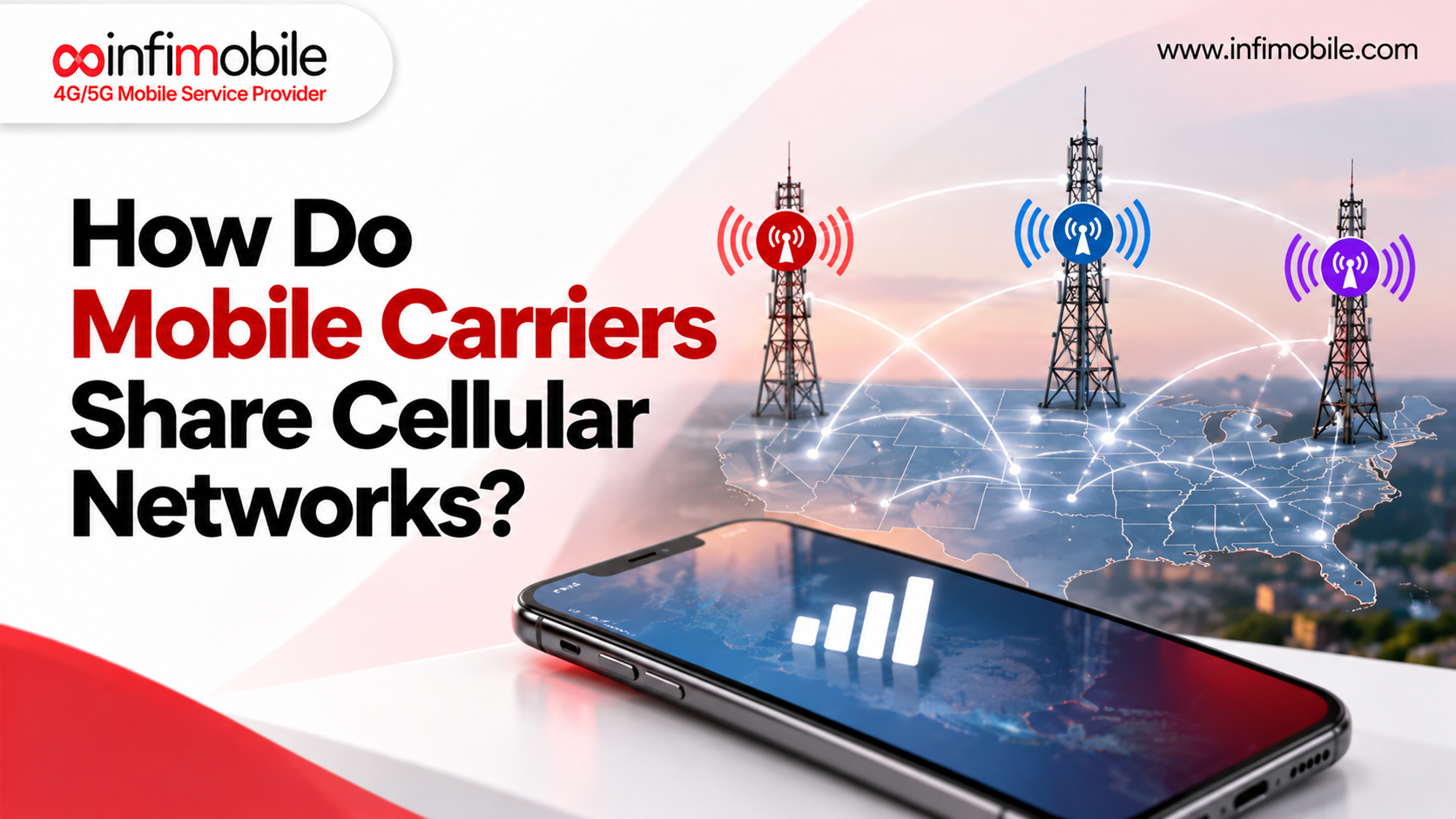
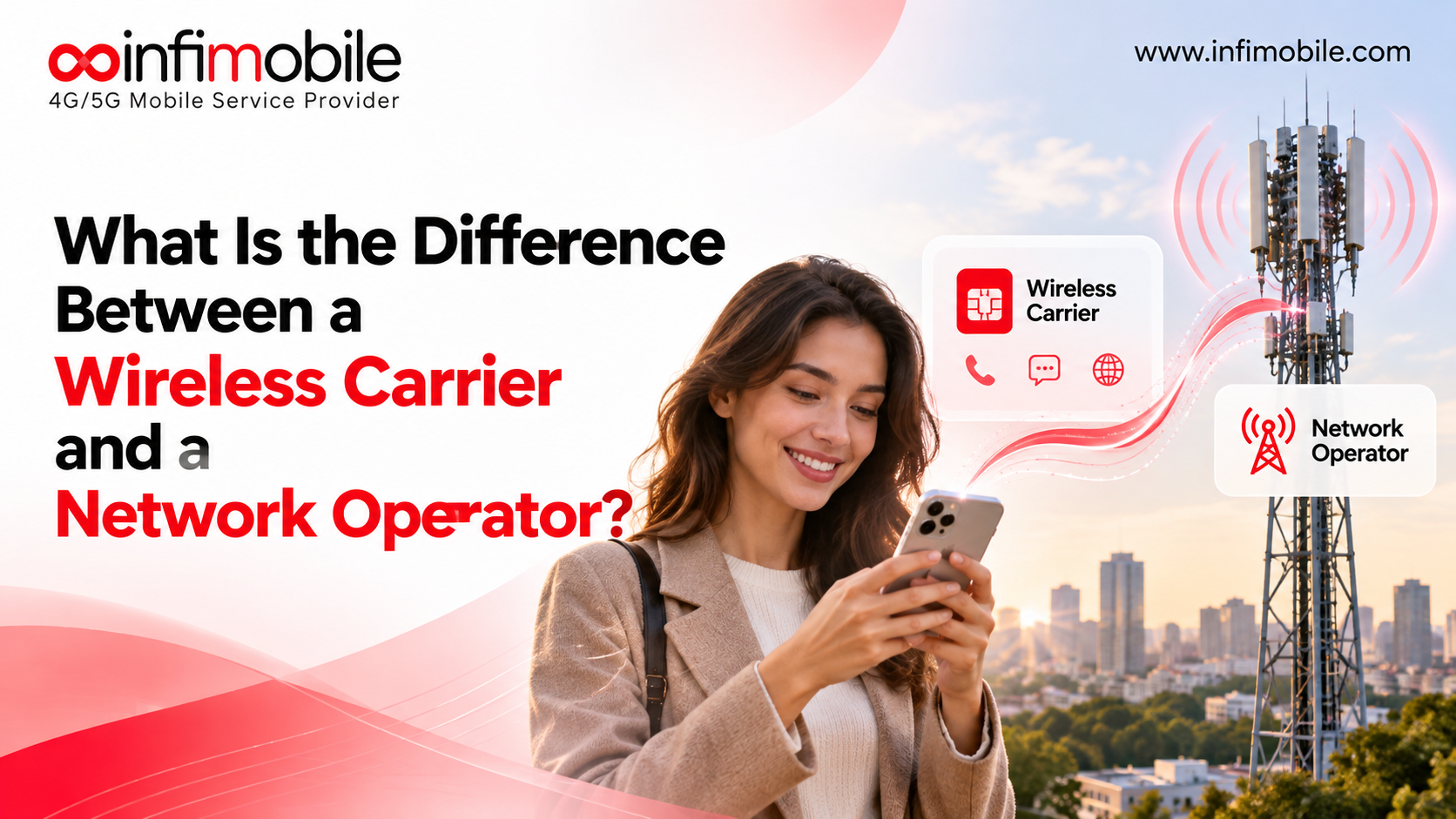
The US has four major national wireless networks: Verizon, AT&T, T-Mobile, and Dish Network. These companies own and maintain the physical infrastructure, the cell towers, the spectrum licenses, and the 5G equipment that connects mobile phones across the country. Their networks collectively cover 99% of the US population with 4G LTE and a rapidly expanding 5G footprint.
Beyond these four, a large and growing ecosystem of MVNOs, Mobile Virtual Network Operators, leases access to this infrastructure at wholesale rates and sells wireless service at significantly lower prices. MVNOs don’t own towers. They buy access to existing ones and pass the savings to customers by eliminating retail stores, advertising budgets, and corporate overhead.
Infimobile is an MVNO. It delivers the same nationwide 5G and 4G LTE coverage as major carriers on the same physical towers at a fraction of the cost. For an international student on a student budget, this distinction is financially significant.
The two types of SIM in the US:
A physical SIM card is a removable chip you insert into your phone. Getting one traditionally required visiting a store or waiting for mail delivery, neither of which works well before you’ve arrived in the country.
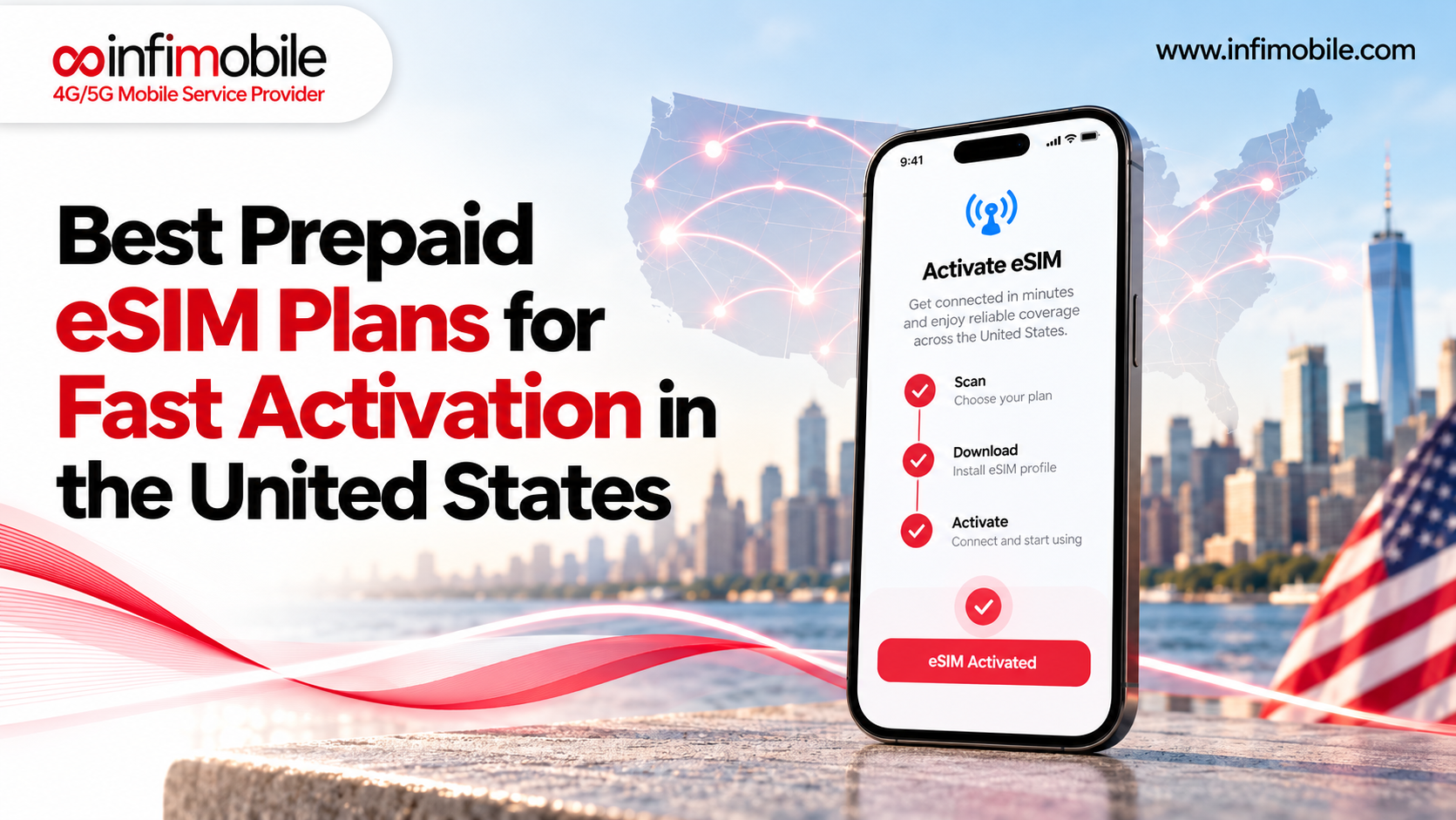
An eSIM is a digital SIM built into your phone’s hardware, activated by scanning a QR code. It requires no physical card, no store visit, and no US address. For international students, this is the game-changing option: you can get a US number and data plan from your home country before your flight.
Option 1: Airport SIM Card Convenient but Costly
Most major US airports have SIM card kiosks or stores in the arrivals area. After clearing customs, you can walk to one of these kiosks, buy a prepaid SIM, and get connected within 30 to 60 minutes.
What’s good about airport SIM cards:
The convenience is real. If you arrive without any prior arrangement, an airport kiosk solves your immediate connectivity problem. Staff are usually available to help with setup. You leave the airport with a working number.
What’s not good:
Airport SIM cards are priced at a significant premium over the same carriers’ regular rates. The captive audience model requires a phone, and there’s one place to buy it, which allows kiosk operators to charge substantially more than you’d pay for an equivalent plan online.
Setting up at an airport kiosk can take 30 to 60 minutes after a long international flight. If there’s a queue, add more time. The process of inserting a new SIM, configuring the phone, porting if desired, and troubleshooting any issues happens in the arrivals hall when you’re tired, jet-lagged, and your family is waiting for a message.
You’re typically limited to the plans the kiosk operator offers, which may not be the most cost-effective for a student staying for months or a year.
The verdict: Airport SIM cards work as a last resort. For a student who can plan ahead, there are significantly better options.
Option 2: Major Carrier Store: Full Features, High Price
Visiting a Verizon, AT&T, or T-Mobile store near your university after arrival is another common approach. Major carrier stores are widespread near US university campuses; the staff is knowledgeable, and the plans include the full feature sets each carrier offers.
What’s good:
In-person support for a student who is unfamiliar with US mobile plans. Access to the full range of plan options. Ability to ask questions in person. Some carriers offer student discounts with a university ID.
What’s not good:
Major carrier postpaid plans, the kind prominently advertised in stores, often require a Social Security Number and a US credit history. Most international students don’t have either when they first arrive. Without these, students are directed to prepaid options that are available in stores but are often more expensive than equivalent plans available online through MVNOs.
Even on prepaid, major carrier prices are significantly higher than comparable MVNO plans. A student paying $45 to $60 per month for a major carrier prepaid plan is paying $540 to $720 per year for coverage available through Infimobile for $75 to $199 annually.
The store’s visit requires transportation to reach, adding complexity during a period when you’re still figuring out how to get around an unfamiliar city.
The verdict: Major carrier stores are fine if you prefer in-person support and are prepared for higher prices. For budget-conscious students, the price premium is hard to justify when equivalent coverage is available for much less.
Option 3: Prepaid MVNO Plans Best Value for Students
Prepaid MVNO plans from carriers like Infimobile that lease major carrier network access to deliver equivalent coverage at dramatically lower prices. They require no SSN, no credit check, or no contract. For international students, these advantages are directly relevant.
What’s good:
Significantly lower pricing than major carrier alternatives. No Social Security Number is required. No credit history is needed. No contract locking you in for a fixed term. Full nationwide coverage on the same infrastructure as major carriers. Online purchase and activation; no store visit is required.
What’s not good:
Some MVNOs have limited customer support hours or digital-only support models. You need to research the MVNO and understand what you’re purchasing before arrival. Not all MVNOs offer eSIM, meaning some require physical card delivery.
The verdict: Prepaid MVNO plans are the best value option for most international students, and Infimobile specifically addresses the eSIM and support limitations that affect other providers.
Option 4: eSIM Activate Before You Land
eSIM is the option that changes the student arrival experience most fundamentally because it moves the entire process from after landing to before departure.
With eSIM, you purchase a US mobile plan online from your home country, receive a QR code by email within minutes, scan it in your phone settings, and your US line is installed on your device before you board the plane. The moment your flight lands and your phone detects a US network tower, the eSIM activates automatically. You walk through customs already connected.
Which phones support eSIM:
iPhone XS and all newer models, including all iPhone 14, 15, and 16 devices, support eSIM. Note that iPhone 14 and newer US models are eSIM-only, while international models typically support both physical SIM and eSIM simultaneously. Google Pixel 3 and newer support eSIM. Samsung Galaxy S20 and newer support eSIM. Most flagship smartphones released globally after 2019 support eSIM.
Check compatibility:
iPhone: Settings → General → About → Look for “Available SIM” or an EID number.
Android: Settings → Connections → SIM Card Manager → Look for the “Add eSIM” option.
The dual SIM advantage:
On phones with dual SIM support, you can run your home country SIM and an Infimobile eSIM simultaneously. Your home number stays active for contacts who reach you there. Infimobile handles your US data, US number, and outbound calling. Both work at the same time on the same device; no SIM swapping required.
What to Look for in a US SIM Card as a Student
Not every prepaid US SIM card serves international students’ needs equally. These are the criteria that matter most.
No SSN requirement. If the plan requires a Social Security Number, it doesn’t work for most newly arrived students. Prioritize plans with no SSN requirement.
No credit check. Prepaid plans should not require a credit history. Confirm before signing up.
eSIM availability. For pre-arrival activation, eSIM is essential. Not all providers offer it.
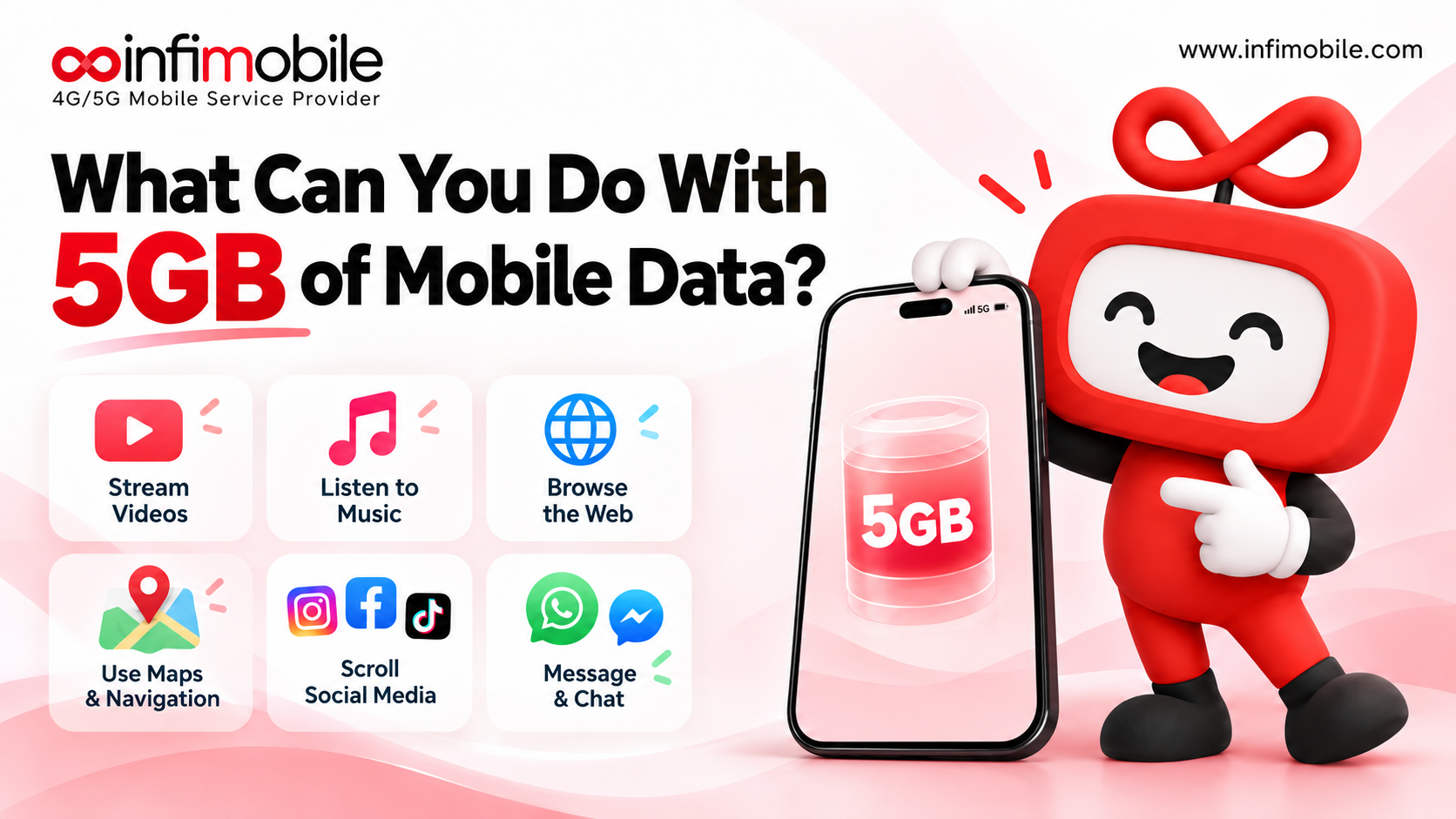
Sufficient data for student usage. Navigation, communication, social apps, and occasional streaming require meaningful data. Plans with 5GB to 15GB monthly cover most student usage patterns when campus Wi-Fi supplements cellular.
Nationwide coverage. Your university might be in New York, Texas, California, or a small college town in the Midwest. Your plan needs to work everywhere across the US, not just in major cities.
No contract. Student circumstances change. A plan with no lock-in contract lets you adjust, upgrade, or change plans as your needs evolve through your academic year.
Real customer support. When something goes wrong, and occasionally it does, being able to reach a real person by phone is valuable, especially for a student navigating an unfamiliar mobile system in a new country.
Infimobile: The Best SIM Card for International Students
Infimobile is a US MVNO running on major US carrier networks, covering 99% of the US population with 5G and 4G LTE. It was built around the prepaid model: no SSN, no credit check, no contract, and complete online activation that works precisely for international students.
Why Infimobile specifically:
No Social Security Number required at any stage of signup or activation. No credit checks; prepaid means you pay upfront, eliminating any financial history requirements. eSIM activation is available from any country. Purchase online, receive a QR code by email, and install it from home before departure. Physical SIM is also available for phones without eSIM support. Real phone and email customer support, not just chatbots or ticketing systems. Transparent all-in pricing: the price stated is the price paid, with a zero-activation fee.
With dual network choice at signup, you select the major US network with stronger coverage in your university location, rather than being assigned to a single network regardless of where you’ll be living and studying.
For international students arriving from India, Nigeria, South Korea, Brazil, Colombia, China, Saudi Arabia, Germany, or anywhere else in the world, Infimobile’s online signup works exactly the same way. No US presence is required before you arrive. No bureaucratic barriers exist for domestic students. Just a working plan, a working number, and working data from the moment you land.
Infimobile Plans Priced for Student Budgets
5GB Annual Plan $75/year ($6.25/month)
5GB of high-speed monthly data, 2,500 talk minutes, 2,500 text messages. Nationwide 5G and 4G LTE. Wi-Fi calling, visual voicemail, eSIM support. Zero activation fees.
Best for students whose university provides strong campus Wi-Fi and who use cellular data primarily for navigation, messaging apps, and calls when off campus. At $4.08 per month, this is the most affordable legitimate wireless plan with full nationwide coverage available in the US market.
15GB Annual Plan $150/year ($12.50/month)
15GB of high-speed monthly data, unlimited talk, unlimited text. Nationwide 5G and 4G LTE. Wi-Fi calling, visual voicemail, eSIM support. Taxes are included in the checkout, based on the region.
Best for students who use data actively throughout the day, streaming music during commutes, video calling family over cellular, and using data regularly off campus. Unlimited talk and text are particularly valuable for students making frequent calls to university offices, employers, and new classmates. At $9.92 per month equivalent, this is the strongest value plan in the student wireless category.
Choosing the right plan:
Check your current monthly data usage on your home phone iPhone: Settings → Cellular → Current Period; Android: Settings → Network & Internet → Data Usage. If you’re using under 5GB monthly while relying on home Wi-Fi, the $75 plan likely covers you. If you use 5GB to 15GB, the $150 plan gives you a comfortable room.
Step-by-Step: How to Get Your US Number Before Landing
Step 1: Confirm eSIM compatibility.
Use the phone settings method described above. If your phone supports eSIM, proceed with eSIM for instant pre-arrival activation. If not, order a physical SIM from Infimobile.com with enough lead time for delivery to your home before departure.
Step 2: Visit Infimobile.com.
Available from any country. No US address is required. Choose your plan and select eSIM at checkout. International payment methods are accepted.
Step 3: Receive your QR code.
Within minutes of purchase, your eSIM QR code arrives by email.
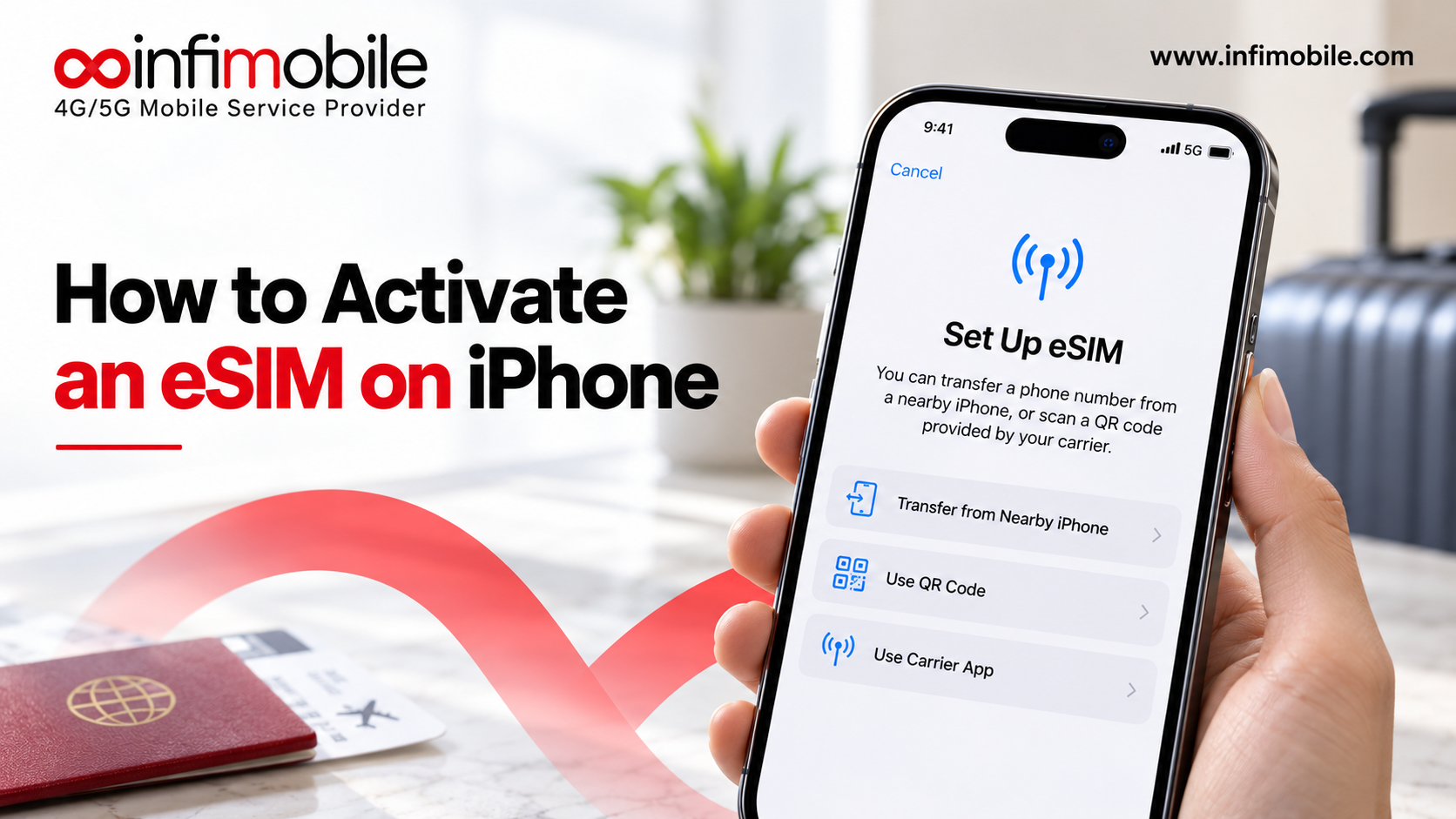
Step 4: Install the eSIM on your phone.
iPhone: Settings → Cellular → Add Cellular Plan → Scan QR code.
Android: Settings → SIM Card Manager → Add eSIM → Scan QR code.
The profile installs in approximately 30 seconds. Please start your phone.
Step 5: Configure dual SIM settings.
Set Infimobile as your primary cellular data line. Keep your home SIM as the line for your home number. Both run simultaneously.
Step 6: Your eSIM shows “No Service” until you land.
This is normal; the plan is installed but waiting for a US network connection. No action is needed.
Step 7: Land in the USA, and you’re automatically connected.
When your phone connects to a US network tower, Infimobile activates automatically. Message your family. Open Google Maps. Navigate to your pickup. You’re connected before you’ve left the terminal.
Common Mistakes International Students Make
Waiting until after arrival to research options. The airport is not the right place to compare mobile plans. Research and purchase before you travel, even if only for a few days.
Choosing unlimited plans they don’t need. Students on well-served campuses with strong Wi-Fi often pay for unlimited data they never use. Check actual usage first; 5GB or 15GB covers most student patterns at far lower cost.
Assuming a major carrier means better coverage. Infimobile runs on the same physical towers as major carriers. The coverage is equivalent because it’s literally the same infrastructure.
Not setting up a dual SIM. Students who remove their home SIM lose their home number and the contacts, WhatsApp identity, and banking verifications tied to it. Dual SIM keeps both numbers active; there is no need to choose.
Forgetting that many US services require a US number. Banking apps, delivery services, certain government portals, and university systems may only send verification codes to US numbers. Having a US number from day one prevents friction with these systems.
Not testing the eSIM before departure. Install the eSIM at home where you have reliable Wi-Fi and time to troubleshoot. Don’t leave eSIM setup for the airport.
USA Arrival Checklist for Students
Before you board your flight, confirm that the following connectivity items are complete.
Infimobile eSIM purchased and QR code received by email. eSIM is installed on your phone and showing as a secondary line in settings. Dual SIM configured with Infimobile as the primary data line and home SIM as the secondary. WhatsApp is updated and working on the home number. Google Maps offline map downloaded for your arrival city. University contact number saved to phone. Accommodation address saved and tested in Google Maps. The university’s international student office number is saved. Emergency contacts saved with country codes.
On landing: confirm Infimobile shows an active signal. Send an arrival message to the family. Open Google Maps to navigate to the pickup zone. Confirm pickup with the driver or contact.
Frequently Asked Questions
The easiest method is Infimobile’s eSIM, purchased online at Infimobile.com from your home country before arrival. No US address, no SSN, and no credit check required. You receive a QR code by email, install it on your phone, and activate automatically when you land in the USA.
Yes, most major US airports have SIM card kiosks in the arrivals area. However, airport SIM cards are priced significantly higher than equivalent plans available online. For students who can plan ahead, purchasing an Infimobile eSIM before departure is more affordable and eliminates airport setup time.
Major carrier postpaid plans often require an SSN. Infimobile’s prepaid plans require no SSN at any stage. This makes Infimobile immediately accessible to newly arrived international students who haven’t yet received an SSN.
Infimobile’s 5GB annual plan at $75/year, $6.25 per month equivalent, is one of the most affordable legitimate wireless plans with full nationwide 5G coverage in the US market. Taxes are excluded from the stated price with no activation fee.
For most international students, Infimobile’s 15GB annual plan at $150/year offers the strongest combination of data allowance, unlimited talk and text, nationwide 5G coverage, and transparent pricing.