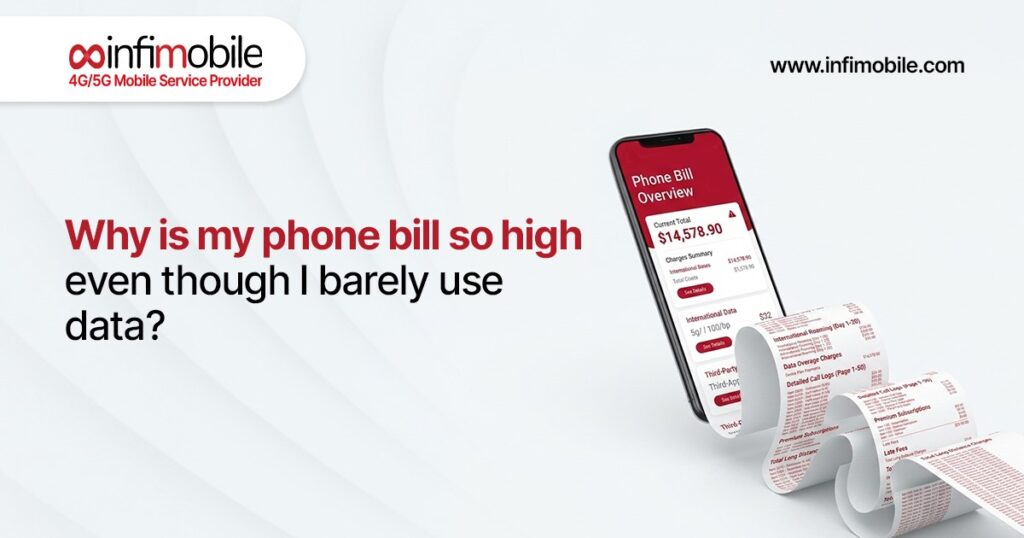
You checked your data usage. 3GB. Maybe 4GB if it was a busy month. You’re not streaming or gaming on cellular; you’re mostly on Wi-Fi at home and at work. And yet the bill arrives every month at $85, $95, sometimes more.
If you’ve ever stared at your phone bill and thought, “This makes no sense,” you’re not imagining things. The disconnect between how little data you actually use and how much you’re paying is one of the most common and most justified frustrations in American consumer life. And the reason is that it has almost nothing to do with your data usage.
This guide breaks down exactly why your phone bill is so high despite barely using data, what’s actually driving the charges on a typical carrier bill, the hidden fees that inflate your total every month, and, most importantly, what you can do about it.
Table of Contents
- The Real Answer: Your Bill Isn’t About Data
- What’s Actually on Your Phone Bill
- Why Did My Phone Bill Go Up Suddenly?
- The Hidden Fees Nobody Explains
- Why Unlimited Plans Cost So Much When You Don’t Need Unlimited
- “My Phone Says I Used Data, But I Didn’t” What’s Going On
- What Actually Uses Data in the Background
- How to Check What You’re Really Paying For
- How to Lower Your Phone Bill: Real Steps
- The Cheaper Alternative: What MVNOs Actually Offer
- Frequently Asked Questions
The Real Answer: Your Bill Isn’t About Data
Here’s the uncomfortable truth: your phone bill is high not because of what you use, but because of what you’re paying for that has nothing to do with usage at all.
Major carriers price their plans around a bundle of things: network access, retail store overhead, advertising budgets, device financing infrastructure, customer acquisition costs, and corporate profit margins, and very little of that bundle scales with your actual data consumption. Whether you use 2GB or 20GB on a typical unlimited plan, you’re paying the same base rate, because the plan was never really priced based on your usage in the first place.
This is why so many people who “barely use data” are shocked to learn they’re on a $90/month unlimited plan. They were sold a plan sized for a heavy user, priced to include the margin the carrier needs, regardless of what that specific customer consumes, and it’s been renewing quietly every month without anyone stopping to ask whether it fits.
The honest answer to “why is my phone bill so high even though I barely use data” is this: your bill was never designed around your usage. It was designed around the carrier’s business model. And that model includes many costs unrelated to the signal reaching your phone.
Actionable tip: Check your actual data usage right now. iPhone: Settings → Cellular → scroll to Current Period. Android: Settings → Network & Internet → Data Usage. Compare that number to your plan’s data allowance. If there’s a big gap, you’ve just confirmed you’re paying for capacity you don’t use.
What’s Actually on Your Phone Bill
Pull up your last phone bill and look past the headline number. Most major carrier bills break down into several distinct categories, and understanding each one explains where your money is actually going.
Base plan cost. This is the advertised price “$65/month unlimited” or similar. It’s rarely the number you actually pay.
Regulatory fees and surcharges. Carriers incur charges such as the Federal Universal Service Fund fee, regulatory cost recovery fees, and administrative charges. These are not government taxes directly, but carrier-imposed fees justified by regulatory compliance costs, and they typically add $3 to $10 per month, which doesn’t appear in the advertised price.
State and local taxes. Wireless taxes vary significantly by state and are among the highest tax categories in the country. Some states impose combined wireless tax rates exceeding 20% when state, local, and federal charges are combined.
Device financing payments. If you finance a phone through your carrier, a monthly installment payment is added to your bill, separate from your service plan cost, and continues until the device is paid off.
Add-on services. Insurance, cloud storage bundles, streaming service bundles, international calling packages- many of these are added during sign-up or through in-store upsells and continue billing monthly, whether or not you use them.
Line access fees. Some multi-line family plans charge a per-line access fee in addition to the shared plan cost.
By the time all of these layer together, a plan advertised at $65 per month frequently arrives as an actual bill of $85 to $95. The gap between advertised and actual is one of the most consistent sources of consumer frustration with major carriers.
Why Did My Phone Bill Go Up Suddenly?
If your bill increased without you changing anything, a few specific culprits are almost always responsible.
Administrative and regulatory fees increased. Major carriers periodically raise these fees independently of your plan price, meaning your bill rises even though you’re on the exact same plan you’ve had for years. These increases are typically disclosed in a small-print notice on your bill or an email you may have missed.
A promotional discount expired. Many plans include an introductory rate for the first several months or a bundled discount tied to a promotion. When that period ends, the bill reverts to full price, often a $10 to $30 monthly jump that feels sudden but was scheduled from the start.
You lost an autopay or paperless billing discount. These discounts, typically $5 to $10 per line, disappear if your payment method changes, if autopay fails once, or if billing preferences are reset, sometimes without clear notification.
A new line or device payment was added. A new family member added to the plan, an upgraded device financed through the carrier, or an add-on service enabled during a customer service call can all quietly increase your total.
Your plan was migrated during a carrier restructuring. Carriers periodically discontinue older plans and move customers to newer equivalents, sometimes at a different price point than what you were originally paying.
Actionable tip: Compare your last three monthly bills side by side, not just the current one against your memory of what you used to pay. The itemized differences between bills reveal exactly which line item caused the increase.
The Hidden Fees Nobody Explains
Across major carriers, several fee categories consistently confuse and frustrate customers because they’re rarely explained clearly at the point of sale.
The Administrative or Regulatory Cost Recovery Fee. Despite sounding like a government tax, this is a carrier-imposed fee that carriers use to recover costs associated with regulatory compliance, cell site rents, and similar business expenses. It is not a tax, though it’s often perceived as one. This fee has increased multiple times across major carriers in recent years, sometimes without dedicated customer notification beyond a bill-of-lanes item change.
Federal Universal Service Fund (USF) fee. This one actually is a government-mandated contribution that carriers pass through to customers, funding programs that support telecommunications access in rural and underserved areas. It fluctuates based on a federally set contribution rate and varies month to month.
State and local taxes on wireless service. Wireless taxation in the US is notably high compared to general sales tax rates, with some states imposing combined effective wireless tax rates well above 20%. This is one of the largest and least controllable line items on any carrier bill.
911 fees. Nearly every state imposes a small monthly fee to fund emergency 911 service infrastructure, typically $0.50 to $1.50 per line.
None of these fees relate to your data usage. They apply whether you use 1GB or 50GB. This is the core reason a light data user can end up with a bill that looks similar to a heavy user’s bill on the same plan tier. The fees are largely flat, not usage-based.
Why Unlimited Plans Cost So Much When You Don’t Need Unlimited
The single biggest reason light data users overpay is being on an unlimited plan they don’t need.
Unlimited plans are priced to cover the carrier’s cost of serving heavy users, people who consume 30GB, 50GB, or more monthly, often streaming video extensively on cellular. The plan’s price reflects that potential usage ceiling, not the actual usage of any specific customer.
If you use 3GB to 5GB monthly, you are paying the unlimited-tier price for a fraction of the capacity, subsidizing the carrier’s heavy-user infrastructure costs without benefiting them. This is standard telecom pricing. Flat-rate unlimited plans always involve light users effectively subsidizing heavy users, because carriers can’t easily price plans purely on marginal usage without the sales friction of granular metering.
Industry data consistently shows the median US smartphone user consumes significantly less than 15GB monthly, and the majority of unlimited plan subscribers never come close to using enough data to justify an unlimited tier’s price relative to a capped plan.
The math: A $75/month unlimited plan costs $900/year. A capped plan sized to your actual usage, say, 15GB monthly, can cost a small fraction of that through an MVNO. If your usage doesn’t require unlimited, you’re paying an unlimited premium capacity you never touch.
“My Phone Says I Used Data, But I Didn’t” What’s Going On
A common source of confusion is opening data usage settings and seeing consumption you don’t remember generating. This isn’t a bug; it’s background activity that most users don’t realize is happening.
Why does my phone use data when not in use?
Background app refresh allows apps to update content, sync data, and check for notifications even when closed. Email apps checking for new messages, weather apps updating forecasts, social media apps preloading content, and cloud backup services syncing photos all consume data without actively opening the app.
What uses data on my phone in the background:
Automatic app updates download over cellular instead of waiting for Wi-Fi. Cloud photo and video backup services sync new photos immediately after you take them. Push notification services maintain a persistent connection. Podcast and music apps pre-download content for offline listening. Operating system updates are downloaded in the background before prompting you to install.
Why does my phone use data so fast:
Video content is by far the largest data consumer on any phone. Auto-playing videos in social media feeds, video call apps, and streaming services running while you multitask all consume data at a much higher rate than text-based browsing or messaging.
How to reduce mobile data usage:
iPhone: Settings → Cellular → scroll down and disable Background App Refresh for apps that don’t need it, and disable automatic downloads for apps and updates over cellular.
Android: Settings → Network & Internet → Data Usage → Data Saver → Turn on. This restricts background data for most apps automatically.
Both platforms let you restrict specific apps from using cellular data entirely, useful for apps like cloud backup services that only need to run over Wi-Fi.
What Actually Uses Data in the Background
Beyond the general categories above, specific everyday behaviors are the most common sources of unexpected data consumption.
Cloud photo backup. Photo backup services back up every photo and video you take automatically, often over cellular unless specifically restricted to Wi-Fi only. A single photo is small, but dozens of photos and videos over a month add up.
Social media autoplay videos. Most major social platforms autoplay video content as you scroll, consuming data continuously even if you’re not deliberately watching anything.
Software updates. Both app updates and full operating system updates can be sized in the hundreds of megabytes to several gigabytes, and unless configured to update only on Wi-Fi, these downloads happen over cellular.
Location services. Apps using continuous GPS tracking, fitness apps, ride-sharing apps left open, and navigation apps running in the background consume data continuously while active.
Configuring data-saving settings on both platforms takes about five minutes and meaningfully reduces the gap between what you think you’re using and what you’re actually using.
How to Check What You’re Really Paying For
Before deciding what to change, get a clear picture of your actual bill and actual usage.
Step 1: Log into your carrier account online and find the itemized bill breakdown, not just the total, but each line item separately: base plan, taxes, fees, device payments, and add-ons.
Step 2: Check your real data usage for the past 3 months, not just the current period, to identify your typical pattern rather than a single unusual month.
Step 3: Identify every recurring add-on insurance, streaming bundle, cloud storage, and international package, and determine which you actually use.
Step 4: Calculate your true annual cost by multiplying your average total monthly bill by 12. This is the number to compare alternatives, not the advertised plan price.
Step 5: Determine whether you’re on the right data tier by comparing your 3-month average usage against your plan’s data allowance. A large gap means you’re overpaid for unused capacity.
How to Lower Your Phone Bill: Real Steps
Downgrade your plan tier if you’re not using premium features. If you’re on an unlimited premium tier but rarely exceed 15GB, a capped plan or lower tier delivers identical real-world performance for significantly less.
Remove unused add-ons. Cancel insurance you’re not using, streaming bundles you don’t watch, and international packages you don’t need if you don’t travel internationally.
Confirm that autopay and paperless billing discounts are applied. These discounts, typically $5 to $10 per line, are sometimes lost when payment methods change or billing preferences are reset.
Pay off device financing early if you can. Once a financed device is paid off, that line item disappears from your bill permanently.
Consider switching to an MVNO. This is the single most impactful change available. Since MVNOs lease access to major carrier networks at wholesale rates, they deliver equivalent coverage without the retail store, advertising, and corporate overhead that inflate major carrier prices.
Actionable tip: Call your current carrier’s retention department and ask directly what discounts or lower-tier plans are available before switching elsewhere. Sometimes a phone call alone results in a lower rate. But compare that offer against MVNO alternatives before committing. Retention discounts are usually temporary, while MVNO pricing is structurally lower on an ongoing basis.
The Cheaper Alternative: What MVNOs Actually Offer
MVNOs, Mobile Virtual Network Operators, lease network access from major carriers and sell services directly to customers without the overhead that inflates major carrier bills. The coverage is equivalent because it has the same physical towers. The price is different because the business model removes retail stores, national advertising campaigns, device financing infrastructure, and much of the corporate overhead layered into major carrier pricing.
Infimobile is a US MVNO built specifically around transparent, low-cost pricing for users who don’t need unlimited data.
Infimobile 5GB Annual Plan $75/12mo
5GB of high-speed monthly data, 2,500 talk minutes, 2,500 texts, nationwide 5G and 4G LTE coverage on major US network infrastructure, Wi-Fi calling, visual voicemail, eSIM support. Zero activation fees.
Infimobile 15GB Annual Plan $150/12 mo
15GB of high-speed monthly data, unlimited talk, unlimited text, nationwide 5G and 4G LTE coverage, Wi-Fi calling, visual voicemail, eSIM support.
For a light data user paying $85/month on a major carrier, over $1,000 per year, switching to Infimobile’s 15GB annual plan saves several hundred dollars a year for coverage on the same underlying network infrastructure. The gap isn’t about network quality. It’s about everything layered on top of the network that Infimobile doesn’t charge you for.
Why Infimobile’s pricing is transparent: There’s no separate administrative fee, no regulatory cost recovery charge added at checkout, no surprise increase to a “base fee” months after signup. The price you see is the complete annual cost.
Frequently Asked Questions
Your bill is priced around your plan tier, taxes, regulatory fees, and any add-ons or device financing, not around your actual data consumption. Unlimited plans in particular are priced to cover heavy-user network costs regardless of whether you’re a light user. If you use under 15GB monthly, you’re likely paying for capacity you don’t need.
The most common causes are an expired promotional rate, an increase in administrative or regulatory fees, a lost autopay or paperless billing discount, a new line or device added to the account, or a plan migration during a carrier restructuring. Comparing your last three bills line by line usually reveals the exact cause.
Background app refresh, cloud photo backup, automatic app updates, and push notification services all consume data while running in the background, even when you’re not actively using your phone. Disabling background refresh for apps that don’t need it reduces this consumption.
Downgrade your plan tier to match your actual usage, remove unused add-ons like insurance or streaming bundles, confirm autopay and paperless discounts are applied, pay off device financing if possible, and consider switching to an MVNO for equivalent coverage at a significantly lower price.
Infimobile’s 5GB annual plan at $75/year and 15GB annual plan at $150/year are among the most affordable full-featured wireless plans available, with nationwide 5G coverage, unlimited talk and text on the 15GB plan.