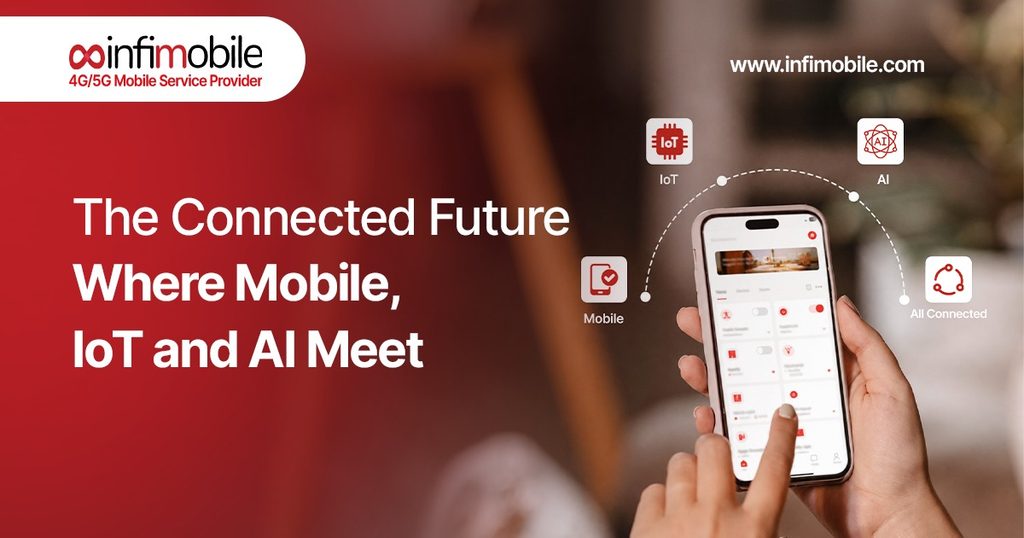
The Connected Future: Where Mobile, IoT, and AI Meet
Not long ago, “mobile technology,” “smart devices,” and “artificial intelligence” were three separate conversations. Your phone was for calls and apps. Smart devices were a handful of gadgets like a thermostat or a video doorbell. AI was something running in a data center somewhere, mostly invisible. That separation is disappearing fast. Today, your phone is the control panel for a growing web of connected devices, and AI increasingly runs right there on the device in your hand, not just somewhere far away in the cloud.
This convergence of mobile networks, the Internet of Things (IoT), and AI, all working together, is quietly becoming the backbone of everyday life. This guide breaks down what’s actually happening at that intersection, where you’re probably already experiencing it without realizing it, and what it means for the kind of mobile connection you’ll need going forward.
What “Connected Future” Actually Means
Strip away the buzzwords, and the idea is straightforward: more devices than ever are connected to a network, more of them are talking to each other, and more of the decision-making that used to require a person is now handled automatically by AI. Your phone sits at the center of all three trends, acting as the hub that ties your devices together, the connection that keeps them online, and increasingly, the AI assistant that helps make sense of it all.
This isn’t a general, futuristic idea; it’s already the quiet infrastructure behind things people do without thinking: a phone that unlocks a smart lock, a watch that nudges you to stand up, a doorbell camera that recognizes a familiar face and sends a summary instead of a raw video clip.
A Brief History: How We Got Here
Each piece of this convergence developed on its own timeline before starting to overlap. Mobile networks moved from basic voice and text on 2G, through mobile internet on 3G, to genuinely fast, low-latency data on 4G and 5G infrastructure originally built for phones that turned out to be exactly what a much wider category of devices needed too. IoT started as a niche industrial and research concept, connecting sensors and machines long before “smart home” was a mainstream phrase, then expanded into consumer products as chips got cheaper and networks got more capable. AI, meanwhile, spent years living almost entirely in data centers, requiring far more computing power than any handheld device could offer.
What’s new is the timing: all three matured to the point where they could support each other at roughly the same moment. Mobile networks became fast and widespread enough to carry IoT traffic at scale, IoT devices became cheap and common enough to be worth connecting to AI, and AI models became efficient enough to run directly on the same small chips already inside a phone. That alignment is what turned three separate technology trends into one connected system.
Mobile Networks: The Backbone Holding IoT Together
The Internet of Things needs somewhere to actually connect, and mobile networks have become one of its main highways. Industry tracking from IoT Analytics puts the number of active connected IoT devices worldwide at more than 21 billion, and cellular connections running on 4G, 5G, and purpose-built low-power standards like NB-IoT and LTE-M now make up a meaningful and fast-growing share of that total, expanding faster than IoT connections as a whole.
That matters because not every connected device sits comfortably on home Wi-Fi. Cars need connectivity on the move. Fitness trackers and medical wearables need a signal away from the house. Security cameras and asset trackers often need coverage in places without a router nearby at all. Mobile networks fill exactly that gap, and as 5G expands, it’s doing so with lower latency and more capacity built specifically to support large numbers of connected devices at once, not just faster phone downloads. Purpose-built low-power standards add another layer to this, letting simple sensors run for months or years on a small battery while still staying connected over a cellular signal.
AI Has Moved From the Cloud to Your Pocket
For years, “AI” mostly meant sending a request to a distant server and waiting for an answer. That’s changing. Many current flagship phones now ship with dedicated AI processing chips capable of running assistant features directly on the device, without needing to send everything to the cloud first. Apple’s on-device Apple Intelligence, Google’s Gemini and Gemini Nano on Pixel and Android devices, and Samsung’s Galaxy AI all represent different approaches to the same shift: putting real AI capability physically inside the phone.
In practice, this shows up as live translation during a phone call, a written message rewritten in a different tone, a photo cleaned up automatically, or a voice memo summarized into text, all handled locally, or through a light hybrid of on-device and cloud processing depending on the task. The result is AI that responds faster, works in more places, and in many cases keeps more of your data on the device itself rather than sending it elsewhere. For anyone without a strong, constant connection, that shift toward on-device processing also means AI features keep working reasonably well even when the network itself is under strain.
Where the Three Actually Meet: Everyday Examples
The genuinely interesting part isn’t mobile, IoT, or AI on their own; it’s what happens when they combine:
- Smart home + AI: A doorbell camera doesn’t just record video; AI on the device or in the app recognizes who’s there and sends a relevant alert, while your phone (often over mobile data, not just Wi-Fi) is how you actually see and respond to it from anywhere.
- Wearables + AI: A smartwatch collects heart rate and activity data continuously, and AI on the paired phone turns that raw stream into a pattern worth noticing, flagging something worth a closer look rather than just logging numbers.
- Connected cars + mobile networks: Modern vehicles increasingly rely on cellular connections for real-time traffic data, remote diagnostics, and software updates, effectively becoming another device on the mobile network.
- Voice assistants + IoT: A spoken request to adjust the lights, check the weather, or lock the door routes through AI running partly on your phone and partly on connected smart-home devices, coordinated over your mobile or home network.
- Remote health monitoring + AI: Connected blood pressure cuffs, glucose monitors, and other health devices can sync to a phone and let AI flag trends worth a doctor’s attention, extending monitoring far beyond a clinic visit.
None of this works in isolation. Each piece depends on the others, and the phone is almost always the thread tying them together.
The Home Is Becoming One Big Connected System
Smart plugs, video doorbells, connected thermostats, robot vacuums, smart speakers, and security sensors: most households now have a small constellation of devices that didn’t exist a decade ago, and the phone has become the universal remote for all of them. Rather than a separate app or interface for each gadget, a single phone increasingly manages the entire system, often with AI quietly deciding what’s worth surfacing as a notification and what can stay in the background.
This also means your phone’s connection matters more than it used to. When your home Wi-Fi goes down, mobile data and hotspot capability aren’t just a backup for browsing; they’re what keeps a security camera streaming, a smart lock responsive, or a video call running while the router gets sorted out.
Why This Convergence Needs More Bandwidth, Not Less
Every device added to this connected ecosystem adds a little more demand on the network behind it. A single smartphone streaming video is one thing; a household running a phone, a smartwatch, a laptop tethered over a hotspot, a couple of smart cameras, and a voice assistant simultaneously is a meaningfully bigger load, even if no single device feels demanding on its own.
This is one of the quieter shifts happening alongside the mobile-IoT-AI convergence: households are increasingly using their phone as a genuine internet backbone, not just a personal device. Mobile hotspot usage for laptops, smart TVs, or backup home internet has moved from an occasional convenience to something families budget data around specifically.
Privacy and Security in a More Connected World
More connected devices and more AI making decisions on your behalf also means more places where something could go wrong: a device with weak security, an app collecting more data than it needs, or a notification revealing more than intended at the wrong moment. This isn’t a reason to avoid the convergence of mobile, IoT, and AI, but it is a reason to be deliberate about it.
A few habits go a long way: keeping device software updated, reviewing which apps and smart devices actually need location or camera access, and favoring AI features that process data on-device when privacy matters to you. The same convergence that makes a connected home more convenient also makes basic digital hygiene more important than it was when a “smart device” simply meant a phone.
What This Means for Your Mobile Plan
As more of daily life routes through a phone-centered network of devices, the plan behind that phone starts to matter as much as the phone itself. A data allowance that felt generous for one person browsing and streaming can get consumed quickly once hotspot use, smart-device notifications, and AI features that rely on cloud processing are added into the mix.
This is exactly the kind of shift Infimobile’s Family Plan is built around. Multiple lines up to five can share one account with per-line pricing that drops as more lines are added, which fits naturally with households running several connected devices per person rather than just one phone each. Mobile hotspot is available as an add-on (and included at no extra cost on Infimobile’s largest data tier), letting a phone genuinely stand in as a backup internet connection for a laptop, smart TV, or other devices when needed. And because Infimobile runs on a choice of major nationwide networks rather than being tied to just one, coverage for all those connected devices doesn’t depend on a single carrier’s footprint in your area. For a household actively running phones, wearables, and hotspot-tethered devices side by side, that kind of flexible, scalable data allowance matters more than it would have just a few years ago.
Staying Ready for What’s Next
The pace of change here isn’t slowing down. Network technology keeps evolving past today’s 5G toward even lower latency and more device capacity, AI models keep getting more capable while running on smaller and more efficient chips, and new categories of connected devices keep appearing in homes, cars, and workplaces. None of that requires predicting the future perfectly; it just means building on a mobile foundation flexible enough to keep up: enough data, reliable coverage, and a plan that can grow as more of your life connects through it.
Conclusion
Mobile, IoT, and AI stopped being three separate trends a while ago. Today they function as one interconnected system, with your phone sitting at the center of the network connection, the control hub, and increasingly the AI engine tying everything together. The devices themselves will keep multiplying and getting smarter, but the thing that makes any of it actually usable day-to-day is still the same: a mobile connection dependable and flexible enough to carry the weight of everything now running through it.
Frequently Asked Questions
It means more of your everyday devices phones, wearables, smart home gadgets, even cars are online, talking to each other, and increasingly managed through AI running on or near your phone, rather than existing as separate, unconnected gadgets.
Many connected devices, from cars to wearables to security cameras, need connectivity away from home Wi-Fi. Cellular networks, including standards built specifically for low-power devices, provide that coverage, making mobile infrastructure a core part of how IoT actually functions.
Both, depending on the task. Many current phones include dedicated AI chips that handle features like text rewriting, translation, or photo editing directly on the device, while more complex requests may still route through the cloud. The balance varies by phone and AI platform.
Often, yes. Hotspot use, smart-device notifications, and AI features that rely on cloud processing all add to data usage. It’s worth reviewing your plan’s data allowance and hotspot options as you add more connected devices to your household, rather than assuming the plan that worked for a single phone will still be enough once a handful of other devices are drawing on the same connection.
A shared family plan with per-line pricing that drops as you add lines, combined with a hotspot add-on for backup internet, is generally more cost-effective than paying for separate individual plans across every device and family member. Reviewing actual usage every so often also helps, since a data tier that fit a household a year ago may no longer match how many devices are now sharing that connection.