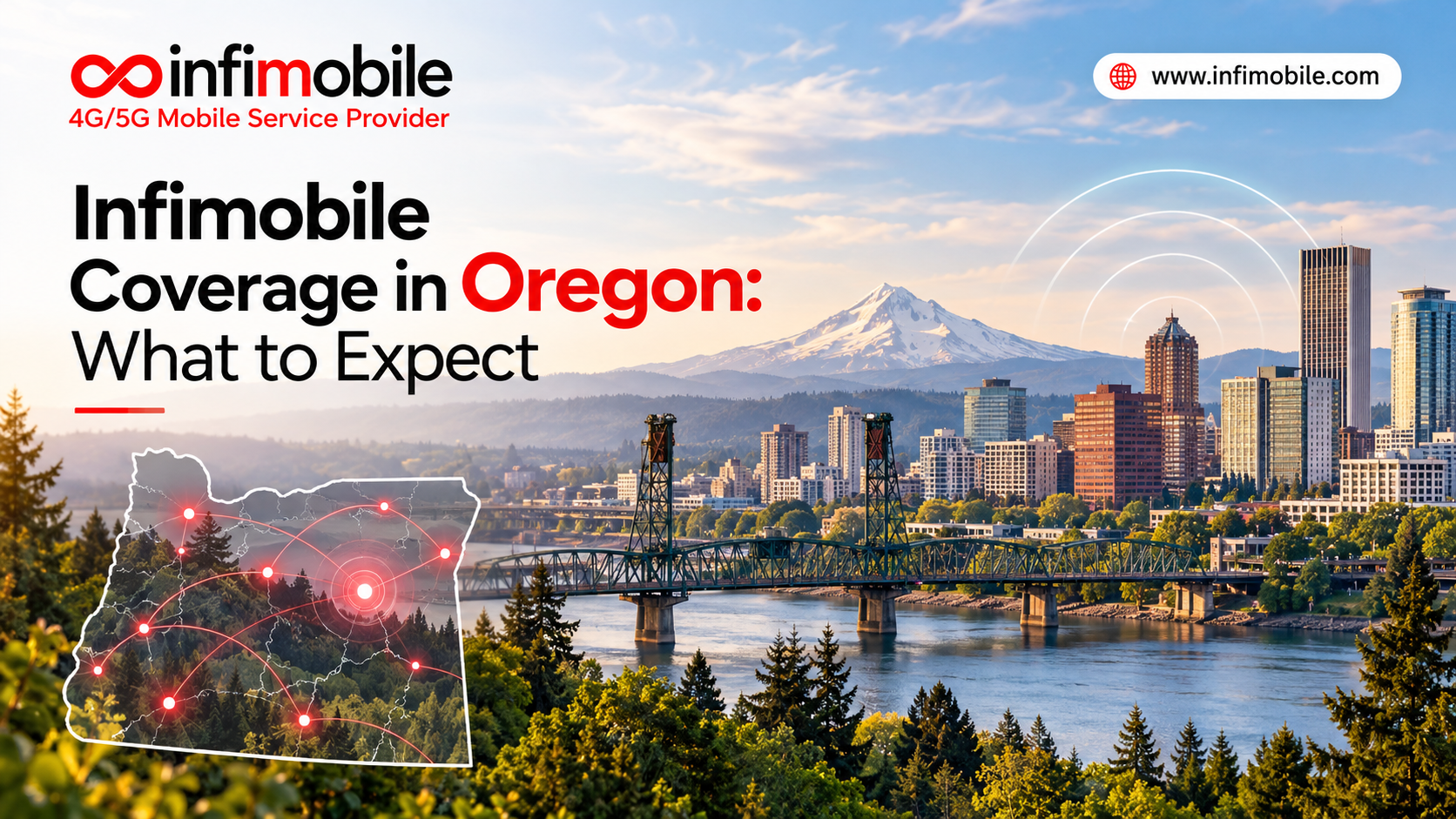
Infimobile coverage in Oregon is generally strong in the Portland metro area, the Willamette Valley, and the larger cities along Interstate 5, and it becomes more variable on the coast, in the Cascade Mountains, and across the eastern high desert. That pattern is not unique to Infimobile. It reflects how Oregon’s geography shapes every wireless network in the state.
Oregon is a tricky state for cell service. You can go from a dense city to a forested mountain pass to an empty stretch of desert in a single afternoon drive. This guide explains how Infimobile network coverage works, what to expect in each part of Oregon, how to choose between the two available networks, and how to test coverage at your own address before you switch.
How Infimobile Coverage Actually Works
Infimobile is a mobile virtual network operator, or MVNO. In plain terms, that means Infimobile does not build or own cell towers. It uses the networks of T-Mobile and Verizon, and customers typically pick one of the two when they activate service.
This matters for Oregon because your signal depends on the tower network you choose, not on Infimobile itself. When your phone connects, it reaches the same nearby towers that T-Mobile or Verizon customers use. If a hillside in Hood River has a weak signal on one of those networks, it will have a weak signal on Infimobile running on that network too.
A few points are worth keeping in mind:
- Two networks, one plan: The T-Mobile and Verizon options give you a second chance at good coverage if one network is weak where you live or travel.
- Nationwide reach: Infimobile offers 4G LTE and 5G service in the United States. Plans are for U.S. use only.
- Outdoor versus indoor: Public coverage maps generally show outdoor and in-vehicle service. Thick walls, basements, and older brick buildings can weaken a signal indoors.
Coverage in Portland and the Willamette Valley
Most Oregonians live in the Willamette Valley, and this is where wireless service is at its best. The Portland metro area, including Beaverton, Hillsboro, Gresham, Tigard, and Lake Oswego, has dense tower coverage from both T-Mobile and Verizon. Both networks have invested heavily in 5G in this region, so Infimobile customers on either network can usually expect fast, reliable service outdoors and in most buildings.
Farther south, the same is true of the valley’s main cities and the corridor that connects them:
- Salem and Keizer: Solid 4G LTE and 5G in town and along most of Interstate 5.
- Eugene and Springfield: Strong coverage across both cities and the University of Oregon area.
- Corvallis and Albany: Reliable service in town, with minor variation in the surrounding farmland.
- Interstate 5 as a whole: Generally dependable from the Washington border to the California border, with a few weaker pockets in the mountains of southern Oregon.
Even in a well-covered metro area, small dead zones exist. The West Hills of Portland, parts of the Columbia River Gorge, and some narrow river valleys can shadow a signal. Basement apartments and parking garages are also common trouble spots, regardless of carrier.
If you live and work inside the Portland to Eugene corridor, you are in the part of the state where prepaid phone plans in Oregon tend to feel the same as full-price postpaid service.
Coverage on the Oregon Coast
The Oregon Coast is beautiful, but it is a more demanding environment for cell service. Towns such as Astoria, Seaside, Cannon Beach, Tillamook, Lincoln City, Newport, Florence, Coos Bay, and Brookings generally have workable service in their town centers. Out on Highway 101, though, the signal can fade quickly between communities.
Several things make the coast different from the valley:
- The Coast Range: The mountains between the valley and the ocean create gaps along routes like Highway 26, Highway 18, Highway 6, and Highway 20. It is common to lose service for stretches while driving over them.
- Fog and forest: Dense tree cover and steep ravines can weaken signals, especially on side roads and in state parks.
For people who live on the coast, the practical advice is to test both networks at home and at the places you visit most. For people who travel there, it helps to download maps and music before leaving the valley, since you may hit a quiet stretch on the way.
Coverage in Central and Southern Oregon
East of the Cascades, the pattern shifts again. Central Oregon is one of the fastest-growing parts of the state, and wireless coverage has grown along with it.
Central Oregon: Bend, Redmond, Sisters, and Prineville typically have good 4G LTE and 5G service within city limits, and the Highway 97 corridor is generally well served. Service becomes patchier as you head toward the Deschutes National Forest, the Three Sisters Wilderness, and the backcountry areas near Mount Bachelor.
Southern Oregon: Medford, Ashland, Grants Pass, and Klamath Falls generally have solid service in town, and the Interstate 5 route through the Rogue Valley is dependable. The rugged terrain of the Siskiyou Mountains, the Umpqua National Forest, and the area around Crater Lake can be more unpredictable.
In both regions, the difference between a strong signal and no signal often comes down to a ridgeline, so an address-level check matters more here than a regional average.
Coverage in Eastern and Rural Oregon
Eastern Oregon is where the gap between city and rural coverage is widest. The high desert covers a huge area with very few people, and building towers there is expensive. Counties like Harney, Malheur, Lake, and Grant are among the most sparsely populated in the country, so signal drops off quickly once you leave a town.
Here is what you can reasonably expect:
- Larger Eastern Oregon towns: Pendleton, La Grande, Baker City, and Ontario generally have decent 4G LTE service in town. 5G is more limited and tends to appear first in the larger communities.
- The Interstate 84 corridor: Service is usually dependable along the freeway through The Dalles, Hermiston, Pendleton, and La Grande, though remote exits can have gaps.
- Smaller towns and ranch country: Burns, John Day, and communities like them may offer basic service in town, with long stretches of no signal on the roads between them.
- Remote destinations: Places like Steens Mountain, the Alvord Desert, and the Wallowa Mountains can have little or no coverage on any network.
In the most remote parts of the state, 4G LTE is often the better expectation than 5G. If you spend time in these areas for work or recreation, plan as though you may be offline. Tell someone your route, carry a paper map or offline map, and do not rely on a phone alone for safety.
Choosing Between T-Mobile and Verizon in Oregon
Because Infimobile lets you pick your network, the most useful decision you will make is which one to choose. Neither is the right answer for every part of Oregon, so it helps to think about where you spend your time.
Consider T-Mobile if:
- You live or work in the Portland, Salem, or Eugene areas and use your phone mainly in town.
- Fast 5G speeds in a city matter more to you than rural reach.
- You mostly drive along major highways like Interstate 5 and Interstate 84.
Consider Verizon if:
- You travel regularly to the coast, the Cascades, or Eastern Oregon.
- You live in a smaller town or rural area outside the main metros.
- You want the network with a long history of rural LTE coverage in the state.
These are general tendencies, not guarantees. The best approach is to check both networks at your home, your workplace, and one or two places you visit often. If one clearly wins at the spot where you spend the most time, that is your answer.
Infimobile Plans Available in Oregon
Coverage only helps if the plan fits how you use your phone. The same Infimobile plans are available to Oregon customers, and the network you pick does not change which plan you can choose. The table below shows the 12-month prices at the time of writing.
| Plan | Data | Talk and Text | 12-Month Price |
| Deal Buster | 500MB per month | 100 minutes and 100 SMS | $30 |
| Pro Plus | 5GB per month | 2,500 minutes and 2,500 SMS | $75 |
| Unlimited | 10GB per month | Unlimited nationwide talk and text | $75 |
| Promotional | 15GB per month | Unlimited talk and text | $108 |
| Premium | 20GB per month | Unlimited talk and text | $120 |
| Freedom Unlimited | Unlimited data | Unlimited talk and text | $175 |
Infimobile also offers a Family Plan, with a per-line price that drops as you add more lines. Promotions and flash sales come and go, and final pricing can vary, so confirm current details at infimobile.com/plans before you order.
A quick way to match a plan to Oregon life: someone in Portland who spends most of the day on Wi-Fi may be well served by a smaller data plan, while someone who streams music on long drives across the state may prefer a larger one.
How to Check Your Own Coverage Before You Switch
A general guide cannot replace a check of your own address. Because Oregon coverage can change from one hillside or valley to the next, a few minutes of testing is worth it. Here is a simple process:
- Use the Infimobile checker. Go to infimobile.com/compatible and enter your details to confirm that your phone works with the service and to look at coverage for your area.
- Cross-check the carrier maps. Look at both the T-Mobile and Verizon public coverage maps for your exact address. Since Infimobile uses their towers, these maps show what you are likely to get.
- Test where it matters. Maps are estimates. If a friend, neighbor, or family member uses T-Mobile or Verizon, ask how their signal is at your home or at a cabin you visit.
- Check indoors and outdoors. A strong signal on the sidewalk does not always carry into a back bedroom or basement.
- Confirm your phone’s compatibility. Dial *#06# on your phone to find your IMEI number, then enter it into the compatibility tool. Your phone needs to support the right bands for the network you choose.
- Pick the network that performs best where you spend your time. Then activate with a physical SIM or an eSIM.
Infimobile is a bring-your-own-device service, so you keep the phone you already have as long as it is compatible.
Frequently Asked Questions
Service in these areas depends on the underlying T-Mobile or Verizon network, and it varies by location. Towns and busy recreation hubs usually have some coverage, while trailheads, forest roads, and wilderness areas often have none. If you hike or camp in these places, download offline maps first and tell someone your plan, no matter which carrier you use.
Yes, they can affect any carrier. Smoke itself rarely blocks a signal, but fires, ice, and heavy snow can damage equipment or cut power to towers, especially in rural areas. It is smart to keep a charged power bank, save key phone numbers offline, and have a backup way to get emergency alerts during severe weather.
Most modern unlocked phones are compatible, but you should always confirm before switching. Dial *#06# to get your IMEI number and enter it at infimobile.com/compatible. Your phone also needs to be unlocked so it can accept a new SIM or eSIM.
Yes. Infimobile supports activation with either a physical SIM kit or a digital eSIM, and the whole setup can be completed online. That is helpful in smaller Oregon towns where a wireless store may be far away. If your phone supports eSIM, you can skip waiting for a SIM card to arrive.
No. Your signal strength depends on the T-Mobile or Verizon towers near you, not on the plan you choose. A larger plan only gives you more data to use when you do have service. If your signal is poor at home, the better fix is to test the other network or look at options like a signal booster.
Final Thoughts
Infimobile coverage in Oregon works best when you understand the state’s geography. In the Portland metro area, the Willamette Valley, and along the main highways, you can generally expect strong 4G LTE and 5G service. On the coast, in the mountains, and across Eastern Oregon, coverage becomes more variable, and the right network choice matters more.
The main advantage of Infimobile is flexibility. You get access to two established networks, a no-contract setup, and prepaid pricing that is typically far lower than many postpaid plans. Check your address on both networks, confirm your phone is compatible, and choose the plan that matches your daily habits. When you are ready, take a look at Infimobile’s plans to find the right fit.