Switching carriers has a reputation for being a hassle, and if you’ve ever tried to cancel a subscription you no longer want, you already know why people put it off. The good news is that moving your number from AT&T to Infimobile is a much more contained process than it sounds, and the vast majority of the work happens automatically once you’ve handed over the right information. You don’t need to visit a store, you don’t need to spend hours on hold, and in almost every case, you keep the same phone number you’ve had for years.
The part that trips people up isn’t the switch itself. It’s not knowing what AT&T is going to ask for before it will let your number go, and not knowing the order of operations that avoids a gap in service. This guide walks through both: what to gather from AT&T before you start, how the actual port and activation works on Infimobile’s side, and what to watch for so your number moves over cleanly the first time.
Before You Start: Unlock Your Phone and Check Compatibility
If you’re planning to keep using your current phone on Infimobile rather than buying a new one, the first thing to sort out is whether it’s unlocked. A phone that’s still locked to AT&T won’t connect to another carrier’s network, regardless of how the porting process goes, so this step needs to happen before anything else.
Unlock eligibility. AT&T will unlock a device once it has been active on an AT&T line for a minimum period, any device installment plan tied to it has been paid off in full, and the account is in good standing with no past-due balance. If you’re still paying off the phone in installments, cancelling AT&T service before that balance is cleared makes the remaining amount due immediately on your final bill, so it’s worth checking your payoff balance before you set a switch date.
Wireless Account Lock. AT&T introduced Wireless Account Lock as a security feature to prevent unauthorized SIM swaps and port-outs. If it’s turned on, which it is by default for many accounts, you’ll need to switch it off in the myAT&T app (profile icon, then Manage or remove account, then Settings) before AT&T will let you unlock the device or generate a transfer PIN. AT&T will never call or text you asking to disable this setting; if someone does, treat it as a scam.
Compatibility check. Once your device is confirmed unlocked, run it through Infimobile’s coverage and compatibility checker using its IMEI (dial *#06# on the phone if you’re not sure where to find that number). This confirms both that the device will work on Infimobile’s network and lets you pick between the Verizon and T-Mobile network options Infimobile runs on, whichever performs better where you actually spend your time.
Gather Your AT&T Account Details
Porting a number is essentially a handoff between two carriers, and AT&T will only release your number once the details Infimobile submits match what’s on file exactly. Getting this information ready in advance is what keeps the whole process to a matter of minutes instead of a back-and-forth over several days.
Account number. For most consumer wireless accounts, this is a 9-digit number. You’ll find it by logging into your AT&T account online under Billing and Payments, in the myAT&T app under Profile, or in the top right corner of any paper or PDF bill. You can also get it by calling AT&T directly.
Number Transfer PIN. AT&T requires a 6-digit Number Transfer PIN to authorize any port request; the account’s old static PIN no longer works for this purpose. You can generate one three ways: in the myAT&T app (Profile, then Manage or remove account, then Settings, then Transfer phone number, then Request a new PIN), through your online AT&T account under the same Settings path, or by dialing *PORT directly from your AT&T phone and entering your account passcode when prompted. Only the primary account holder can generate this PIN.
Timing matters here. The Number Transfer PIN expires after 4 days on consumer accounts, and generating it too early is one of the most common reasons a port request gets rejected. Request the PIN only when you’re ready to submit your port request to Infimobile right away, ideally within 24 to 48 hours, rather than grabbing it days in advance.
Billing address and account holder name. These need to match AT&T’s records exactly, down to abbreviations and formatting. If you’ve moved recently and haven’t updated your billing address with AT&T, update it there first, since a mismatch here is one of the most common reasons ports get rejected.
Choosing Your Infimobile Plan and Network
While you have your AT&T details in hand, this is also the moment to decide what you’re switching to. Infimobile runs as an MVNO, meaning it delivers service over existing Verizon and T-Mobile infrastructure rather than its own towers, and you choose which of those two networks to activate at sign-up. If most of your day happens in a major metro area, either option is likely to perform well; if you spend real time on rural highways or in older buildings with thick walls and basements, it’s worth checking coverage maps for both before deciding, since that choice affects your day-to-day signal far more than any plan tier does.
On the plan side, Infimobile’s lineup ranges from a 5GB entry-level tier with full 5G speeds and no throttling, up through 10GB, 15GB, and 20GB options for people who stream, navigate, and video call more regularly, a Family Plan spanning 5GB to 40GB across up to four lines, and an Unlimited Plan with a 10GB monthly hotspot allowance included at no extra charge. If you’re not sure which tier fits, it’s worth pulling up your last couple of AT&T bills and checking your actual monthly data usage, since most people overestimate how much they need.
The Switch, Step by Step
With your AT&T account number, Number Transfer PIN, billing address, and unlocked device ready, the actual switch is a short, mostly self-serve process on Infimobile’s side.
1. Confirm eligibility. Before anything else, contact AT&T or check your account to confirm your number is portable and there’s no port protection or restriction currently active on the line.
2. Choose your plan and sign up. Head to Infimobile’s site or app, pick the plan and network that fits, and start the sign-up flow. You’ll be asked whether you want a new number or want to bring your existing one; select the option to transfer your number.
3. Enter your porting details. During sign-up, you’ll fill in a Port-In Application with your AT&T account number, Number Transfer PIN, billing address, and the phone number you’re bringing over. Double-check every field against your AT&T account before submitting; a single mismatched character in the billing address is enough to bounce the request.
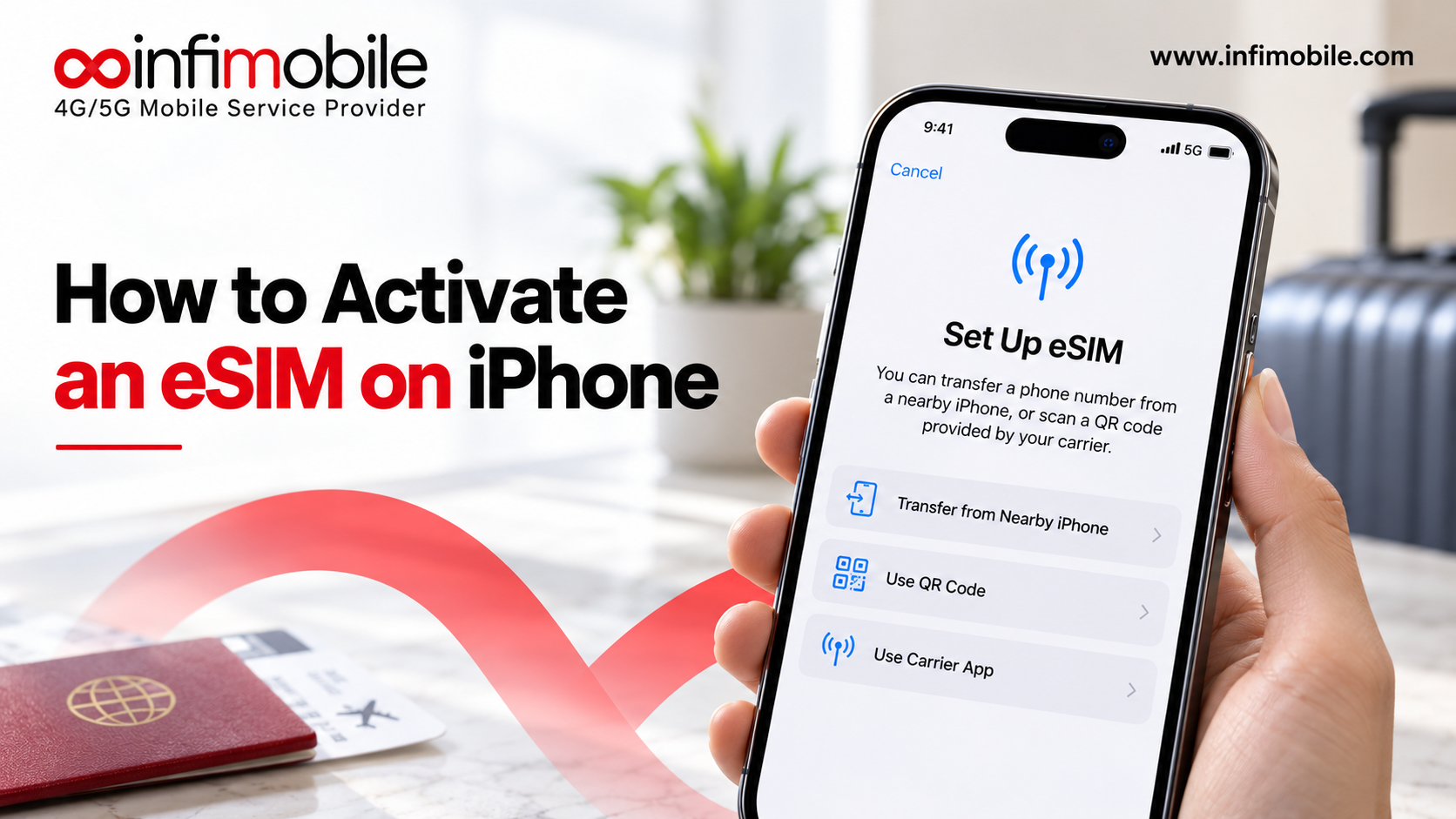
4. Submit the request and activate your SIM or eSIM. Once submitted, Infimobile handles the back-and-forth with AT&T automatically. If you chose eSIM, your profile is delivered digitally and can typically be installed the same day. If you ordered a physical SIM, you’ll activate it once it arrives, following the prompts in the Activate SIM section of the site or app.
5. Wait for the port to complete. Most number transfers from AT&T complete within a few hours to one business day, though it can occasionally take longer if AT&T flags anything for manual review. Keep your AT&T SIM active and don’t cancel that line yourself during this window; more on why in the next section.
6. Confirm the switch. Once the port completes, calls and texts to your number will route through Infimobile automatically. Test by calling or texting yourself from another phone, then check that mobile data and Wi-Fi calling are both working as expected.
Don’t Cancel AT&T Yourself: Let the Port Do It
This is the step that causes the most unnecessary panic, so it’s worth stating plainly: you do not need to call AT&T and cancel your line before or during the port. In fact, doing so can backfire. If AT&T closes your account before the port-out request completes, your number can be released back into AT&T’s general pool instead of transferring to Infimobile, and at that point recovering the same number may not be possible.
The port-out process itself is what closes your AT&T line for that specific number, automatically, as part of the transfer. Your job is simply to make sure the AT&T account stays active and in good standing (auto-pay on, no past-due balance) until the port has fully completed on Infimobile’s end. Once you’ve confirmed the switch worked, any other lines or services still open on the AT&T account are yours to close through AT&T directly, and it’s worth asking for a final bill in writing so you’re not surprised by a prorated charge or an early termination fee if you were still under contract.
If Your Port Gets Rejected
Port rejections are common enough that they’re rarely a sign something has gone seriously wrong. They’re almost always a data-matching issue that’s simple to fix. The most frequent causes are a mistyped account number, an incorrect or expired Number Transfer PIN, a billing address that doesn’t match AT&T’s records exactly, or a name mismatch between the port request and the AT&T account holder. AT&T also imposes waiting periods after certain account changes; postpaid-to-prepaid ports are generally the easiest and fastest, while a very recent prior port on the same number can trigger a short mandatory wait before another transfer is allowed.
If your request is rejected, the fix is usually straightforward: confirm the correct details directly with AT&T, correct whichever field was wrong, wait roughly 24 hours, and resubmit. If you’ve generated a new Number Transfer PIN in the meantime, make sure you’re using the current one, since each PIN is only valid for a few days.
Frequently Asked Questions
No, as long as you choose the port-in option during sign-up rather than requesting a new number. Your number stays with AT&T until the transfer fully completes, and the FCC guarantees your right to keep it when you switch carriers. Just avoid cancelling your AT&T line yourself; the port request is what closes it, on schedule, as part of the transfer.
Yes, if you’re keeping your current device. AT&T will unlock a phone once it’s been active on the account for a minimum period, any installment balance is paid off, and the account is in good standing. You can request this through AT&T’s Device Unlock Portal. If you’re buying a new phone directly through Infimobile instead, this step isn’t necessary.
Most transfers complete within a few hours to one business day once the Port-In Application is submitted with correct details. It can take longer if AT&T flags the request for manual review, which usually happens when something like the account name or billing address doesn’t match exactly.
Your AT&T account number, a Number Transfer PIN (generated through the myAT&T app, online account, or by dialing *PORT), your exact billing address on file, and the phone number you’re porting. Generate the Number Transfer PIN only when you’re ready to submit right away, since it expires after 4 days on consumer accounts.
The specific line you ported closes automatically as part of the transfer. If you have other lines or services on the same AT&T account, those remain active until you close them separately through AT&T. It’s worth requesting a final bill in writing to confirm there’s no prorated charge, remaining device installment balance, or early termination fee you weren’t expecting.
The Bottom Line
Switching from AT&T to Infimobile is far less disruptive than it feels before you start. The entire process comes down to two things: making sure AT&T has released your device and is ready to release your number, and making sure the details you hand Infimobile match AT&T’s records exactly. Get your account number and Number Transfer PIN at the right time, double-check your billing address, and leave your AT&T line active until the port fully completes; the switch itself typically wraps up within a day, often with your number never once showing as unreachable.
Once you’re live on Infimobile, you’re on the same Verizon or T-Mobile towers you were reaching before, just without the premium price tag attached to them: same number, same coverage, and a bill that finally reflects what the service actually costs to deliver.