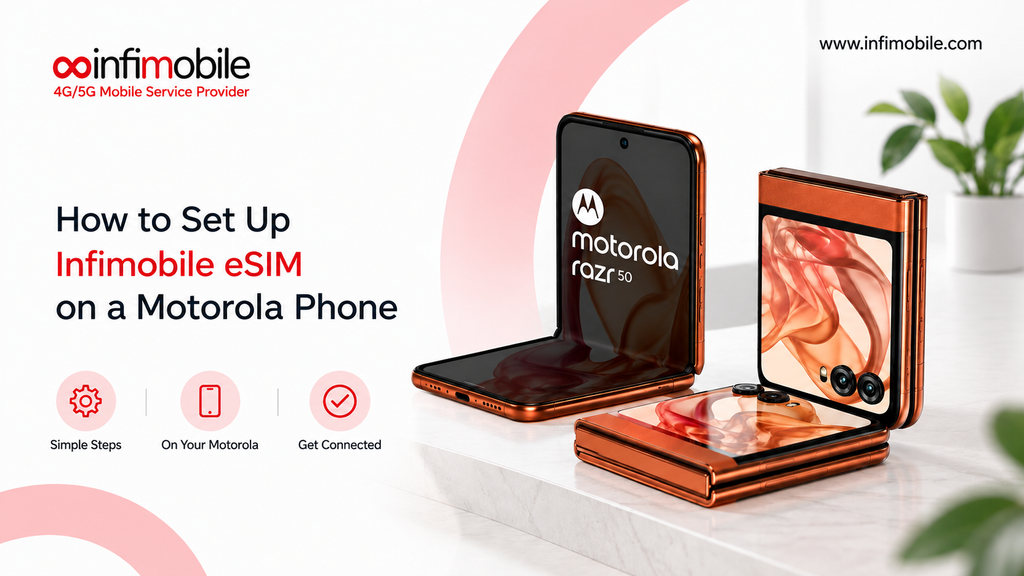
If you just picked up a new Motorola phone or you’re switching to Infimobile, setting up your eSIM takes only a few minutes once you know where to look. The short answer: you activate your Infimobile eSIM plan online first, receive a QR code, then scan that code from your Motorola’s Network settings to install it. This guide walks through the entire process step by step, explains which Motorola models actually support eSIM, covers dual SIM setups, and lists the common hiccups people run into along the way so you can avoid them.
What Is an eSIM and Why It Matters for Motorola Users
An eSIM, short for embedded SIM, is a digital SIM card built directly into your phone’s hardware. Instead of inserting a plastic SIM card, you download your carrier’s profile to the phone using a QR code or activation code. The phone number, data plan, and network settings all live on that embedded chip rather than on a removable card.
For Motorola owners, eSIM support has become more common in recent years, but it isn’t standard on every model. Budget devices and older Moto G phones often ship with a physical SIM slot only, while Motorola’s Razr and Edge lines, along with the newer Moto G series and ThinkPhone, generally include eSIM support. Knowing whether your specific model supports it is the first thing to check before you buy a phone or activate a plan, since not every version of a Motorola model sold worldwide includes the same hardware.
Is Your Motorola Phone eSIM Compatible?
eSIM compatibility on Motorola phones depends on the model and, in some cases, the region it was sold in. Here’s a general breakdown of what typically supports eSIM:
| Motorola Series | eSIM Support |
| Razr (2019 and newer, including Razr+ and Razr Ultra models) | Generally supported |
| Edge series (2022 and newer, including Edge+ and Edge Fusion) | Generally supported |
| ThinkPhone | Supported |
| Moto G series (2024 and newer 5G models) | Often supported, varies by model |
| Older or budget Moto G / Moto E models | Typically physical SIM only |
Because Motorola updates its lineup frequently and support can differ by carrier or region, the most reliable way to confirm compatibility is to check your specific model. On the phone itself, go to Settings, then Network & Internet, then SIMs or Mobile Network, then Add SIM. If you see an option like “Download a SIM” or “Set up an eSIM,” your device supports it. You can also search your exact model number alongside “eSIM” on Motorola’s official support site to confirm before activating a plan.
Why eSIM Support Varies Across Motorola Models
It’s worth understanding why this differs so much from phone to phone. Motorola sells versions of the same model in different countries, and the internal hardware isn’t always identical even when the phone name matches. A Moto G model sold in one region might include an eSIM chip, while the same model number sold elsewhere may only have a physical SIM tray to keep manufacturing costs down for budget-focused markets.
Carrier-branded phones add another layer to this. A Motorola phone sold directly through a specific carrier sometimes has eSIM functionality restricted or disabled at the software level, even if the hardware technically supports it, until the device is unlocked. This is one reason two people with what looks like the same Motorola phone can have completely different experiences trying to activate an eSIM. If you’re buying a Motorola phone specifically to use with Infimobile, an unlocked version purchased directly from Motorola or a major retailer is generally the safer choice.
What You Need Before You Start
Before you begin the Infimobile eSIM activation process, gather the following:
- Compatible, unlocked device. Confirm your Motorola model supports eSIM and isn’t locked to another carrier, since a locked phone may reject the new profile.
- Your device’s IMEI number. Find it by dialing *#06# on the phone dialer, or by checking Settings, then About Phone.
- A stable Wi-Fi connection. eSIM downloads work best over Wi-Fi rather than mobile data, especially during the initial profile install.
- Your ZIP code and billing details. These are needed for account setup on Infimobile’s site or app.
- A backup of your contacts and data. While switching to an eSIM doesn’t erase your phone, it’s good practice to back up before making any network changes.
- A few minutes of uninterrupted time. Restarting the setup partway through can sometimes require starting the activation process over from the beginning.
How to Activate Your Infimobile eSIM on a Motorola Phone
Setting up Infimobile eSIM happens in two parts. First, you activate your plan and generate your QR code through Infimobile. Then, you install that QR code on your Motorola device.
Part 1: Activate Your Plan Through Infimobile
- Choose your plan on the Infimobile website or app based on your data needs.
- Select the eSIM option on the activation page instead of a physical SIM.
- Enter your details, including the activation code sent to you, your IMEI number, and your ZIP code, then click Continue.
- Review your information. If everything is correct, save and continue. If something needs changing, uncheck the relevant boxes and update your details before proceeding.
- Choose optional add-ons like auto-renewal or hotspot if you want them, enter a referral code if you have one, then click Activate.
Once activation goes through, Infimobile sends your QR code, typically by email. Keep this code handy, since you’ll need it for the next part, and avoid forwarding it to anyone else, as each code is generally tied to a single device.
Part 2: Install the eSIM on Your Motorola Phone
- Open Settings and go to Network & Internet.
- Tap SIMs or Mobile Network, depending on your Motorola model.
- Select Add SIM or Download a New SIM, then choose Set Up an eSIM.
- When prompted, scan the QR code from Infimobile using your phone’s camera. If scanning doesn’t work, most Motorola models also let you enter the activation code manually instead.
- Follow the on-screen prompts to finish the download. You may be asked to label the eSIM, for example, naming it “Infimobile,” and choose whether it’s your primary or secondary line if you’re keeping a second SIM active.
- Once installed, restart your phone to make sure the new eSIM profile registers properly with the network.
After the restart, check that you have signal and that mobile data is working. You can verify this under Settings, then Network & Internet, then SIMs, where your Infimobile eSIM should now appear as active.
After You Activate: Things to Check
Once your eSIM shows as active, take a few minutes to confirm everything is working as expected before you put your old SIM away.
- Test calls and texts. Make a short test call and send a text to confirm both directions are working.
- Check mobile data. Turn off Wi-Fi briefly and confirm you can load a webpage using cellular data alone.
- Set your preferred SIM for calls and data. If you’re running a dual SIM setup, go back into SIM settings and confirm which SIM is used for calls, texts, and data by default.
- Delete old profiles you no longer need. If you’re replacing a previous eSIM, removing the old profile keeps your SIM list from getting cluttered and avoids any confusion about which line is active.
Running eSIM and a Physical SIM Together
One advantage of eSIM on supported Motorola models is the ability to run it alongside a physical SIM, giving you two active lines on one phone. This is useful if you want to keep a personal number on a physical SIM while adding Infimobile as a second line, or vice versa. Most Motorola phones with dual SIM support let you choose a default line for calls and a default line for mobile data separately, so you could, for example, use your original line for calls and Infimobile eSIM for data. Keep in mind that dual SIM behavior and battery impact vary a bit by model, and not every Motorola phone supports two active lines simultaneously even if it has eSIM capability, so it’s worth checking your specific model’s dual SIM specs if this matters to you.
Common Motorola eSIM Setup Problems and Fixes
A few issues come up more often than others during eSIM setup. Here’s how to handle them:
- QR code won’t scan. Make sure the code isn’t displayed on the same screen you’re using to scan it. Print it, view it on another device, or use the manual entry option instead.
- “Could not add eSIM” error. This usually means a weak or unstable internet connection. Switch to a strong Wi-Fi network and try again.
- Phone shows no service after activation. Toggle Airplane Mode on and off, or restart the device. This forces the phone to reconnect to the network using the new profile.
- eSIM not recognized as compatible. Confirm your exact model supports eSIM, since some regional Motorola variants sold outside the U.S. may lack the feature even within the same product name.
- A locked device rejects the profile. If your Motorola was purchased through another carrier, it may need to be unlocked before a new eSIM profile will install.
- QR code already used or expired. eSIM QR codes are generally single-use. If you scanned it once before or waited too long to activate, you may need to request a new code from Infimobile rather than reusing the old one.
- Data works but calls or texts don’t. Double-check that the correct SIM is set as your default for calls and messages under SIM settings, particularly if you’re running a dual SIM setup.
If none of these resolve the issue, Infimobile’s support team can confirm whether the problem is on the account side or the device side.
eSIM vs Physical SIM on Motorola: Which Should You Choose
Both options work well, but they suit different situations depending on how you use your phone.
eSIM advantages:
- No physical card to lose or damage.
- Faster activation once you have the QR code, without waiting for a card to arrive by mail.
- Easier to switch plans or carriers without physically swapping anything.
- Useful for dual SIM setups, since many Motorola models can run an eSIM alongside a physical SIM.
Physical SIM advantages:
- Works on any phone, including older models without eSIM support.
- Easy to move between devices manually by simply removing and reinserting the card.
- No dependency on Wi-Fi for initial setup, which can help in areas with limited internet access.
If your Motorola phone supports eSIM and you don’t need to swap the SIM between multiple devices often, eSIM is generally the more convenient choice. If you frequently switch phones or your device doesn’t support eSIM, a physical SIM remains a reliable fallback.
Infimobile Plans and Motorola eSIM
Infimobile is a prepaid wireless provider that runs on major nationwide networks, and every plan supports eSIM activation for compatible devices like most modern Motorola phones. Plans are structured around data allowances and set term lengths rather than long-term contracts, so you’re not locked into a multi-year agreement the way you might be with a traditional postpaid carrier.
If you’re setting up eSIM on a Motorola phone for the first time, it’s worth comparing data tiers based on how you actually use your phone. Light users who mostly text and browse occasionally need far less data than someone who streams video or uses navigation apps regularly. Infimobile offers a range of data tiers, from smaller plans suited to light or backup phone use up to higher-data options for heavier users, along with a Family Plan option where the per-line cost decreases as more lines are added. Because prepaid carriers, including Infimobile, frequently run limited-time promotions and flash sales, the current data amounts, term lengths, and pricing are best checked directly on Infimobile’s plan page before you activate, rather than relying on numbers that may have changed.
Frequently Asked Questions
No. Only Motorola models with eSIM support, generally recent Razr, Edge, ThinkPhone, and newer Moto G 5G models, can use an eSIM. Older or budget Moto G and Moto E phones typically require a physical SIM instead.
Yes, a stable Wi-Fi connection is strongly recommended during setup. Cellular data alone can sometimes cause the download to fail or time out, especially in areas with weaker signal.
Yes, but you’ll need to contact Infimobile to transfer the eSIM profile to your new device’s IMEI, since a QR code can typically only be used to activate one device at a time and can’t simply be rescanned on a second phone.
This usually means either the phone doesn’t support eSIM or it’s still locked to a previous carrier. Confirm your model’s compatibility and check the lock status before trying again.
Once your plan is activated on Infimobile’s end and you receive the QR code, installing it on your Motorola phone typically takes just a few minutes, though network registration can occasionally take a bit longer after the initial restart.
Final Thoughts
Setting up an Infimobile eSIM on a Motorola phone is straightforward once you confirm your device supports it and have your QR code ready. The process involves activating your plan through Infimobile, then installing the eSIM profile through your phone’s Network settings, a method that’s largely consistent across Motorola’s Razr, Edge, ThinkPhone, and newer Moto G models. If you run into trouble, most issues trace back to a weak Wi-Fi connection, an incompatible or locked device, an expired QR code, or a default SIM setting that needs adjusting in a dual SIM setup.
For more on choosing the right data plan for your usage, check out Infimobile’s plans page to compare current options before you activate.