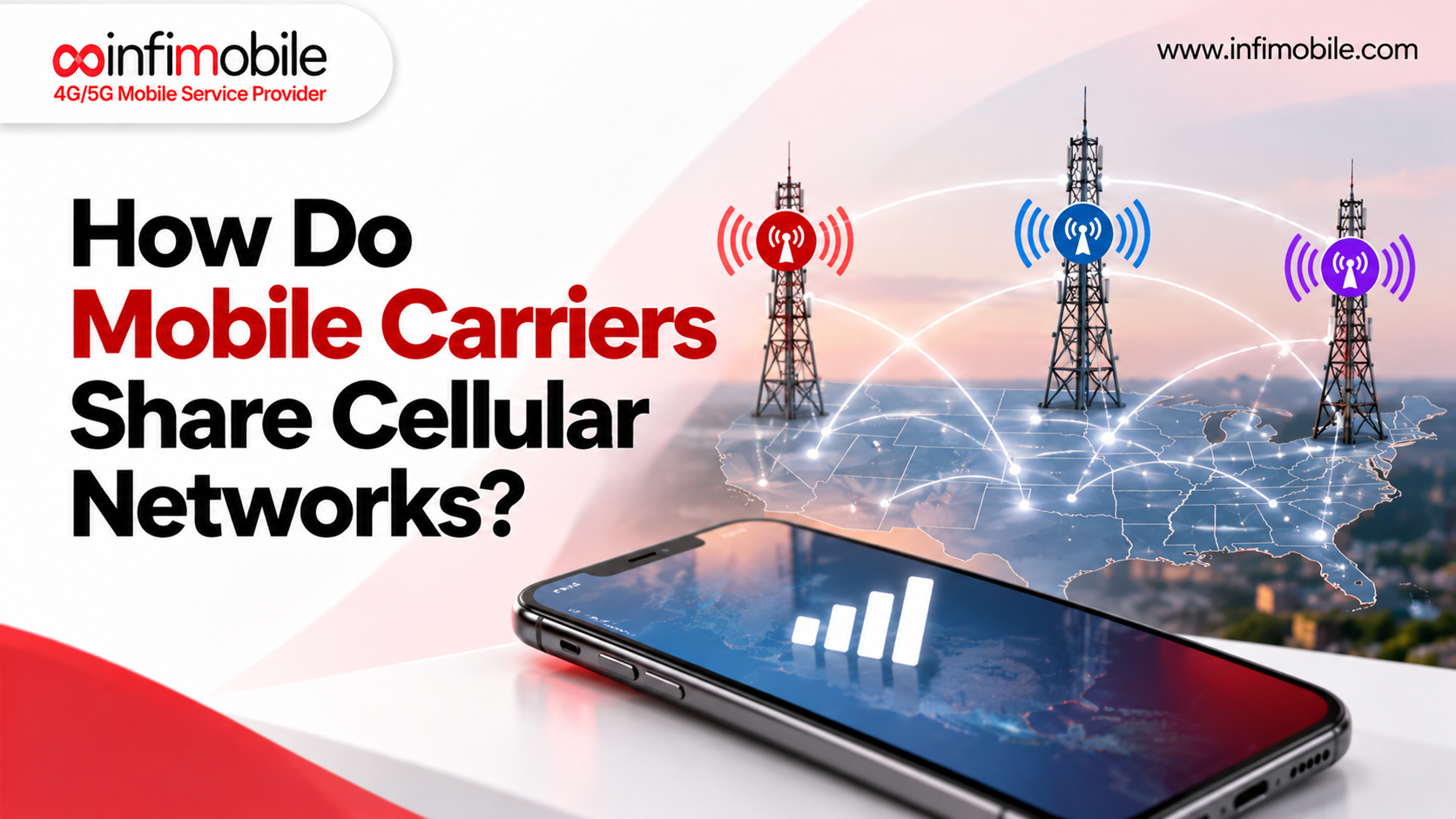
Switching phone companies can feel like a big change, but the signal reaching your phone may not change. Many wireless brands you can choose from share the same towers, radio equipment, and underlying networks. That’s not a trick or a loophole. Sharing is built into how modern wireless service works, and it’s a big reason you have so many choices at so many price points.
This guide explains how mobile carriers share cellular networks: the main methods, why companies do it, how it shows up in the United States, and what it means for your coverage, speed, and wallet.
Table of Contents
The Short Answer
Why Carriers Share Networks
Wholesale Access: How MVNOs Use Another Carrier’s Network
Tower and Site Sharing
Roaming Agreements
Active Network Sharing: RAN Sharing
Spectrum Sharing and Leasing
Hybrid Operators: A Real-World Example
What Network Sharing Means for You
How Infimobile Fits In
How to Choose When Networks Are Shared
FAQs
The Short Answer
Carriers share cellular networks in several different ways, ranging from very simple to very technical:
Wholesale access. A carrier that owns a network sells capacity to other companies, which resell it under their own brands. These resellers are called mobile virtual network operators, or MVNOs.
Tower and site sharing. Several carriers mount their equipment on the same tower or at the same site and split the cost of the structure and power.
Roaming agreements. A carrier lets another carrier’s customers use its network in areas where the other carrier has no coverage.
Radio access network (RAN) sharing. Carriers share the actual radio equipment at a site, while keeping their customers and core systems separate.
Spectrum sharing and leasing. Carriers share or lease the radio frequencies themselves.
Most people encounter just the first one. When you buy a prepaid plan from a smaller brand, you’re almost always on a network owned by one of the large operators.
Why Carriers Share Networks
Building a wireless network is expensive. It takes spectrum licenses, thousands of towers, radio equipment, power, fiber connections, and constant upgrades as technology moves from 4G to 5G. Sharing spreads those costs and solves several problems at once.
Cost. Sharing towers, power, and equipment cuts the capital and operating expenses of deploying and maintaining dense networks.
Coverage. A carrier can extend its reach into areas where building its own towers wouldn’t make financial sense, such as rural regions with few customers.
Faster rollouts. Shared infrastructure can speed up the deployment of new technology.
Using spare capacity. Network owners build for peak demand, so there’s unused capacity much of the time. Selling wholesale access turns that spare capacity into revenue.
Competition and choice. Sharing lets smaller brands compete on price, plan design, and customer service without building a network from scratch.
Wholesale Access: How MVNOs Use Another Carrier’s Network
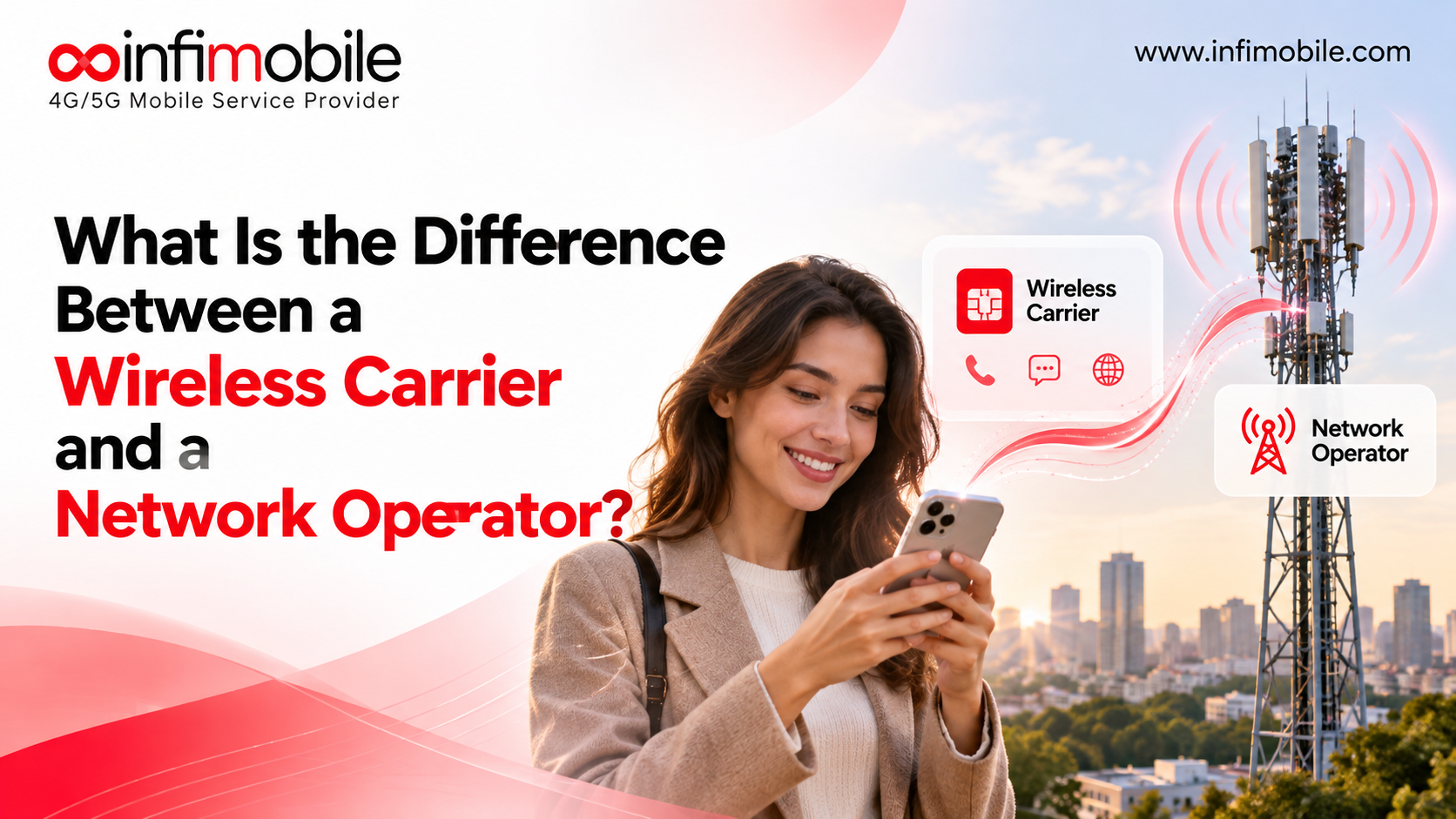
This is the form of sharing most consumers know. A mobile network operator, or MNO, owns spectrum licenses and a radio network. A mobile virtual network operator, or MVNO, owns neither. The MVNO signs a wholesale agreement with an MNO, buys capacity in bulk at wholesale rates, and sells service to consumers under its own name and at its own prices.
The MVNO handles the retail side: plans, pricing, marketing, billing, and customer support. The host network carries the traffic. The result is that an MVNO’s coverage footprint is the same as its host’s, since both use the same towers.
MVNOs come in different shapes. Some are simple resellers that add little beyond a brand and billing. Others operate more of their own systems, including parts of the core network, while still depending on a host for spectrum and radio access. Companies called MVNEs (enablers) and MVNAs (aggregators) also exist in the background to help MVNOs launch or to bundle wholesale access for many of them.
Tower and Site Sharing
The most common and simplest form of sharing is passive sharing, which means sharing physical infrastructure rather than electronic equipment. Typically that means the tower structure itself, the land, the shelter, and the power supply.
In practice, multiple carriers often put antennas on the same tower. In the United States, many towers are owned by independent tower companies that lease space to several carriers. Each carrier still installs and operates its own radio equipment and uses its own spectrum, so customers of different carriers are served by different hardware that simply sits on a shared structure.
Passive sharing is attractive because it cuts costs and reduces the number of towers a community needs, while leaving each carrier in full control of its own network and customers.
Roaming Agreements
Roaming is a different kind of sharing. Under a roaming agreement, one carrier lets another carrier’s customers connect to its network in places where the second carrier has no service of its own.
When this happens within a country, it’s often called national or domestic roaming. It’s especially useful for smaller or regional carriers and for new entrants that want to offer nationwide coverage before they’ve finished building their own network. Instead of building towers everywhere at once, they roam onto a larger carrier’s network to fill the gaps.
Roaming arrangements are usually invisible to customers. Your phone just connects to whichever network it’s allowed to use. For the carrier, though, it’s a business agreement with its own pricing and terms, and the customer’s experience can depend on those terms.
Active Network Sharing: RAN Sharing
More complex is active sharing, where carriers share electronic equipment rather than just a tower. The most common version is radio access network, or RAN, sharing. The RAN is the part of the network made of base stations, antennas, and radio equipment that connects phones to the network over the air.
Two main models are used around the world:
MORAN (Multi-Operator Radio Access Network). Carriers share the RAN equipment, such as base stations and antennas, but each keeps its own spectrum and runs its own radio carriers. This keeps things comparatively simple and lets each operator maintain its independence.
MOCN (Multi-Operator Core Network). Carriers share the same RAN and can pool their spectrum, while each keeps its own separate core network. This is the more resource-efficient option, since pooled spectrum can be used more efficiently, but it’s also more complex to manage.
In both cases, each carrier keeps control of its own customers, services, and core systems, so shared radio equipment doesn’t mean shared accounts or plans. RAN sharing has been deployed in many countries. Operators in Japan, for example, have deployed shared 5G radio networks to cut costs and speed up rollouts.
In the United States, deep RAN sharing among the major carriers has been less common, partly because spectrum is a competitive asset the big carriers guard closely. Analysts have suggested that MORAN-style sharing is the more likely model on large macro networks, while MOCN-style sharing is better suited to places like airports, campuses, and business districts, where a neutral host can serve several carriers’ customers with one shared system.
Spectrum Sharing and Leasing
Spectrum, the licensed radio frequencies that carry wireless signals, is the scarcest resource in wireless, and it can be shared in a few ways. One operator can lease its spectrum to another. Several operators can pool their bands. Or regulators can create bands that many users share under common rules. In the U.S., the 3.5 GHz CBRS band is one example of spectrum designed to be shared among different types of users under rules set by the FCC.
Leasing has also appeared in recent U.S. deals. When EchoStar announced the sale of spectrum licenses to AT&T in 2025, the agreement included an option for AT&T to lease the spectrum while the sale awaited regulatory approval, so the airwaves could be put to use sooner. That shows how spectrum can be shared or put to work well before ownership changes.
Hybrid Operators: A Real-World Example
Some carriers blend ownership and sharing. Boost Mobile is a recent U.S. example. As EchoStar announced in August 2025, Boost is moving to a hybrid model in which it runs its own cloud-native 5G core while relying primarily on AT&T’s cell sites for connectivity, with access to T-Mobile’s network as well. In effect, it keeps part of a network operator’s role, the core, while leaning on a partner’s towers for the radio side.
The Boost story shows how fluid these arrangements can be. A carrier that once built its own radio network can shift toward sharing someone else’s, and the line between a network operator and a virtual operator can blur. For customers, the practical lesson is to look at which network actually carries your service rather than assuming from the brand name.
What Network Sharing Means for You
Sharing sounds abstract, but it affects you in a few concrete ways:
Coverage follows the network, not the brand. If your carrier runs on a host network, your coverage in any place is that host’s coverage there. Two brands on the same network will usually have the same footprint.
Price differences come from business models. MVNOs often cost less because they skip the expense of building networks, running large retail footprints, and subsidizing devices, not because they use inferior towers.
Priority can differ in a crowd. Host networks generally serve their own customers first, and depending on the agreement, MVNO customers may see slower data at peak times in crowded places.
Service experience varies by brand. Even on the same network, brands differ in support, plan structure, and how they handle things like hotspot, data limits, and renewals.
Your number and phone stay yours. Because your number is portable and many phones are unlocked, you can generally move between providers without changing either.
How Infimobile Fits In
Infimobile is an MVNO that uses wholesale access to two major networks: T-Mobile and Verizon. When you sign up, you choose which of the two your line will run on. That’s a practical advantage of the wholesale model, since the stronger network can differ from one neighborhood to the next.
Same towers, different brand. Infimobile doesn’t build its own towers. Your signal comes from the network you select.
A coverage checker. Infimobile’s coverage and compatibility checker at infimobile.com/compatible helps you see what to expect at your address, and it’s wise to cross-check T-Mobile’s and Verizon’s public coverage maps.
12-month prepaid plans. Infimobile’s core plans are paid upfront for 12 months, which lowers the effective monthly cost. Current plans and pricing are on the plans page at infimobile.com/plans.
Bring your number and phone. You can port your existing number and use an unlocked, compatible phone, and a trial port-in option lets you test service on a temporary number first.
Occasional congestion slowdowns. As with any prepaid MVNO, data can occasionally be slowed when the host network is under heavy load.
How to Choose When Networks Are Shared
Knowing that many brands share the same networks makes shopping simpler. Focus on what actually differs:
Find out which network a provider runs on, and whether you can choose it.
Check coverage at your specific address, using the provider’s tool and the host network’s public map.
Compare plan structure. Look at data allowances, what happens when you run out, hotspot, and whether you pay monthly or upfront.
Confirm your phone is compatible. You’ll typically need an unlocked device with 5G or 4G LTE and VoLTE. Dial *#06# to find your IMEI and check it with the provider’s tool.
Read refund and commitment terms before paying for a long prepaid plan.
Test first if you can. A trial or temporary number lets you check real-world service before committing.
Frequently Asked Questions
Often, yes. Smaller brands called MVNOs buy wholesale access to a larger operator’s network, so they use the same towers and radio network. In addition, multiple carriers frequently place their own equipment on the same physical towers, which are often owned by independent tower companies.
Not by itself. An MVNO’s coverage footprint matches its host’s. The main difference is that host networks typically prioritize their own customers during heavy congestion, so MVNO customers may see slower data in crowded places at peak times, depending on the agreement.
Roaming lets a carrier’s customers use another carrier’s network in areas the first carrier doesn’t cover, usually as a gap-filler. An MVNO, by contrast, sells service entirely over a host network under its own brand, with no network of its own.
RAN sharing means two or more carriers share the radio access network equipment, such as base stations and antennas, while keeping their own customers and core networks separate. The two main models are MORAN, where each carrier keeps its own spectrum, and MOCN, where spectrum can be pooled.
Infimobile runs on T-Mobile and Verizon, and you choose which one when you sign up. Checking coverage for your address on both can help you decide.
Network sharing is one of the quiet reasons wireless service is as affordable and competitive as it is. Whether a brand runs on shared towers, roams onto a partner’s network, or buys wholesale capacity, the practical question stays the same: does it work where you are, and does the plan fit how you use your phone? Check your coverage, compare plans, and see how Infimobile’s 12-month plans work at infimobile.com/plans.