If you’ve seen “5G UW” appear at the top of a phone screen, or spotted “Ultra Wideband” in a carrier ad, you’ve probably wondered what it is and whether you get it. The question matters more for customers of prepaid providers like Infimobile because the answer depends on who owns the network, your plan, and what your phone supports.
This guide explains what Ultra Wideband actually is, how it differs from regular 5G and 4G LTE, how access works for customers of a mobile virtual network operator, what Infimobile’s plans say about 5G, and how to check what you’ll really get at your address.
Table of Contents
- Short-answer
- What Is Ultra Wideband?
- How to Tell What Your Phone Is Connected To
- How Ultra Wideband Works for MVNO Customers
- Where Infimobile Stands
- Where Ultra Wideband Is Available
- Does Your Phone Support It?
- When Ultra Wideband Matters, and When It Doesn’t
- How to Check What You’ll Get Before You Commit
- Infimobile Plans at a Glance
- Tips
- FAQs
The Short Answer
Ultra Wideband is a brand name used by Verizon for its fastest 5G service. It isn’t a separate network you can add to any plan, and it isn’t something Infimobile owns or controls.
Here’s what that means for Infimobile customers:
- Infimobile is an MVNO. It leases network access from larger operators, so your coverage and speeds depend on the host network, your plan, your phone, and your location.
- Infimobile’s plans are listed as 5G and 4G LTE.
- Some customers on Verizon-network lines report seeing 5G UW, while others report slower speeds than other Verizon-network plans on the same phone. Results vary.
- The best way to know is to check your address, your phone, and, if you can, test with a trial before you commit.
What Is Ultra Wideband?
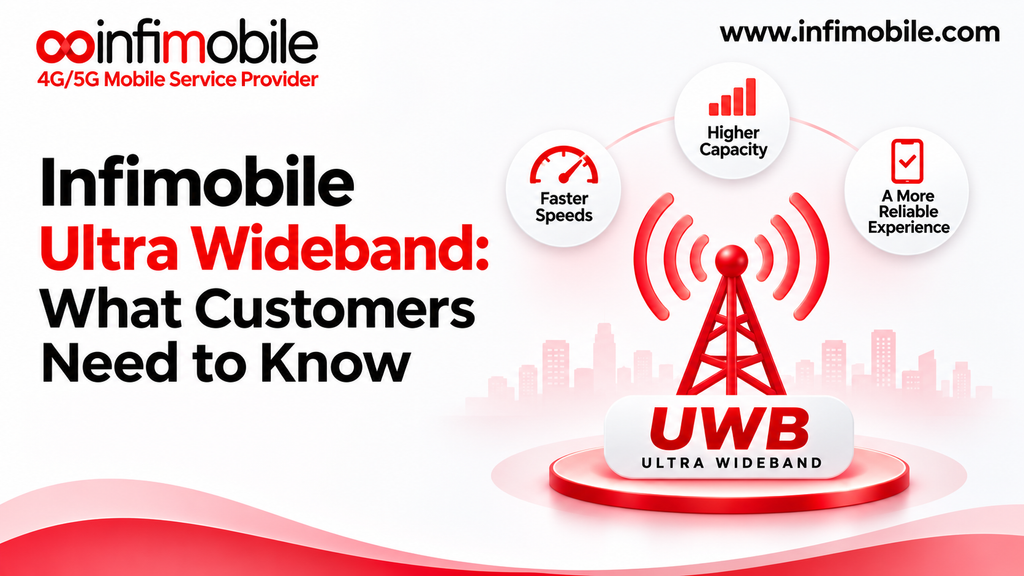
“5G Ultra Wideband,” often shown as 5G UW, is Verizon’s name for its highest-performing 5G tier. According to Verizon, it uses two kinds of radio spectrum:
- C-band (mid-band). A mid-range slice of spectrum, around 3.7 to 3.98 GHz, that balances speed and coverage. It’s the workhorse behind most Ultra Wideband coverage today.
- mmWave (high-band). Very high-frequency spectrum that delivers the fastest speeds but only over short distances, which is why it’s mostly found in dense downtowns, stadiums, and airports.
Verizon’s other 5G layer, 5G Nationwide, uses low-band spectrum. It reaches much farther and penetrates buildings better, but its speeds are often comparable to 4G LTE rather than dramatically faster.
| Spectrum | Several bands | Low-band | Mid-band C-band and mmWave |
| Coverage | Very broad | Very broad | Concentrated in cities and busy areas |
| Typical speeds | Good | Often similar to LTE | Much faster, especially on mmWave |
| Phone icon | LTE or 4G | 5G | 5G UW |
Other carriers have their own names for similar technology. T-Mobile, for instance, calls its faster mid-band 5G “Ultra Capacity.” The idea is the same: higher-capacity mid-band spectrum layered on top of broader, slower coverage.
How to Tell What Your Phone Is Connected To
The easiest check is the icon next to your signal bars:
- LTE or 4G: your phone is on the 4G LTE network.
- 5G: typically indicates the broader-coverage 5G layer. On Verizon’s network, that’s 5G Nationwide.
- 5G UW: your phone is connected to Verizon’s Ultra Wideband network, using C-band or mmWave.
Icons can change as you move. You might see 5G UW outside a stadium, plain 5G in the next neighborhood, and LTE in a basement. That’s normal. The network hands your phone to whichever layer works best at that spot.
How Ultra Wideband Works for MVNO Customers
An MVNO doesn’t own towers. It buys wholesale access from a host network and sells service under its own brand. That has a few consequences for premium 5G features like Ultra Wideband:
- Access is set by the wholesale arrangement and the plan, not by the phone alone. Verizon itself has historically reserved full Ultra Wideband access for certain higher-tier plans, and MVNOs make their own choices about what each plan includes.
- Brands differ. Some Verizon-network prepaid brands advertise Ultra Wideband on specific higher-tier plans, such as Visible+ and Total Wireless’s top plan, according to Infimobile’s own comparison pages. Others describe their service more simply as 5G and 4G LTE.
- Priority can differ in crowds. Host networks typically prioritize their own customers when a tower is busy, so MVNO data can slow in crowded places at peak times.
- Coverage still follows the host. The towers are the same, so where a signal reaches doesn’t change. What can change is which layer of the network your line is allowed to use and how it’s prioritized.
This is why two customers with the same phone, standing in the same spot, on two different Verizon-network brands can see different speeds.
Where Infimobile Stands
Here’s what can be said accurately about Infimobile and Ultra Wideband.
What the plans say. Infimobile’s plan listings describe its service as 5G and 4G LTE. The listings don’t name Ultra Wideband as a feature, and Infimobile’s own comparison with a brand that does advertise Ultra Wideband lists Infimobile’s network simply as 5G and 4G LTE. In other words, 5G and 4G LTE are what the plans promise.
What customers report. Community reviews of Infimobile’s annual plans on Verizon’s network are mixed on speed. Some customers say they’ve seen strong 5G Ultra Wideband speeds, while others report speeds noticeably slower than other Verizon-network plans on the same device. Individual reports like these depend on location, phone, time of day, and plan, so they’re anecdotes, not guarantees.
Which network you’re on. Infimobile is described as primarily a Verizon MVNO and also offers T-Mobile service, and network availability varies by plan. For example, Infimobile has said its 12GB plan runs on Verizon. Confirm the network for the exact plan you’re buying at checkout.
The practical takeaway. Treat 5G and 4G LTE as what you can count on, and treat Ultra Wideband as a possible bonus in some places, not a promised feature. If Ultra Wideband speeds are important to you, ask Infimobile support about your specific plan and test service before relying on it. Support is reachable at +1 (855) 484-1855 or +1 (678) 608-1414, or at support@infimobile.com.
Where Ultra Wideband Is Available
Ultra Wideband is concentrated where demand is highest. mmWave covers small areas such as downtown blocks, stadiums, and airports. C-band covers far more territory, and Verizon has been steadily expanding it. Verizon has reported that its Ultra Wideband network covers well over 200 million people, though “covered” means areas where the service is available, not every building or street.
Because mid-band and mmWave signals don’t travel as far or pass through walls as easily as low-band signals, indoor and edge-of-coverage experiences vary. Even in a city with strong Ultra Wideband, the basement of a thick-walled building may drop to plain 5G or LTE.
Our state coverage guides for places like Texas, Illinois, and Colorado describe Verizon’s Ultra Wideband expansion in specific markets. Those describe what the host network has built, which is not the same as a guarantee about any individual plan. For your own address, check the coverage tools before you decide.
Does Your Phone Support It?
Ultra Wideband needs a compatible phone. Verizon says phones that support the n77 band (C-band) and the n260 and n261 bands (mmWave) can access all parts of its Ultra Wideband network. A few clarifications:
- C-band is the common one. Most recent 5G phones support the n77 C-band, which covers most Ultra Wideband availability.
- mmWave is less common. Many phones, including some versions of popular models, don’t include mmWave support. Without it, you can still use C-band Ultra Wideband but not the mmWave pockets.
- You still need the basics. Infimobile requires an unlocked phone that supports 5G or 4G LTE and VoLTE. Dial *#06# to find your IMEI number, then check it with the compatibility checker at infimobile.com/compatible.
- Some devices aren’t supported. SIM-enabled smartwatches, iPads, and standalone routers aren’t currently supported on Infimobile.
When Ultra Wideband Matters, and When It Doesn’t
Faster 5G sounds appealing, but it’s more important for some activities than others.
| Calls, texts, messaging | Not really |
| Maps and navigation | Not really |
| Email and browsing | Slightly |
| Music streaming | Not really |
| HD video streaming | Helpful in busy areas |
| Large downloads and updates | Helpful |
| Video calls in a crowd | Helpful |
| Using your phone as a hotspot | Helpful |
| Gaming and cloud apps | Helpful |
For many people, especially light and moderate data users, reliable 5G Nationwide or 4G LTE is more than enough. Ultra Wideband is a nice-to-have if you spend time in busy places or move large files, but it isn’t what determines whether a plan is a good value.
How to Check What You’ll Get Before You Commit
A few steps give you a much clearer picture than any marketing term:
- Use Infimobile’s coverage and compatibility checker at infimobile.com/compatible to see what to expect at your address and to confirm your phone works.
- Look at the host network’s public map. Verizon’s coverage map shows where Ultra Wideband and 5G Nationwide are available, and T-Mobile’s map shows its 5G layers. Remember that maps show where a network offers service, not what a specific MVNO plan can access.
- Test before you move your number. Infimobile offers a trial port-in option in the account portal that lets you test service on a temporary number first. Check the icon, run a speed test at home, at work, and on your commute.
- Ask support about your plan. If Ultra Wideband matters to you, ask Infimobile support directly whether it applies to the plan you’re considering.
- Compare at the times that matter. Speeds can vary by time of day, so test during busy hours, not just late at night.
Infimobile Plans at a Glance
Plan features and prices change with promotions, so confirm current details at infimobile.com/plans. As of this writing, Infimobile’s 12-month plans include:
| 10GB Unlimited | $75 | Unlimited talk and text, 10GB of 5G/4G data, hotspot as an add-on |
| 20GB Premium | $120 | Unlimited talk and text, 20GB of 5G/4G data, hotspot as an add-on |
| Freedom Unlimited | $150 | Unlimited data, speeds reduced after 40GB, listing shows hotspot up to 10GB per month |
All plans are listed as 5G and 4G LTE, and Infimobile states its plans are non-refundable, so check coverage and compatibility before you buy. After you use your high-speed data, your speeds are reduced for the rest of the monthly cycle rather than you being charged overage fees. As with any prepaid MVNO plan, data can also be slowed during heavy network congestion.
Tips for Better Speeds
Whatever network layer you’re on, a few habits help:
- Restart your phone or toggle airplane mode if you seem stuck on a slower connection after moving locations.
- Keep your phone updated. Software updates often include network improvements.
- Use Wi-Fi when it’s available, especially for large downloads.
- Turn on Wi-Fi calling for better calls indoors.
- Test at different times. Congestion at peak hours can slow data for MVNO customers more than off-peak.
- Check for signal at your exact spot. Moving near a window or outdoors can change which network layer you connect to.
Frequently Asked Questions
Ultra Wideband, or 5G UW, is Verizon’s name for its fastest 5G service, which uses mid-band C-band and high-band mmWave spectrum. It’s faster than Verizon’s low-band 5G Nationwide layer but covers less area, and it needs a compatible phone.
Infimobile’s plan listings describe service as 5G and 4G LTE and don’t name Ultra Wideband as a feature. Some customers on Verizon-network lines report seeing 5G UW, but access depends on the plan, network, phone, and location. Ask Infimobile support about your specific plan before relying on it.
Look at the icon next to your signal bars. 5G UW means Ultra Wideband, 5G usually means the broader 5G layer, and LTE or 4G means the 4G network. The icon can change as you move.
Phones that support the n77 band can use C-band Ultra Wideband, and phones that also support n260 and n261 can use mmWave. Many phones lack mmWave. Infimobile also requires an unlocked phone with 5G or 4G LTE and VoLTE, which you can verify at infimobile.com/compatible.
Check your address with Infimobile’s coverage and compatibility checker, look at the host network’s coverage map, and use the trial port-in option to test service on a temporary number. Run speed tests at the places and times you use your phone most.
Ultra Wideband is a useful label for Verizon’s fastest 5G, but it’s one factor among many. For most customers, dependable coverage at your address and a plan that fits your data use matter more than any network brand name. Check your phone and address at infimobile.com/compatible, see current plans at infimobile.com/plans, and contact Infimobile support if you have questions about your specific plan.