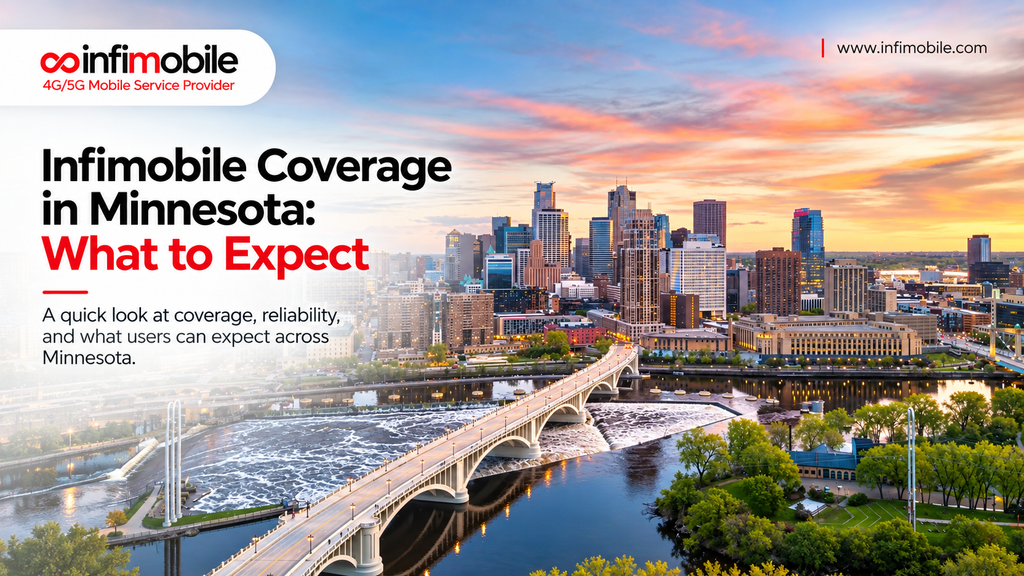
If you’re weighing a switch to a budget prepaid carrier, the first question is almost always the same: will it actually work where I live, work, and drive? That question matters even more in a state like Minnesota, where a single wireless plan has to hold up in a dense downtown skyway system, a Mayo Clinic waiting room, a deer stand in the Iron Range, and a gravel road somewhere south of Worthington, sometimes all in the same week.
Infimobile has become a popular option for Minnesotans looking to cut their phone bill without giving up nationwide coverage, largely because of its low annual pricing and its ability to run on two major carrier networks instead of just one. But how well it performs depends almost entirely on where you are in Minnesota. This guide walks through what Infimobile coverage looks like across the state’s metros, mid-size cities, farm country, and far north, plus how to check your own address before you commit.
What Is Infimobile, and Why Does Its Network Setup Matter in Minnesota?
Infimobile is a mobile virtual network operator, or MVNO. It doesn’t build cell towers, own spectrum, or maintain any physical network infrastructure. Instead, it buys wholesale access to existing wireless networks and resells that access at a much lower price, cutting out the cost of retail stores, device subsidies, and heavy advertising that traditional carriers pass on to customers.
For Minnesota users, Infimobile leases network access from T-Mobile or Verizon, and customers typically choose which one to activate at signup. This dual-network setup is one of Infimobile’s most useful features because it means your coverage isn’t locked to a single carrier’s strengths and weaknesses; you can pick whichever network performs better at your home address, your workplace, or your cabin up north.
The tradeoff is that Infimobile’s own coverage is only ever as good as the underlying network at your location. If T-Mobile or Verizon has a weak spot in a particular township or along a particular stretch of highway, that weak spot carries over to Infimobile too. Understanding how T-Mobile and Verizon each perform across Minnesota is the real key to understanding what you’ll get with Infimobile.
How Verizon Performs Across Minnesota
Verizon’s reputation in Minnesota runs almost the opposite direction. It has long been considered one of the more dependable options for 4G LTE coverage in rural and small-town Minnesota, including farm country in the southern and western parts of the state, thanks to a rural network buildout that predates most of the current 5G race. If your day-to-day life involves driving on county highways, working on land outside city limits, or spending time at a lake cabin away from a larger town, Verizon’s 4G LTE has traditionally been the safer bet.
Verizon’s 5G rollout in Minnesota, however, is more concentrated around the state’s biggest population centers: the Twin Cities, Rochester, St. Cloud, and the area near the North Dakota border around Fargo-Moorhead. Outside those pockets, Verizon customers (and by extension, Infimobile customers on the Verizon side) will typically fall back to 4G LTE, which for most everyday tasks like calls, texts, and browsing is still perfectly usable.
Coverage in the Twin Cities and Minnesota’s Other Major Cities
Minneapolis–St. Paul: Both networks are strong here, and 5G is widely available across downtown, the skyways, the University of Minnesota campus, and most inner-ring suburbs. The one thing worth knowing is that during very large gatherings a Vikings game at U.S. Bank Stadium, a Twins game, or the Minnesota State Fair prepaid traffic on any MVNO, including Infimobile, can be deprioritized behind postpaid customers on the host network. This is standard across the prepaid industry, not something specific to Infimobile, and it usually only becomes noticeable in the most crowded moments of a big event.
Rochester: Home to the Mayo Clinic and a steady stream of visitors, Rochester has solid 4G LTE and a growing 5G footprint on both networks, with generally reliable indoor coverage in the hospital district.
Duluth: Built on a hillside along Lake Superior, Duluth’s terrain can create small pockets of weaker signal in low-lying harbor areas or steep residential streets, even though the city overall gets a healthy mix of 4G LTE and 5G from both networks.
St. Cloud, Mankato, and Moorhead: All three see dependable 4G LTE with expanding 5G, making them solid options regardless of which network you pick through Infimobile.
Coverage in Rural and Northern Minnesota
This is where the choice of network matters most.
The Iron Range (Hibbing, Virginia, Eveleth, Grand Rapids, Ely): Coverage here leans more heavily on 4G LTE than 5G, and the region’s mix of forest, hills, and lakes can create occasional dead spots between towns. Both T-Mobile and Verizon serve the Range, but signal strength can vary block by block more than it does in flatter parts of the state.
Southern and western prairie farmland: The flat, open terrain in much of southern and western Minnesota actually helps cellular signals travel farther with fewer obstructions, but towers are more spread out, so you may notice brief gaps in coverage on long stretches between small towns.
The Driftless Area (southeastern bluff country): The hills and bluffs around towns like Winona and Lanesboro can create localized signal shadows, a pattern typical of hilly terrain anywhere in the country.
The Boundary Waters Canoe Area Wilderness (BWCA) and Voyageurs National Park: This is the one part of Minnesota where no carrier, including Infimobile, can promise reliable service. Cell towers generally can’t be built inside designated wilderness areas, so coverage exists mainly around the edges, in gateway towns like Ely and Grand Marais, and along corridors like the Gunflint Trail. Deeper into the BWCA, you should plan on being unreachable by ordinary cell service. Satellite-to-phone technology (T-Mobile has been piloting a partnership in this space) is starting to close that gap for basic texting and emergency alerts, but it isn’t a substitute for a dedicated satellite communicator if you’re planning an extended backcountry trip.
How Minnesota Winters Affect Your Cell Service
Cell towers themselves are built to handle Minnesota’s climate; extreme cold, ice, and heavy snow are accounted for in their design, and outages tied purely to weather are relatively rare. Where winter actually affects your experience is more about you than the network:
- Cold drains batteries faster. Lithium-ion batteries lose charge more quickly in freezing temperatures, so a phone that reads 80% in your warm car might drop faster than usual once you’re outside. Keeping a portable charger in the car during winter road trips is a smart habit regardless of carrier.
- Blizzards and whiteouts make connectivity more important, not less. If you’re driving through rural Minnesota in winter, download offline maps ahead of time and don’t assume you’ll have a strong signal the entire route, especially in the stretches described above.
- Power outages during ice storms can occasionally affect a local tower’s backup power for short periods, though this is uncommon and typically resolved quickly.
5G vs. 4G LTE: What You’ll Actually Experience on Infimobile
Because Infimobile rides on top of T-Mobile and Verizon’s existing networks, your day-to-day experience will look a lot like any other customer’s on that network in the same area. In practice, that means:
- In the Twin Cities, Rochester, St. Cloud, and Duluth, expect 5G most of the time, with 4G LTE as a normal fallback indoors or in fringe neighborhoods.
- In smaller cities and towns, expect a mix of 5G and 4G LTE depending on how recently that specific area was upgraded.
- In rural counties, the Iron Range, and the western prairie, 4G LTE remains the more consistent baseline, which is still more than adequate for calls, texts, navigation, and most streaming.
- As with any prepaid MVNO plan, data can be deprioritized during periods of heavy network congestion think a packed State Fair weekend or a Sunday afternoon Vikings game rather than being a sign of a problem with your specific line.
Infimobile Plans Available in Minnesota
Infimobile’s plans are structured around annual pricing, which is where most of its savings come from, along with one monthly option for people who want more flexibility. Exact pricing and promotions change periodically, so treat the figures below as a general guide and confirm current pricing directly on Infimobile’s site before you activate.
All plans generally include nationwide 5G/4G LTE access on your chosen network, Wi-Fi calling, visual voicemail, eSIM or physical SIM support, and no long-term contract. Mobile hotspot is either included at a capped allowance or available as a low-cost add-on, depending on the plan. Speeds are typically reduced (not cut off) once you exceed your plan’s high-speed data allowance for the billing cycle.
How to Check Your Own Coverage Before You Switch
Because the quality of Infimobile’s service in Minnesota depends entirely on the underlying network, don’t rely on a general “nationwide coverage” claim alone. Before switching or transferring your number:
- Check both T-Mobile’s and Verizon’s own coverage maps using your exact home address, workplace, and any cabin or rural property you visit regularly.
- Ask around locally. Coworkers, neighbors, or family members already on T-Mobile or Verizon can tell you a lot about real-world performance in your specific area; coverage maps are estimates, not guarantees.
- Confirm your device is compatible with the network you plan to choose, especially if you’re bringing an older or unlocked phone.
- Use a trial period if one is available before committing to a full year of service, particularly if you split time between the metro and a more rural part of the state.
Choosing Between T-Mobile and Verizon on Infimobile in Minnesota
If most of your life happens in the Twin Cities, Rochester, St. Cloud, or another mid-size city, either network will likely serve you well, and the choice comes down to price or personal preference. If you spend significant time in rural southern or western Minnesota, on farmland, or at a lake cabin outside a larger town, Verizon’s long-standing rural 4G LTE strength gives it a slight edge. If you’re mostly in urban and suburban areas and want the fastest available 5G speeds, T-Mobile tends to pull ahead. And if your travels regularly take you into the Iron Range or near the edges of the BWCA, it’s worth checking both networks’ maps for that specific area, since coverage there can vary more than a statewide generalization would suggest.
FAQs
Generally, yes, though performance depends on which network you choose. Verizon tends to have a stronger rural 4G LTE presence in southern and western Minnesota farm country, while T-Mobile’s rural coverage has improved but can still thin out in the most sparsely populated counties. Checking the specific address matters more than any general statewide claim.
If you’re mostly in a city like Minneapolis, St. Paul, Rochester, or St. Cloud, either network works well. If you spend a lot of time in rural areas, small towns, or on farmland, Verizon’s historical rural strength may give it an edge, while T-Mobile is often the stronger pick for fast 5G in urban and suburban areas.
Not reliably. Cell towers generally can’t be built inside the BWCA or similar protected wilderness, so coverage exists mainly at the edges, in towns like Ely and Grand Marais. Deep in the wilderness, plan for no cell service and consider a dedicated satellite communicator for safety.
Cell towers are built to handle Minnesota’s winters without issue. The bigger factor is your phone’s battery, which drains faster in cold temperatures, worth keeping in mind on winter road trips or extended time outdoors.
Infimobile lets you choose a network at signup based on your device and location, but switching networks after activation typically isn’t as simple as flipping a setting; it may involve a new SIM, device compatibility check, or account change. Confirm the current process directly with Infimobile before assuming you can switch freely later.
Final Thoughts
Infimobile’s biggest advantage for Minnesota customers isn’t a network of its own; it’s the flexibility to choose between two of the most established carriers in the state and pay a fraction of what a postpaid plan would cost for most Minnesotans living in or near a city, which translates into coverage that feels no different from a full-price plan. The nuance shows up at the edges: deep in farm country, on the Iron Range, or anywhere near true wilderness like the BWCA, where the underlying network, not the plan you’re on, sets the limit. Checking coverage at your specific address before you switch is still the single best step you can take, regardless of which carrier you lean toward.