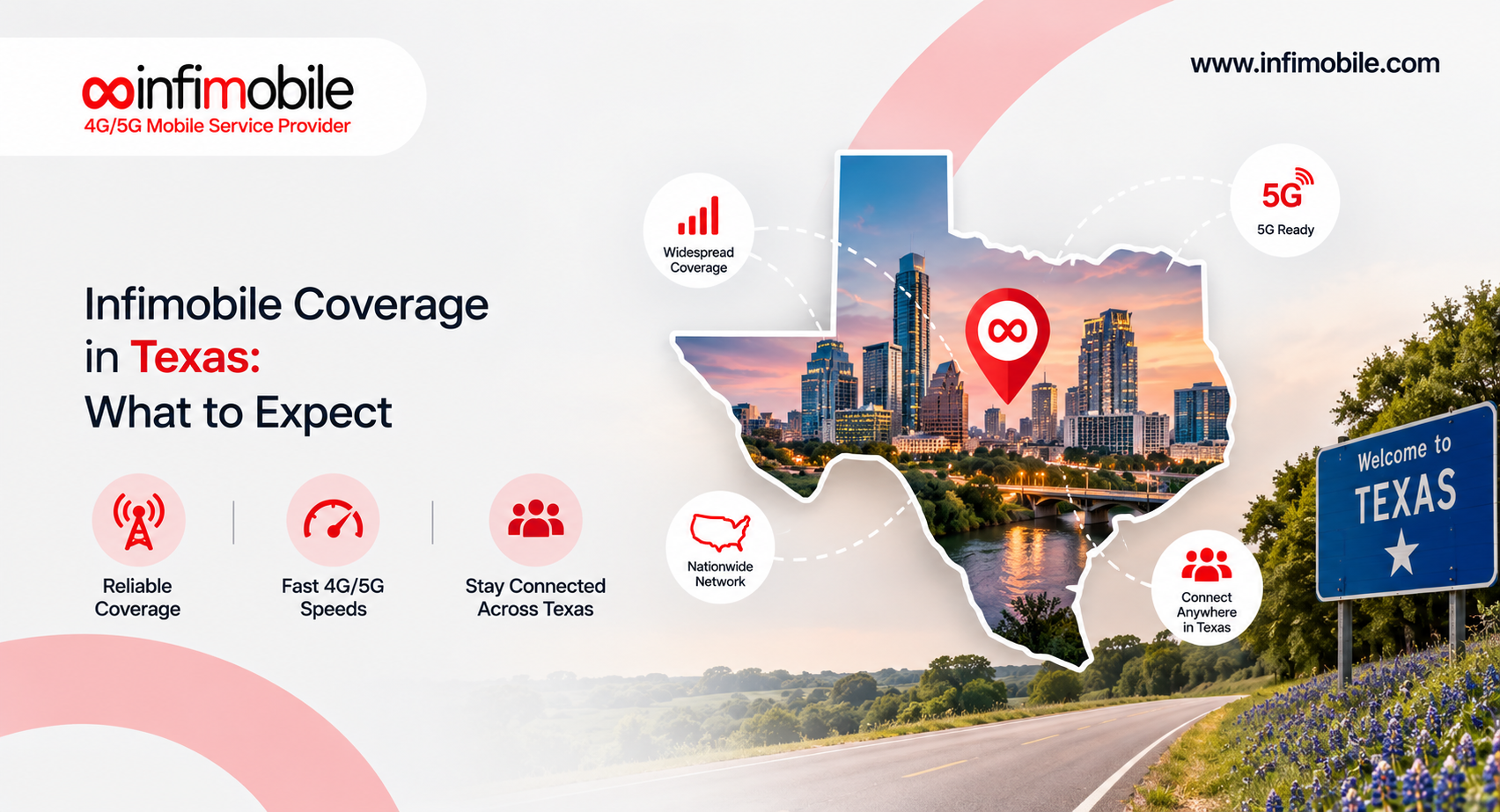
Texas is enormous, big enough that a carrier that performs flawlessly in downtown Houston can feel completely different out past Midland or deep in the Hill Country. So if you’re considering Infimobile and wondering whether it’ll actually hold up where you live, work, and drive, the honest answer is: it depends on where in Texas you are, and which network your Infimobile line runs on.
This guide breaks down exactly how Infimobile coverage works across the state, what to expect in major metros versus small towns and rural stretches, and how to check your specific address before you commit to a plan.
Table of Contents
- How Infimobile Coverage Actually Works
- Coverage in Texas’s Major Metros
- Smaller-cities
- Rural-texas
- 5G vs. 4G LTE: What You’ll Actually Get
- What You Get Once You’re Connected
- Choosing-network
- Check-coverage
- Device-compatibility
- Tips
- Faqs
How Infimobile Coverage Actually Works
Infimobile is a mobile virtual network operator, or MVNO. That means it doesn’t own towers or build physical infrastructure of its own. Instead, it leases wholesale access to two of the largest wireless networks in the country, T-Mobile and Verizon, and passes the savings on to customers by cutting the overhead that traditional carriers spend on retail stores, advertising, and device subsidies.
The practical upshot for Texas customers: when your phone connects to a tower, it’s connecting to the same T-Mobile or Verizon infrastructure that full-price customers on those networks use. Coverage quality in your specific ZIP code isn’t something Infimobile controls directly; it’s a direct reflection of how strong T-Mobile’s or Verizon’s network is in that spot. During sign-up, you choose which of the two networks to activate on, which is genuinely useful in a state as geographically varied as Texas, since the stronger option can shift depending on which part of the state you’re in.
Coverage in Texas’s Major Metros
If most of your day happens in or around Houston, Dallas-Fort Worth, San Antonio, Austin, or El Paso, you’re in the strongest possible position for consistent coverage. Both T-Mobile and Verizon have invested heavily in these metro areas for years, and both operate dense concentrations of 5G-capable towers in and around the urban core, connecting suburbs and major highway corridors between them.
T-Mobile in particular has made large-scale, publicly documented investments across the state: since 2021, the company has installed more than 1,200 new cell sites and upgraded nearly 2,000 existing sites with 5G service in Texas, bringing its 5G network to roughly 99% of the state’s population. Verizon has similarly expanded its 5G Ultra Wideband footprint using recently acquired C-band spectrum, layering faster mid-band 5G on top of its existing 4G LTE and low-band 5G coverage. In practice, that means customers in these metro areas can generally expect strong indoor and outdoor coverage, minimal dead zones, and full access to whichever network they choose during sign-up.
A quick breakdown of what to expect city by city:
- Houston: Dense 5G availability across the inner loop and most surrounding suburbs, including Sugar Land, Katy, and The Woodlands, on both networks.
- Dallas-Fort Worth: One of the more heavily built-out metro areas in the state for both carriers, with strong coverage extending well into suburbs like Plano, Frisco, and Arlington.
- San Antonio: Solid 5G coverage downtown and through most suburban areas, with coverage remaining reliable along the I-35 corridor toward Austin.
- Austin: Strong coverage citywide, including the fast-growing suburbs to the north and southwest, though hill country neighborhoods on the western edge can see more variation between the two networks.
- El Paso: Reliable coverage in the city itself, with both carriers maintaining a solid presence along the border region, though coverage can thin out quickly once you head into the surrounding desert.
Coverage in Smaller Cities and Suburbs
Texas has a long list of mid-size cities and suburbs think Waco, Lubbock, Amarillo, Corpus Christi, Tyler, College Station, McAllen, and the ring of suburbs around the big four metros where coverage is generally reliable but can vary more by specific network than it does in the biggest cities.
Both major carriers have continued building out in these areas rather than stopping at city limits. Verizon, for example, has specifically expanded 5G Ultra Wideband service into smaller Texas communities including Amarillo, Corpus Christi, Wichita Falls, Sherman, Denison, Granbury, and Mineral Wells in recent years. T-Mobile’s rural and small-market buildout, tied partly to commitments made as part of its merger with Sprint, has similarly pushed 5G into smaller Texas communities that previously relied mostly on 4G LTE. If you live in one of these areas, it’s worth checking both networks individually rather than assuming either one is automatically stronger, since local tower placement can make a real difference street to street.
Coverage in Rural and West Texas
This is where things get more location-specific. Rural counties, the Panhandle, the Big Bend region, and long highway stretches through West Texas are geographically massive and less densely populated, which means fewer towers per square mile regardless of which carrier you’re comparing.
That said, “rural” doesn’t automatically mean “no signal.” Both T-Mobile and Verizon have made rural Texas expansion a public priority. T-Mobile committed as part of its Sprint merger settlement with the Texas Attorney General’s office to build out 5G coverage across rural portions of the state, and Verizon has continued acquiring smaller regional carriers and adding tower capacity to close rural gaps. In practice, you can generally expect solid 4G LTE along major highways and in and around small towns, with 5G availability becoming more common but still less consistent than in metro areas. The most remote stretches deep in ranch country or far from any town are where you’re most likely to encounter weaker signal or occasional dead zones, and this is true across every carrier’s network, not just Infimobile.
This is also the part of the state where the choice between T-Mobile and Verizon tends to matter most. In dense metro areas, the two networks are often close enough in performance that it’s not a major factor. Out in rural counties, though, one carrier’s tower placement can genuinely outperform the other’s in a specific area, which is exactly why it’s worth checking both before you activate rather than assuming your experience in Houston or Austin will carry over to a rural property or a long highway drive.
5G vs. 4G LTE: What You’ll Actually Get
Across Texas, your day-to-day experience on Infimobile will typically shift between 5G and 4G LTE depending on exactly where you are, not which plan you’re on. In dense urban cores, you’ll generally land on 5G, often the faster mid-band or Ultra Wideband variety. In suburbs and smaller cities, you’ll get a mix of 5G and 4G LTE depending on tower upgrades in that specific area. In rural stretches, 4G LTE is still the more consistent baseline, with 5G expanding steadily but unevenly.
As with any prepaid MVNO plan, data can occasionally be deprioritized during periods of heavy network congestion, which may lead to slower speeds in crowded areas during peak hours. This is standard across the prepaid industry and isn’t unique to Infimobile; it’s simply part of how wholesale network access works.
What You Get Once You’re Connected
Coverage is only useful if the plan behind it fits how you actually use your phone. Infimobile’s current lineup gives Texas customers a few ways to match a plan to their coverage needs:
- The Family Plan covers multiple data tiers, from 5GB up to 40GB, with options for one to four lines on the same account, a practical fit for households spread across a mix of city and suburban coverage.
- The Freedom Unlimited plan is a 12-month plan priced at $175 upfront ($14.58/month) and includes free mobile hotspot along with 40GB of high-speed data each month before speeds may be reduced for the rest of the cycle, useful if you’ll be relying on your phone’s connection for a laptop or tablet while traveling across the state.
- Whichever plan you choose, the coverage itself 5G or 4G LTE- and how strong it is in your area comes from T-Mobile or Verizon, not from the plan tier you pick. A higher-data plan won’t improve your signal in a weak-coverage area; it just gives you more room to use whatever signal is available.
Choosing Between T-Mobile and Verizon for Your Area
Since Infimobile lets you pick your underlying network at sign-up, it’s worth thinking through which one fits your specific routine rather than picking blindly. A few general patterns worth knowing:
- If most of your time is spent in a major metro, both networks tend to perform comparably well, so device compatibility or personal preference may matter more than raw coverage.
- If you regularly drive long rural stretches or highways, it’s worth checking both networks’ public coverage maps for the specific route, since tower density can differ meaningfully by carrier in less populated counties.
- If you split time between a city and a more remote second home or family property, consider which network historically performs better in that specific rural area, since that’s often the deciding factor rather than your primary city.
There’s no universally “better” choice between the two for the entire state; it comes down to your specific footprint.
How to Check Your Exact Coverage Before You Switch
Rather than relying on general expectations, the most reliable way to know what you’ll get is to check your specific address directly. Infimobile provides a coverage and compatibility checker at infimobile.com/compatible, where you can confirm expected signal strength for your area alongside device compatibility. It’s also worth cross-referencing T-Mobile’s and Verizon’s own public coverage maps for your exact ZIP code, since Infimobile’s service quality is tied directly to whichever of those two networks you select.
Device Compatibility Requirements
Coverage is only half the equation; your phone also needs to support the right technology. Infimobile requires an unlocked device that supports 5G or 4G LTE and is VoLTE-enabled (voice over LTE), which is standard on nearly all phones sold in the past several years. To check compatibility, dial *#06# on your phone to pull up your IMEI number, then enter it into the compatibility checker on Infimobile’s site.
A few devices currently fall outside supported compatibility: SIM-enabled smartwatches (including the Apple Watch), iPads, and standalone routers aren’t supported yet, though Infimobile has noted it’s actively working to expand device compatibility over time.
Tips for Staying Connected in Weak-Signal Areas
If you know you’ll be spending time in a part of Texas with less consistent coverage, a few habits help:
- Enable Wi-Fi calling on your device so calls and texts route over a Wi-Fi network when cellular signal is weak, particularly useful indoors or in rural homes near the edge of coverage.
- Download maps and content in advance before heading into remote stretches of West Texas or the Panhandle, so you’re not relying on a live data connection.
- Check both network options before a long trip if you’re deciding between T-Mobile and Verizon and your route runs through less-populated counties.
- Keep your phone’s software updated, since carriers periodically push network configuration updates that can improve how your device handles handoffs between towers.
Frequently Asked Questions
It depends on the specific area. Both underlying networks, T-Mobile and Verizon, have expanded rural coverage across Texas in recent years, and you can generally expect reliable 4G LTE along highways and near small towns, with 5G becoming more common but less consistent than in major metros. Checking the specific route or address ahead of time is the most reliable way to know what to expect.
Yes. During sign-up, you select which network to activate on. This is useful in Texas specifically, since coverage strength between the two carriers can vary by region, and picking the stronger option for your area can make a real difference.
5G is widely available in major metro areas like Houston, Dallas-Fort Worth, San Antonio, and Austin, and it’s expanding into smaller cities and rural areas as both underlying networks continue building out coverage. In the most remote parts of the state, 4G LTE remains the more consistent option for now.
Use Infimobile’s coverage and compatibility checker at infimobile.com/compatible. It’s also a good idea to cross-check T-Mobile’s and Verizon’s own public coverage maps for your exact ZIP code, since your service quality depends on whichever network you select.
As long as your phone is unlocked and supports 5G or 4G LTE with VoLTE, it should be compatible. Dial *#06# to find your IMEI number, then check it against Infimobile’s compatibility tool before activating. A small number of device types, including smartwatches, iPads, and routers, aren’t currently supported.
Texas is too big for a single blanket answer about coverage, but the tools to get a real answer for your address are straightforward: check the coverage and compatibility checker at infimobile.com/compatible, compare T-Mobile’s and Verizon’s maps for your specific area, and pick the network that fits your routine, whether that’s a downtown Houston commute or a drive across the Panhandle. If you run into questions along the way, Infimobile’s support team is reachable by phone or email to help you make the right call before you switch.