When Apple unveiled the iPhone 18 Pro and iPhone 18 Pro Max on September 9, 2026, most of the conversation centered on the variable-aperture camera system, the 2-nanometer A20 Pro chip, and genuinely significant battery life gains. But buried in the technical specifications was a detail that matters far more to your day-to-day experience than almost anything else on that spec sheet: how the phone actually talks to a cell tower.
The iPhone 18 Pro and Pro Max ship with Apple’s C2 cellular modem, a chip Apple says delivers faster uploads than the previous C1X modem while consuming 15 percent less energy, and for the first time, that modem supports mmWave 5G in the United States. There’s a wrinkle worth knowing about, though: while iPhone 18 Pro models worldwide use the C2 modem, the U.S. version of the iPhone 18 Pro Max is the one exception, using a Qualcomm modem instead, likely to satisfy the remainder of Apple’s supply agreement with Qualcomm. The standard iPhone 18 Pro, on the other hand, uses the C2 modem everywhere, including the U.S. Practically speaking, both configurations support 5G, including mmWave, so the difference is more of an engineering footnote than something that will change how your phone connects. What it does underline is a simple point that gets lost in every “fastest chip ever” headline: the modem is only half the equation. The network it’s talking to is the other half, and that’s the half you actually control when you choose a carrier and a plan.
That’s the idea behind “coverage first” thinking, and it’s especially relevant if you’re bringing a brand-new iPhone 18 Pro onto Infimobile. A phone with a state-of-the-art modem can only perform as well as the network tower it connects to and the data allowance behind it. Pairing genuinely excellent hardware with the wrong plan is like buying a sports car and then only ever driving it in a school zone. This piece walks through what’s actually new in the iPhone 18 Pro’s connectivity, how Infimobile’s network structure works, and how to think about matching your usage to the right data tier so you get full value out of the phone you just paid for.
What’s Actually New in the iPhone 18 Pro’s Connectivity
A few specific upgrades are worth understanding before you think about plans, because they change what “good coverage” even means for this device.
The C2 modem and mmWave 5G. Historically, Apple’s in-house modems (the C1 in the iPhone 16e, the C1X in the iPhone Air) lagged behind Qualcomm’s chips in one specific way: they couldn’t tap into mmWave, the ultra-high-frequency flavor of 5G that delivers the fastest possible speeds in dense urban areas, stadiums, and airports. The C2 closes that gap, supporting mmWave 5G in the U.S. for the first time on an Apple-designed modem. If you live or work in a downtown core with mmWave small cells nearby, this is the generation where your iPhone can finally take advantage of them.
Wi-Fi 7 and Bluetooth 6. The Pro lineup also introduces Apple’s N1 wireless networking chip, which enables Wi-Fi 7, Bluetooth 6, and Thread support. This doesn’t touch your cellular plan directly, but it does mean your phone is more capable of offloading heavy tasks such as large downloads, video calls, and hotspot tethering to a laptop onto Wi-Fi when it’s available, which is worth factoring into how much cellular data you’ll realistically burn through.
eSIM-only in the U.S. In the U.S., Apple lists dual eSIM support with no physical SIM card for either the iPhone 18 Pro or iPhone 18 Pro Max. This has been true since the iPhone 14, but it’s worth restating because it directly affects how you activate service: there’s no SIM tray to worry about, no card to lose, and no in-store swap required. Activation happens entirely through a digital profile, which is exactly how Infimobile’s sign-up flow is built to work.
Battery gains tied to the modem. One underrated detail: Apple says eSIM-only models gain additional battery capacity because the space that used to house a physical SIM tray can now hold more battery cells, and the more efficient 2nm A20 Pro processor, along with the lower-power C2 modem, contribute to real battery life improvements. A more power-efficient modem also tends to hold a stable signal more gracefully in marginal coverage areas, which matters more than most people realize when you’re out of a strong signal zone.
Put together, this is a phone built to make the most of a strong, fast network connection. The question is whether the network underneath it is actually strong and fast where you spend most of your time – and that’s a question about towers and plans, not chips.
Why “Coverage First” Beats “Spec First”
It’s tempting to assume that the newest phone automatically means the best connection, but that’s not how wireless service works. Your phone’s modem determines what it’s capable of. The carrier network it connects to determines what it actually gets.
Infimobile customers connect to real, existing cell towers belonging to two major U.S. networks, and when your phone connects to a tower, it doesn’t know or care what you paid for your plan – it connects to the nearest compatible tower and delivers the same signal, the same speeds, and the same coverage as every other phone on that network. That’s the core mechanic of how an MVNO (mobile virtual network operator) works, and it’s worth restating plainly: Infimobile uses the same infrastructure as the premium carriers – the difference is the business model sitting between you and those towers, not the towers themselves.
Infimobile lets you pick your underlying network at sign-up, and coverage itself – 5G or 4G LTE, and how strong it is in your area – comes from T-Mobile or Verizon, not from the plan tier you pick. This is the single most important thing to internalize before you activate an iPhone 18 Pro: a bigger data bucket does not translate into a stronger signal. A higher-data plan won’t improve your signal in a weak-coverage area; it just gives you more room to use whatever signal is available. Coverage quality and data tier are two separate decisions, and treating them as one is the most common mistake people make when switching carriers.
So “coverage first” really means two things in sequence: first, pick the underlying network (Verizon or T-Mobile) that actually performs where you live, work, and commute. Second, once that foundation is settled, choose the data tier that matches how you’ll actually use a phone this capable.
Choosing Between Verizon and T-Mobile for an iPhone 18 Pro
If most of your time is spent in a major metro, both networks tend to perform comparably well, so device compatibility or personal preference may matter more than raw coverage. If you regularly drive long rural stretches or highways, it’s worth checking both before deciding. One network option is generally recognized for exceptional rural and highway coverage, superior penetration in buildings and basements, and one of the most extensive nationwide 5G deployments in the country – a meaningful consideration if you spend time in older buildings, parking garages, or areas outside dense city cores, where the iPhone 18 Pro’s improved sensitivity and mmWave gains won’t help you if there’s no tower nearby to begin with.
In suburbs and smaller cities, you’ll typically get a mix of 5G and 4G LTE depending on tower upgrades in that specific area, and in rural stretches, 4G LTE remains the more consistent baseline, with 5G expanding steadily but unevenly. The iPhone 18 Pro’s C2 modem is excellent at automatically stepping down to 4G LTE without a jarring experience, but it can’t manufacture 5G coverage where none exists. This is exactly why Infimobile’s coverage checker tool is worth using before you activate: rather than guessing which network is “better” in the abstract, you can check your specific zip code and daily routes against both.
One more honest note worth including here, because it applies to every MVNO and isn’t unique to Infimobile: as with any prepaid MVNO plan, data can occasionally be deprioritized during periods of heavy network congestion, which may lead to slower speeds in crowded areas during peak hours – this is standard across the prepaid industry and isn’t unique to any single carrier; it’s simply part of how wholesale network access works. In practice, this is rarely noticeable outside of extremely dense events (think stadium concerts or holiday-weekend highways), but it’s worth knowing rather than being surprised by.
Matching Data Tiers to How You’ll Actually Use the iPhone 18 Pro
Infimobile deliberately keeps its lineup simple, avoiding the confusing five-tier matrix or “premium unlimited” versus “basic unlimited” doublespeak that some larger carriers use. That said, the tiers do span a real range, and matching one to your usage matters more with a phone this capable, since faster 5G speeds tend to invite heavier use – 4K video calls, larger photo and video uploads from that new variable-aperture camera system, and AI-assisted features that lean on cloud processing all quietly increase how much data you burn through compared to an older phone.
Here’s a practical way to think about it:
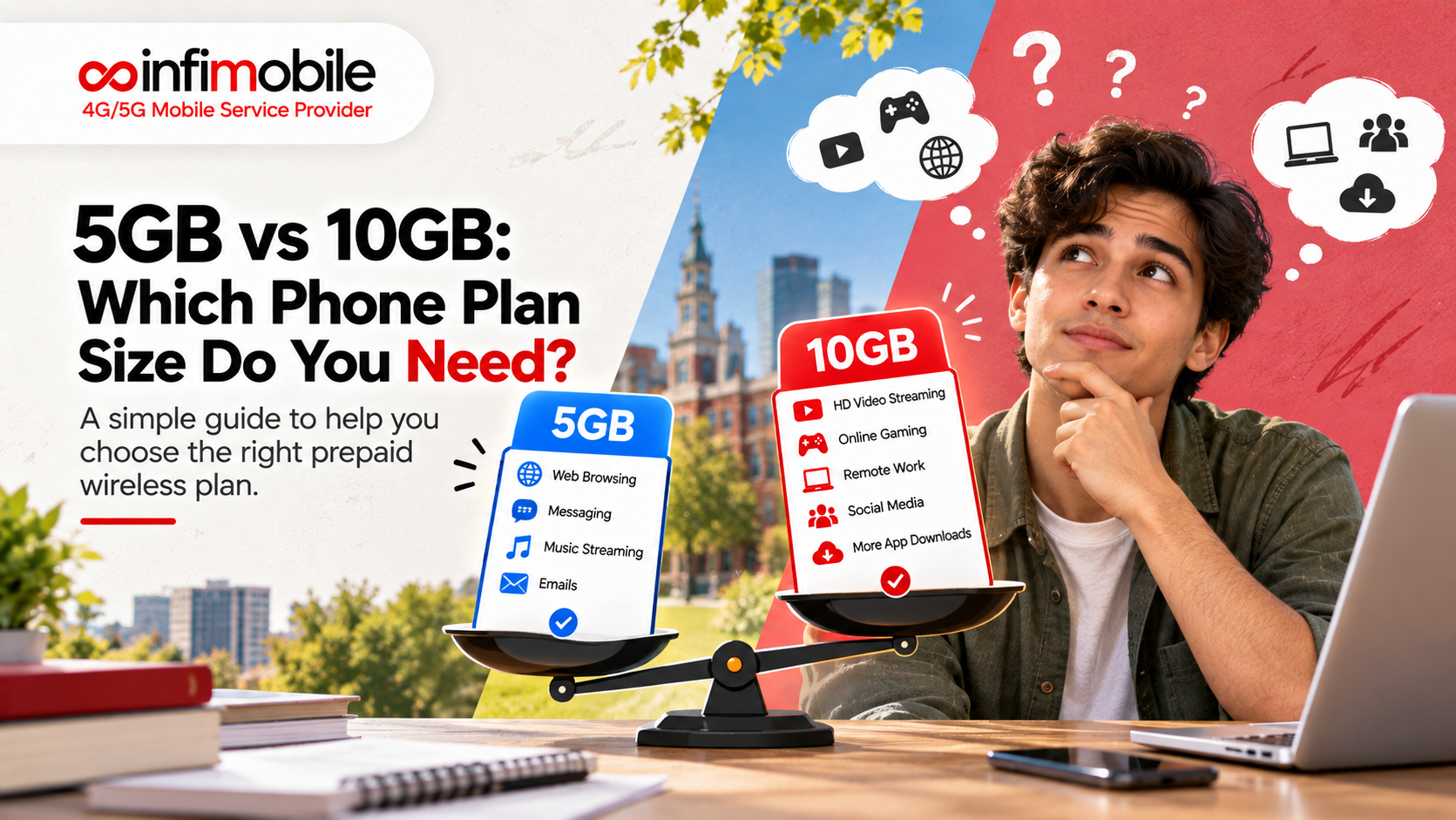
Light users (calls, texts, browsing, occasional streaming): Infimobile’s entry-level tier offers 5GB of high-speed data at full 5G speeds where available, dropping to 4G LTE everywhere else with no artificial throttling, alongside 2,500 talk minutes and 2,500 SMS and MMS messages. This suits someone who relies mostly on Wi-Fi at home and work and uses cellular data for the in-between moments.
Moderate users (regular streaming, navigation, social media, video calls): Infimobile’s 10GB, 15GB, and 20GB tiers give more room for music streaming, social media browsing, and video calls without moving into unlimited pricing. Given the iPhone 18 Pro’s camera upgrades and its tendency to shoot larger file sizes by default, this middle tier is often the sweet spot for someone actively using the phone’s new capabilities without living on cellular data all day.
Multi-line households: The Family Plan spans data tiers from 5GB up to 40GB, with options for one to four lines on the same account – a sensible fit if the iPhone 18 Pro is joining a household with a mix of device types and usage habits.
Heavy users and hotspot-dependent users: Infimobile’s Unlimited Plan runs on the highest-tier nationwide network available in the U.S. market, with strong 5G deployment across major metro areas, reliable 4G LTE everywhere else, and coverage reaching the vast majority of the U.S. population. It includes unlimited talk and text that stay unaffected once the high-speed data allowance is reached, Wi-Fi calling at no extra charge, and a free hotspot allowance of up to 10GB per month – genuinely useful if you plan to tether a laptop to that new Wi-Fi 7 chip on the go, or if you simply do most of your browsing and streaming over cellular rather than Wi-Fi.
Getting the iPhone 18 Pro Actually Set Up on Infimobile
Because the iPhone 18 Pro is eSIM-only in the U.S., activation is entirely digital – there’s no physical card to request or swap. Infimobile works on unlocked 5G and 4G LTE phones that are VoLTE-enabled, and the iPhone 18 Pro comfortably meets that requirement out of the box, provided the specific unit you’re bringing over is unlocked (a phone still under contract with another carrier will need to be unlocked first).
Before you activate, it’s worth running your device through Infimobile’s coverage and compatibility checker using your IMEI – your IMEI is your phone’s ID number and lets Infimobile confirm compatibility, after which you select the underlying network (Verizon or T-Mobile) you want to activate on. This two-step check (device compatibility, then network selection) is exactly where the “coverage first” philosophy becomes concrete: you’re not just picking a plan; you’re confirming the specific combination of phone, network, and location that will actually deliver on the iPhone 18 Pro’s connectivity upgrades.
Frequently Asked Questions
Yes. The iPhone 18 Pro is eSIM-only in the U.S. and supports 5G and 4G LTE with VoLTE, which is exactly what Infimobile requires for activation. If the phone was previously tied to another carrier, make sure it’s unlocked first, then run it through Infimobile’s IMEI-based coverage and compatibility checker before activating.
The standard iPhone 18 Pro uses Apple’s own C2 modem in the U.S., while the U.S. iPhone 18 Pro Max uses a Qualcomm modem instead – the only region where that split exists for the Pro Max. Both configurations support 5G, including mmWave, so day-to-day performance should be very similar; the difference is more of a supply-chain detail than something you’ll notice in daily use.
It depends on where you spend your time. If you’re mostly in a major metro area, both networks tend to perform comparably, so it often comes down to personal preference. If you regularly drive rural highways or spend time in older buildings and basements, it’s worth checking coverage maps for both networks in those specific areas before deciding, since coverage quality – not the plan tier – is what determines your signal strength.
It depends on habits, not just the phone. If you rely on Wi-Fi at home and work, a 5GB or 10GB plan may cover you comfortably. If you stream video, use navigation regularly, or shoot a lot of photos and video with the new camera system, a 15GB–20GB tier or the Unlimited plan (which also includes hotspot data) will likely be a better fit, since higher-resolution 5G usage adds up faster than it did on older phones.
No. Your data allowance and your signal strength are two separate things. Signal strength comes entirely from the underlying network (Verizon or T-Mobile) and your distance from a tower – a larger data plan simply gives you more room to use whatever signal is already available in your area. That’s why choosing the right network first, then the right data tier, is the more effective approach than picking the biggest plan by default.
The Bottom Line
The iPhone 18 Pro is a genuine step forward in cellular hardware – a more efficient modem, mmWave support that finally matches Qualcomm’s longstanding capability, and a battery that benefits directly from the more efficient radio inside it. None of that changes the fundamental truth of how wireless service works: your experience is bounded by the tower you connect to and the data allowance behind your plan, not by how new your phone is. Cheap plans with data can deliver identical coverage and speeds to expensive carriers because they use the same physical cell towers and networks – your phone genuinely cannot tell the difference.
Match the network to where you actually spend your time, match the data tier to how you actually use your phone, and the iPhone 18 Pro’s connectivity upgrades will show up in your daily experience rather than sitting unused on a spec sheet.