The flight has landed. You’re through customs, bags in hand, standing in the arrivals hall of an American airport for the first time. Your family is waiting for a message to know you landed safely. Your university shuttle driver needs to reach you. Google Maps shows that your pickup point is on the other side of the terminal.
And your phone has no signal.
This is the exact moment that catches thousands of international students every year: the gap between landing in the United States and having a working phone number and data plan. It’s a gap that causes real problems: missed pickups, worried families, no way to navigate, no way to confirm accommodation bookings, no way to reach anyone who can help.
Infimobile closes that gap before you ever board the plane.
This guide covers everything international students need to know about getting connected in the USA, how the US mobile system works, what your options are, why eSIM is the right choice for students arriving from abroad, and how Infimobile’s affordable prepaid plans get you connected on day one with no credit check, no Social Security Number, and no contract.
Table of Contents
- Why Connectivity on Day One Matters
- How the US Mobile System Works
- Your Options as an International Student
- Why eSIM Is the Best Choice for Students
- Infimobile: Built for International Students
- Infimobile Plans for Students
- How to Activate Before You Land
- F1 Visa Students: What You Need to Know
- Keeping WhatsApp Active with a US Number
- Student Life Connectivity: What You’ll Actually Use Data For
- Campus Connectivity and Beyond
- Frequently Asked Questions
Why Connectivity on Day One Matters
International students arriving in the USA face a specific and high-stakes connectivity challenge that domestic students simply don’t experience. Everything about your first hours and days in America depends on having a working phone.
Your airport pickup coordination depends on it. Whether it’s a family member, a university shuttle, a friend, or a rideshare driver, communicating with your arrival gate, your delay, and your exact location requires a working phone number and data connection. Airport Wi-Fi exists but is unreliable in the moments you need it most during the walk from customs to arrivals, while bags are being collected, in the outdoor pickup zones where drivers wait.
Your family back home needs confirmation that you arrived safely. The first call or message home after landing is not optional; it’s the relief that ends hours of anxious waiting for parents, siblings, and anyone else who loves you. International calling from a roaming home SIM costs $1 to $3 per minute. A WhatsApp call over data is free. Having US data from the moment you land makes that call immediate and free.
Your navigation depends on it. American airports, university campuses, and cities are large and not always intuitive to navigate. Google Maps requires data. Rideshare apps require data. Finding your dormitory building, your check-in office, and the nearest grocery store requires data.
Your first week requires constant connectivity. Orientation schedules change. Housing assignments get communicated by email and text. Banking appointments need confirmation. Student ID card pickup times need to be checked. Social connections with new classmates begin immediately. None of these works smoothly without a reliable phone.
The students who arrive connected have a fundamentally different first-day experience than those who spend the first hours hunting for Wi-Fi. Infimobile is designed to be the plan that gets you in the first category.
Actionable tip: Purchase your Infimobile eSIM at least 48 hours before your departure. Install it on your phone at home, where you have reliable Wi-Fi and time to troubleshoot if anything needs adjustment. You’ll land in the USA already connected.
How the US Mobile System Works
Understanding the basics of how mobile networks in the United States are structured helps you make the right plan choice before arriving.
The US has four major national wireless networks: Verizon, AT&T, T-Mobile, and Dish/Boost. These networks own and operate the physical tower infrastructure across the country. Beyond these four, hundreds of MVNOs, Mobile Virtual Network Operators, lease access to these networks at wholesale rates and sell wireless service to customers at significantly lower prices.
Infimobile is an MVNO. It leases access to major US carrier infrastructure, the same towers and the same 5G and 4G LTE networks, and delivers that coverage to customers at a fraction of what the major carriers charge directly. The coverage is identical because it’s literally the same hardware. The price is lower because the MVNO business model removes the retail stores, advertising budgets, and corporate overhead that inflate major carrier bills.
SIM cards versus eSIM in the USA:
A physical SIM card is a removable chip you insert into your phone’s SIM tray. A SIM card for USA connectivity used to require going to a carrier store or ordering one by mail, neither of which works well for a student who hasn’t arrived yet.
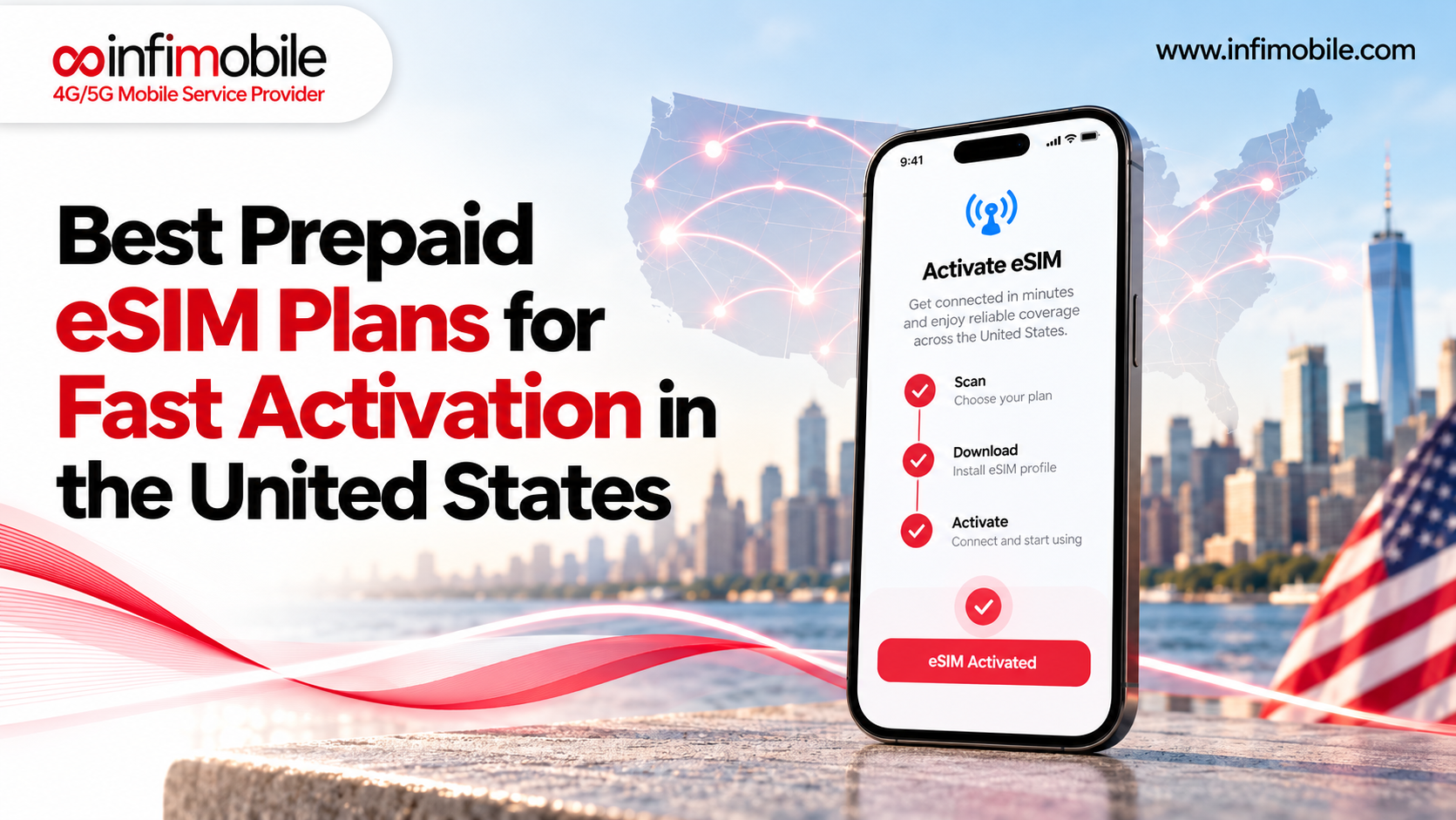
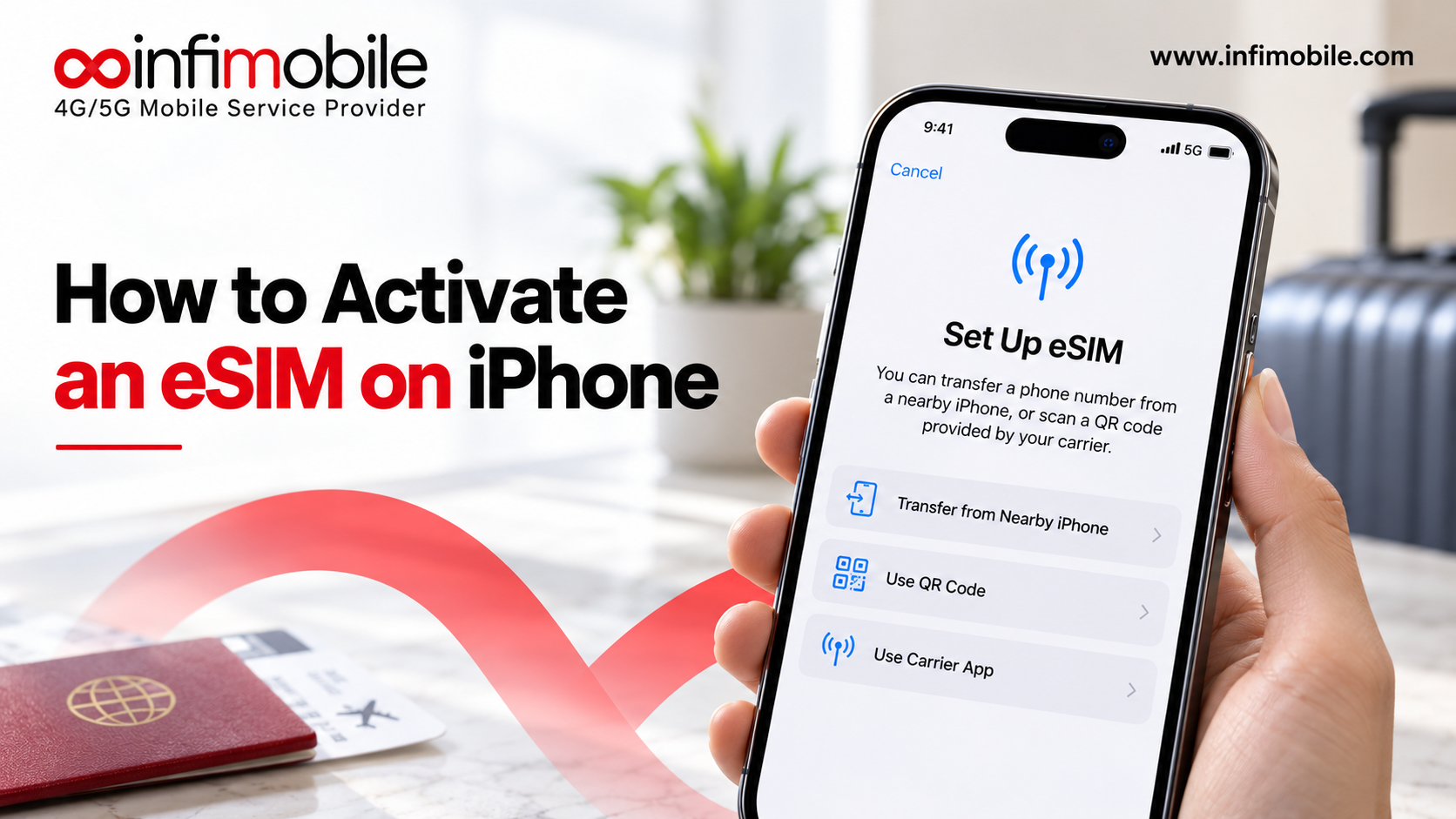
An eSIM is a digital SIM card built into your phone. You activate it by scanning a QR code in your phone settings, from anywhere in the world, without a physical card. For international students, this is the critical advantage: you can purchase an Infimobile eSIM from your home country and have a working US number and data plan before your flight departs.
US phone numbers:
When you get a US SIM card or eSIM, you receive a US phone number. This number lets you receive calls and texts from US contacts, your university, landlord, bank, and classmates without them incurring international rates. It’s also required for many US services, apps, and verification systems that only send SMS codes to US numbers.
Your Options as an International Student
International students arriving in the USA have several options for mobile connectivity, each with meaningful trade-offs.
Airport SIM card kiosks: Many major US airports have SIM card kiosks in the arrivals area. These convenient but expensive airport kiosk plans are often priced at a significant premium over the same carriers’ online prices. You also have to find the kiosk after a long international flight, wait in any queue, set up the SIM in the airport, and hope the process goes smoothly. If anything goes wrong, you’re troubleshooting in an airport.
Major carrier stores near campus: Visiting a Verizon, AT&T, or T-Mobile store after arriving is an option, but major carrier plans are significantly more expensive than MVNO alternatives. Many major carrier postpaid plans require a Social Security Number or credit history, which most newly arrived international students don’t yet have.
International roaming on your home carrier: Using your home country’s carrier with international roaming enabled costs $8 to $15 per day for data packages from most carriers. For a student spending a month or a year in the USA, this is extraordinarily expensive. Even for the first few days, roaming charges add up quickly.
Prepaid MVNO plans, including Infimobile: Purchase online before departure, activate via eSIM from home, and arrive already connected. No store visit. No credit check. No Social Security Number is required. No contract. Affordable monthly or annual pricing that fits a student budget.
The comparison is clear. For international students, the MVNO eSIM model is the most practical, most affordable, and most reliable connectivity solution, and Infimobile’s specific plan features make it the strongest option in that category.
Why eSIM Is the Best Choice for Students
For international students arriving in the USA, eSIM offers advantages over a physical SIM that are specifically relevant to the arrival and early settlement experience.
Activate before you land. This is the defining advantage. Purchase your Infimobile eSIM online from your home country, receive a QR code by email, scan it in your phone settings, and your US line is installed and waiting. The moment your flight touches down, and your phone connects to a US network tower, your Infimobile service activates automatically. You walk out of customs with a working US number.
Keep your home SIM active simultaneously. Most modern smartphones support dual SIM, one physical SIM card, and one eSIM running at the same time. This means your home country’s SIM stays on your phone, keeping your home number active for contacts who reach you there, while Infimobile’s eSIM handles your US data, US number, and outbound calling. Both lines work in parallel on the same device.
No physical card to lose or damage. A physical SIM card can be lost, damaged, or left behind. An eSIM is built into your phone’s hardware; it’s there when you need it and cannot be physically misplaced.
No waiting for mail delivery. Physical SIM cards ordered online require delivery, which assumes you have a US address to receive them and a lead time before arrival. eSIM delivery is instant, to your email inbox, anywhere in the world.
Compatible with modern smartphones. eSIM is supported on iPhone XS and newer, including all iPhone 14, 15, and 16 models. Google Pixel 3 and newer. Samsung Galaxy S20 and newer. Most flagship smartphones released after 2019 support eSIM globally. International students arriving with modern devices are almost certainly carrying eSIM-compatible phones.
Check eSIM compatibility on your phone:
iPhone: Settings → General → About → Look for “Available SIM” or an EID number.
Android: Settings → Connections → SIM Card Manager → Look for the “Add eSIM” option.
Infimobile: Built for International Students
Infimobile’s model aligns precisely with what international students need from a US mobile plan.
No Social Security Number is required. This is critical. Many US carriers require an SSN for postpaid accounts, a number that most international students don’t have when they arrive. Infimobile’s prepaid model requires no SSN. You pay upfront, activate, and connect with no credit history, no government ID beyond what’s needed to process payment, and no bureaucratic barriers.
No credit check. Prepaid means you pay before you use, eliminating any credit assessment. Your financial history in your home country is irrelevant to your ability to get connected to the USA.
No contract. Student life is dynamic; plans change, circumstances shift, stays are extended or shortened. Infimobile’s plans have no lock-in contract. Annual plans run for the year you prepay. Monthly plans run month to month. At the end of the period, you choose whether to renew. No early termination fee. No carrier has leveraged your decisions.
Complete online activation. The entire process of planning selection, payment, QR code receipt, and eSIM installation happens online. No store visit. No in-person appointment. No US address required for signup. A student in India, Nigeria, South Korea, Brazil, Colombia, or anywhere else in the world can set up their Infimobile US plan before their US student visa appointment is even scheduled.
Nationwide coverage on major US networks. Infimobile runs on major US carrier infrastructure covering 99% of the US population. Whether your university is in a major city or a smaller college town, the coverage follows you. Your home campus, your university library, off-campus housing, and the cities you visit during breaks are all within Infimobile’s nationwide coverage footprint.
5GB Annual Plan $75/year ($6.25/month)
For students who spend most of their time on campus on Wi-Fi and primarily need their cellular data for navigation, messaging, and calls when away from Wi-Fi. 5GB of high-speed monthly data, 2,500 talk minutes, 2,500 text messages, nationwide 5G and 4G LTE coverage. Wi-Fi calling, visual voicemail, eSIM support. Zero activation fees.
University campuses are typically well-covered by Wi-Fi in dormitories, libraries, academic buildings, and student unions. Students who connect to campus Wi-Fi throughout the day and use cellular data during commutes, off-campus errands, and travel find 5GB comfortable for most months.
At $4.08 per month, this is one of the most affordable legitimate wireless plans available anywhere in the US market.
15GB Annual Plan $150/year ($12.50/month)
For students who use data more actively, streaming music and podcasts during commutes, video calling family back home over cellular, using mobile data regularly off campus, or using their phone as a hotspot for a laptop occasionally. 15GB of high-speed monthly data, unlimited talk, unlimited text, nationwide 5G and 4G LTE, Wi-Fi calling, visual voicemail, eSIM support.
The unlimited talk and text on the 15GB plan are particularly valuable for students who make frequent calls to academic advisors, landlords, employers for part-time work, and university offices. For $9.92 per month equivalent, this is the strongest value plan in the student budget wireless category.
Which plan is right for you?
If you’ll be on campus Wi-Fi most of the day and your cellular usage is incidental: 5GB annual plan at $75/year.
If you use data actively throughout the day and want unlimited calls, a 15GB annual plan is available for $150/year.
How to Activate Before You Land
The process of getting your Infimobile eSIM active before arriving in the USA takes under 15 minutes. Here’s exactly how.
Step 1: Confirm your phone supports eSIM.
Use the compatibility check described in the eSIM section. If your phone doesn’t support eSIM, Infimobile offers a physical SIM; order it to your home address before departure.
Step 2: Visit Infimobile.com from your home country.
No US address is required. International payment methods are accepted. Choose your plan and select eSIM at checkout.
Step 3: Receive your QR code.
Within minutes of purchase, a QR code arrives in your email inbox.
Step 4: Install the eSIM.
iPhone: Settings → Cellular → Add Cellular Plan → Scan the QR code.
Android: Settings → SIM Card Manager → Add eSIM → scan the QR code.
The profile is downloaded in approximately 30 seconds. Please start your phone.
Step 5: Configure dual SIM settings.
Set Infimobile as your primary data line. Keep your home country SIM as the line for incoming calls on your home number. Both operate simultaneously.
Step 6: Board your flight.
Your phone shows that “No Service” on the Infimobile line is normal, because you’re not connected to a US network yet.
Step 7: Land in the USA.
The moment your phone connects to a US network tower, typically while taxiing or in the terminal, Infimobile activates automatically. Your US number is live. Your data is active. Message your family. Open Google Maps. You’re connected.
F1 Visa Students: What You Need to Know
F1 visa students, the most common student visa category for international students in the USA, have specific connectivity considerations worth understanding.
No SSN is needed for Infimobile. An F1 visa does not automatically grant a Social Security Number. Most F1 students don’t receive an SSN until they apply for work authorization or a specific government benefit. Infimobile’s prepaid model has no SSN requirement; you can activate your US plan before, during, or after the SSN application process without any delay.
Your US phone number is needed for many F1-related processes. University student services, the international student office (DSO), SEVIS-related communications, part-time employment paperwork, and bank account setup all typically require a US phone number. Having your Infimobile number active from day one means you’re ready to provide a US contact number immediately on arrival.
DSO and university communications arrive by SMS. Important notifications from your university’s designated school official, SEVIS updates, I-20-related communications, and urgent campus notifications often arrive via SMS to your registered phone number. Having a reliable US number with dependable SMS delivery from day one is not optional for F1 students.
Keeping WhatsApp Active with a US Number
WhatsApp is the global communication standard for international students. It’s how you stay connected to family in India, friends in Nigeria, classmates from Brazil, and contacts across every country represented in your university’s international student community.
When you switch to a US number as your primary line, your WhatsApp account can be migrated to that new number, keeping your chat history, your groups, and your contacts intact. This means the communication network you built before coming to the USA stays available through your new US number.
How to update WhatsApp to your Infimobile US number:
Open WhatsApp → Settings → Account → Change Number → enter your old number → enter your new Infimobile US number → verify via OTP sent to your new number. Your chat history, groups, and contacts transfer to the new number.
Alternatively, many students run their home SIM and Infimobile eSIM simultaneously on a dual SIM phone, keeping WhatsApp on their home number while using Infimobile data for everything. Both approaches work; the right choice depends on whether you want to transition your primary WhatsApp identity to a US number or keep it on your home number.
WhatsApp calls and video calls over Infimobile’s data are free, meaning calls to family in any country cost nothing beyond your plan price, regardless of international calling rates.
Student Life Connectivity: What You’ll Actually Use Data For
Understanding your real data usage helps you choose the right Infimobile plan before arriving. Here’s what international students actually use mobile data for in the USA.
Navigation is constant. Getting around an unfamiliar American city to the grocery store, to the bank, to government offices, to internship interviews, to airports requires Google Maps running on cellular data whenever you’re away from campus Wi-Fi.
Rideshare apps require data. Uber and Lyft are the primary transportation options in most US cities without extensive public transit. Both require data to book rides, track drivers, and handle payment.
Communication with university offices is important. Email, the student portal, and SMS from the registrar, financial aid, international student services, and housing all require data access when away from campus.
Part-time work coordination. Many international students work on campus or in authorized employment. Coordinating shifts, receiving notifications, and reaching supervisors all happen over the phone.
Social connection. Building a social life in a new country happens partly through apps, messaging classmates, coordinating study sessions, joining student organization group chats, and participating in the digital social fabric of campus life.
Emergency situations. Being in an unfamiliar country without a working phone in an emergency is a serious safety risk. Reliable connectivity is a safety essential, not just a convenience.
Most students using campus Wi-Fi throughout the academic day and using cellular data for commutes, off-campus activities, and travel find that either the 5GB or 15GB Infimobile plan covers their usage comfortably.
Campus Connectivity and Beyond
University campuses in the USA are typically well-served by on-campus Wi-Fi, academic buildings, libraries, dormitories, and student unions, all of which generally provide strong wireless internet access as part of the campus infrastructure. Most students connect to campus Wi-Fi for the majority of their academic day, using cellular data only when away from campus networks.
This usage pattern is substantial on-campus Wi-Fi plus moderate off-campus cellular, which is why the 5GB and 15GB Infimobile plans are well-sized for most students. The cellular data budget covers the times you genuinely need without paying for unlimited data that is mostly available on campus Wi-Fi.
Beyond the campus, US cities vary significantly in transit and walkability. In cities with good public transit, such as New York, Chicago, Boston, and Washington, DC, students may use data heavily during commutes. In more car-dependent cities, data usage during transportation is lower. Factor your specific university location and likely lifestyle into your plan of choice.
Student travel during breaks, domestic trips, and visits to other cities uses cellular data more heavily than typical academic weeks. Having a plan with enough buffer for travel months ensures you’re not rationing data during spring break or winter travel.
Frequently Asked Questions
The easiest method is Infimobile’s eSIM, which you purchase online at Infimobile.com from your home country before departure. No US address, no SSN, and no credit check required. You receive a QR code by email, scan it in your phone settings, and your US line activates automatically when you land.
Major carrier postpaid plans often require an SSN. Infimobile’s prepaid plans require no SSN; you pay upfront and activate via eSIM. This makes Infimobile immediately accessible to international students who haven’t yet received an SSN.
Infimobile’s prepaid plans are well-suited for F1 students: no SSN, no credit check, no contract, competitive pricing, and eSIM activation from outside the USA before arrival. The 15GB annual plan at $150/year covers typical student usage with unlimited talk and text.
Yes. Infimobile’s eSIM can be purchased and installed from anywhere in the world before your flight. Visit Infimobile.com, choose your plan, select eSIM, and receive your QR code by email. Install it before departure and arrive connected.
The 15GB annual plan at $150/year ($12.50/month) is the most popular choice for international students. Unlimited talk and text with 15GB of monthly high-speed data covers typical student usage, including regular calling and moderate off-campus data use. Students primarily on campus Wi-Fi may find the 5GB annual plan at $75/year sufficient.
The Bottom Line: Connected From the Moment You Land
The difference between arriving in the USA connected and arriving without a working plan is the difference between a confident, smooth first day and a stressful scramble for Wi-Fi in an airport arrivals hall.
Infimobile’s prepaid eSIM plans are designed for exactly the situation international students face: the need for instant, affordable, reliable US connectivity without the bureaucratic barriers of credit checks, Social Security Numbers, contracts, and in-store visits. Purchase online from home. Install before your flight. The land is already connected.
Your family gets the message that you arrived safely. The driver finds you. Google Maps opens immediately. Your university’s orientation system has a US number on file from day one.
Everything your first week in America requires, your phone can handle from the moment you clear customs.
Get connected before activating Infimobile’s prepaid eSIM from anywhere in the world at Infimobile.com: 5GB from $75/year, 15GB from $150/year, no SSN required, no contract, instant eSIM activation.