Mobile data deprioritization is a network traffic rule that lets a carrier serve some customers’ data first when a cell tower is crowded. If you are lower in the queue, your data does not stop working. It can just feel slower for a while, usually only where and when many people are online at once. It is a normal part of how prepaid and budget plans work in the U.S., and understanding it helps you choose a plan with realistic expectations.
In this guide, we explain what deprioritization means, why it happens, how it differs from throttling, when you are most likely to notice it, and what you can do about it. We also cover how it relates to prepaid plans like Infimobile’s.
What Does Data Deprioritization Mean?
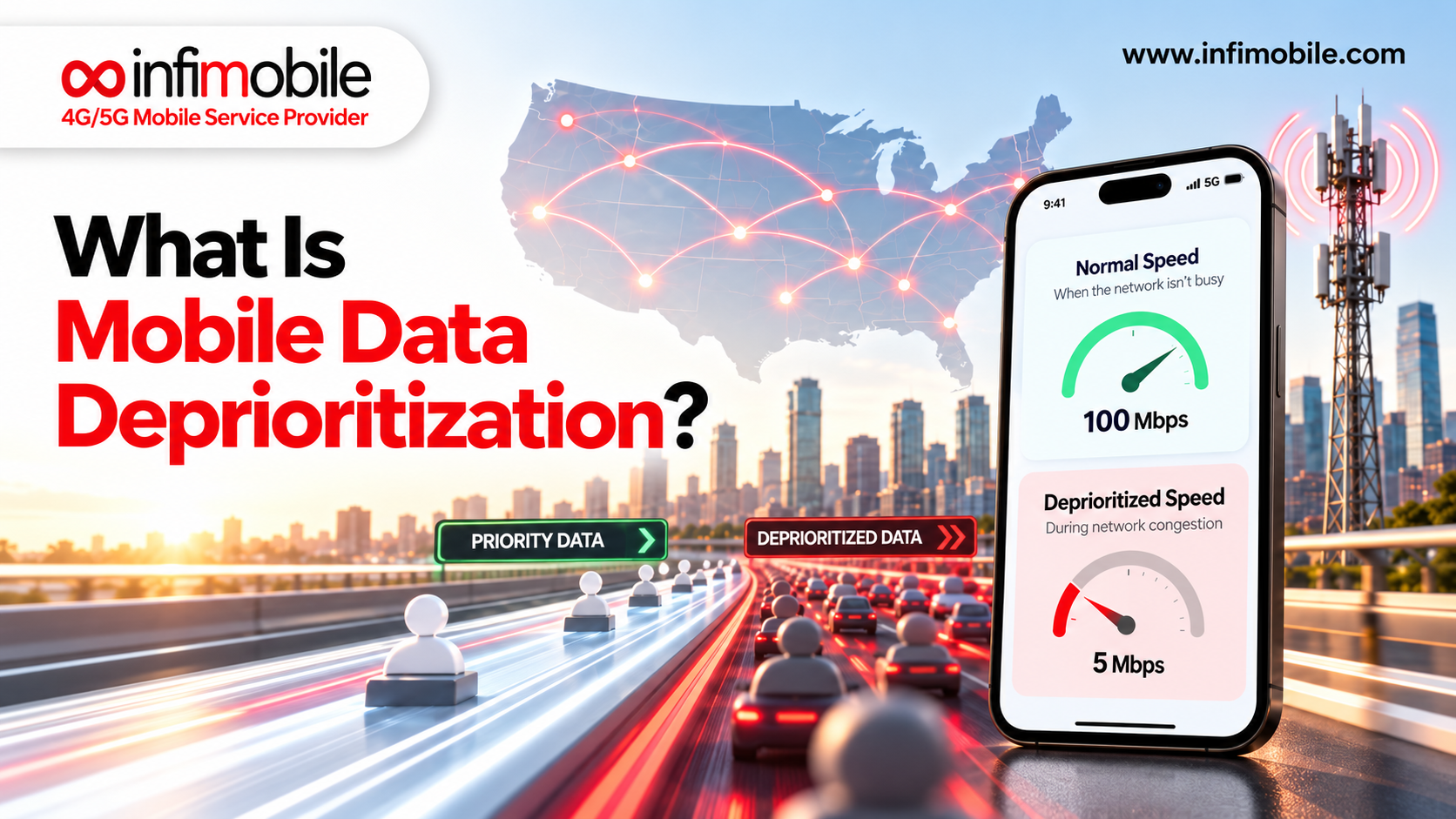
Every cell tower can only handle a limited amount of traffic at one time. When too many phones use the same tower at once, the network becomes congested. To keep things running, carriers use rules that decide whose data gets served first.
Deprioritization means your data sits lower in that order. Here is what that looks like in practice:
- Normal conditions: When the tower is not busy, you get the same speeds as everyone else.
- Busy conditions: When the tower is crowded, higher-priority customers are served first, and your data may slow down.
- After the rush: Once congestion clears, your speeds return to normal.
Think of it like a highway with a carpool lane. When traffic is light, everyone moves at the same pace. When traffic builds up, the carpool lane keeps moving while the other lanes slow down. You still get where you are going, just a little later.
You may also see this called “data prioritization,” “network management,” or “lower priority data.” They all describe the same idea.
Why Do Carriers Use Deprioritization?
Wireless spectrum is limited, and building more towers and capacity costs a lot. Carriers cannot give every customer top priority at every moment, so they set up tiers.
There are a few common reasons carriers use priority levels:
- Managing congestion fairly. The network needs a way to decide what happens when demand is higher than capacity.
- Pricing different plans. Plans with higher priority generally cost more. Plans with lower priority usually cost less.
- Protecting everyday use. Priority rules are meant to keep basic activities like calls, maps, and messaging working for as many people as possible.
Major carriers publish network management policies that explain how this works. For example, T-Mobile’s published policy describes how customers on some plans and on most non-T-Mobile brands receive lower priority than others when a location is heavily loaded. Verizon has also said that its own prepaid customers can be deprioritized during congestion. The details vary by carrier, and they can change, so it is worth reading the current policy for the network you use.
Deprioritization vs. Throttling: What Is the Difference?
People often use these two words as if they mean the same thing. They do not.
| Deprioritization | Throttling | |
| When it happens | Only during network congestion | Often after you reach a set data amount, regardless of congestion |
| How long it lasts | Temporary, until congestion clears | Usually lasts until your next billing cycle |
| What triggers it | Busy towers and your plan’s priority level | A data limit or usage cap |
| What you notice | Slower speeds in crowded places or times | Slower speeds everywhere |
The key point is that deprioritization depends on the network’s condition, not just on your usage. You can use very little data and still notice it if you are standing in a packed stadium. On the other hand, you can use plenty of data in a quiet area and not notice any change at all.
Some plans also reduce speeds after a certain amount of high-speed data is used. That is a data cap, not deprioritization, and it is usually stated in the plan details. It is helpful to know which rule applies to your plan.
What Is a Mobile Virtual Network Operator (MVNO)?
Many prepaid brands are MVNOs. A mobile virtual network operator does not own its own cell towers. Instead, it rents network access from a major carrier and sells service under its own brand.
This model is why prepaid plans can cost less. The MVNO does not have to build and maintain a national network. In exchange, MVNO customers are often placed at a lower priority than the host carrier’s own customers when the network is busy.
Infimobile is an MVNO. It provides prepaid service on major U.S. carrier networks, with Verizon or T-Mobile available at signup. Like other prepaid providers, Infimobile plans are subject to deprioritization during network congestion. This is part of the trade-off that keeps pricing lower than many traditional postpaid plans.
When Are You Most Likely to Notice Deprioritization?
Because it only appears when a tower is crowded, deprioritization tends to show up in predictable situations:
- Large events: Concerts, sports games, festivals, and conventions put thousands of phones on the same few towers.
- Dense downtown areas: Busy city centers during lunch hours or evenings can see heavy demand.
- Commute hours: Train stations, major highways, and airports can be crowded at rush hour.
- Tourist areas in peak season: Small towns can have temporary population surges that strain local towers.
If you live or work in a suburban or rural area with light tower traffic, you may rarely notice it. If you spend a lot of time in crowded places, you may notice it more often. Location matters a lot.
Is Deprioritization Bad?
Not necessarily. It helps to look at it as a trade-off.
Benefits of Plans With Lower Priority
- Lower prices: Plans on lower priority tiers generally cost less than premium tiers.
- Simple terms: Many prepaid plans have no contracts, and you pay for the time you choose.
- Good everyday performance: For most people, in most places, daily tasks work normally outside peak congestion.
Limitations to Keep in Mind
- Slower speeds during congestion: You may notice slowdowns in busy places.
- Less predictable performance at events: If you rely on your phone at crowded venues, it can feel inconsistent.
- Hotspot and tethering effects: Using your phone as a hotspot involves heavier data use, so slowdowns can be easier to notice.
For many users, such as people who mainly use Wi-Fi at home and work, or those who use moderate data for maps, messaging, music, and social media, the trade-off is acceptable. For people who work from a phone hotspot in crowded areas, or who need high-quality video calls everywhere, a higher priority plan may be worth the extra cost.
How to Tell if Your Data Is Being Deprioritized
You cannot see a priority label on your phone, but you can look for patterns:
- Check the time and place. Is the slowdown happening at a busy event, during rush hour, or in a crowded area?
- Compare with another phone. If a friend on a higher-priority plan has faster speeds in the same spot, deprioritization may be involved.
- Run a speed test. Test in the same location at a quiet time and at a busy time. A big difference suggests congestion.
- Check your signal. Full bars with slow data can point to congestion, not weak coverage.
If speeds are poor at all times, check for other causes first, such as weak signal, phone settings, or device compatibility.
Practical Ways to Deal With Slow Data During Congestion
You cannot change your plan’s priority level mid-session, but you can make your experience better.
- Download ahead of time. Save maps, playlists, shows, and podcasts before you head to a busy area.
- Use Wi-Fi when available. Home, work, cafes, and hotels often give faster, more stable connections.
- Use Wi-Fi calling. If your signal or network is crowded, Wi-Fi calling can keep calls and texts working.
- Lower streaming quality. Dropping from HD to standard quality uses less data and buffers less.
- Move a little. Walking away from the busiest area, or to a different floor or side of a building, can sometimes connect you to a less crowded tower.
A VPN does not generally solve deprioritization, since the slowdown happens at the tower level, before your traffic reaches the internet.
How Deprioritization Relates to Infimobile Plans
Infimobile is a prepaid provider that offers service on Verizon or T-Mobile networks, chosen when you sign up. It offers no contracts, eSIM and SIM options, Wi-Fi calling and texting, and plans for different data needs. Because it is a prepaid MVNO, data on Infimobile plans may be deprioritized during network congestion, which is common among prepaid providers.
What this means for you:
- In most everyday situations, you can use your phone normally for calls, texts, maps, social media, and streaming.
- In crowded places, you may notice slower speeds when the network is busy.
- Your experience depends on where you are. Coverage and congestion differ from one area to another.
Here is a quick look at how some of Infimobile’s plans fit different needs. For current prices, terms, and any promotions, always check the plans page, since pricing can change.
| Plan | Best for |
| 5GB | Light users who mostly rely on Wi-Fi |
| 10GB | Everyday users with moderate data needs |
| 12GB | Users who want extra data and a free 5GB hotspot allowance |
| 15GB and 20GB | Heavier users who stream and browse often |
| Unlimited | Users who want the most flexibility with data |
Infimobile also lets you add a hotspot on plans where it is offered. Keep in mind that hotspot use tends to involve more data, so slowdowns during congestion can be easier to notice.
Before you buy, confirm that your phone is compatible and unlocked, and review the plan details for the specific data amount you are considering.
How to Choose a Plan When Deprioritization Matters to You
Use these questions as a guide:
- Where do you use your phone most? Quiet suburban and rural areas are less likely to see congestion than packed city centers.
- How do you use data? Messaging and maps need little. HD streaming, gaming, and video calls need more.
- Do you use a hotspot? If you rely on it for work, think about whether occasional slowdowns would be a problem.
- Is your phone mostly on Wi-Fi? If so, deprioritization may matter very little to you.
- What is your budget? Lower priority is part of why prepaid plans cost less. Decide whether the savings are worth the trade-off.
- Do you travel often to busy events? If yes, plan ahead by downloading content and keeping Wi-Fi calling on.
If you answer “quiet areas, moderate data, mostly Wi-Fi,” a prepaid plan with lower priority is likely to fit well. If you answer “crowded venues, heavy hotspot use, video calls everywhere,” a premium or higher priority plan may be a better match.
Frequently Asked Questions
No. Deprioritization only happens when a tower is congested, and it ends when the congestion clears. Throttling reduces speeds based on a limit or usage amount, often no matter how busy the network is. Check your plan details to see which rules apply.
Deprioritization mainly affects data speeds. Regular calls and texts typically keep working normally, and Wi-Fi calling can help if your signal feels crowded. Data-heavy activities like HD video and large uploads are the ones you will notice most.
Many do. Prepaid and MVNO plans commonly sit at a lower priority than the host carrier’s top tiers, and some major carriers also apply lower priority to certain plans or after a set amount of data. Terms vary by provider and plan, so read the details before you buy.
Not always. More data helps you avoid caps, but priority level is a separate matter. If slowdowns happen in crowded places, the plan’s priority tier matters more than the amount of data you have left.
It can. Hotspot use usually involves more data and more demanding apps, so slower speeds during congestion are easier to see. Some carriers also give on-device data higher priority than tethered data, so hotspot speeds may drop sooner.
Final Thoughts
Mobile data deprioritization is a traffic rule, not a fault with your phone or your signal. It slows data only when a tower is busy, and it goes away once the crowd thins out. For many people, especially those in quieter areas or on Wi-Fi most of the day, it is rarely noticeable.
The best approach is to match your plan to your habits. Know where you use your phone, how much data you need, and whether you depend on a hotspot. Prepaid providers like Infimobile offer no-contract plans at lower prices, with the understanding that data may slow during heavy congestion.
Ready to see which plan fits your usage? Explore Infimobile plans and compare data options, terms, and current pricing.