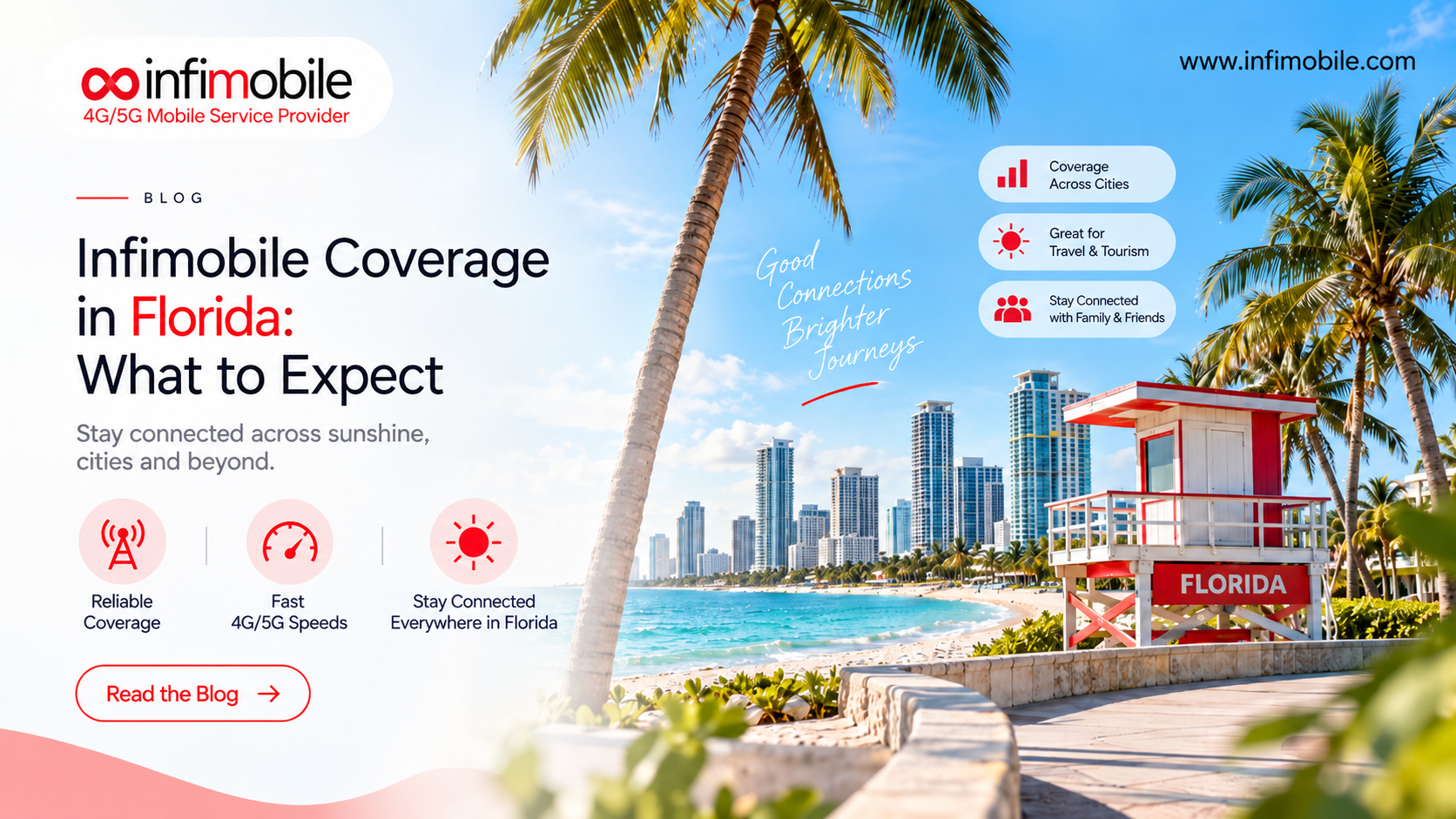
Florida is a state of extremes when it comes to cell coverage: dense, tower-packed metros like Miami and Orlando sit a few hours’ drive from quiet stretches of the Panhandle, the interior ranchland around Lake Okeechobee, and the barrier islands of the Keys. If you’re deciding whether Infimobile will hold up where you actually spend your time, the answer depends on your location and which network your line runs on.
This guide walks through exactly how Infimobile coverage works across Florida, what to expect in the state’s biggest cities versus its smaller towns and rural counties, how hurricane season factors in, and how to check your own address before you switch.
Table of Contents
- How Infimobile Coverage Actually Works
- Coverage in Florida’s Major Metros
- Smaller-cities
- Rural-florida
- Coverage During Hurricane Season
- 5G vs. 4G LTE: What You’ll Actually Get
- What You Get Once You’re Connected
- Choosing-network
- Check-coverage
- Device-compatibility
- Faqs
How Infimobile Coverage Actually Works
Infimobile is a mobile virtual network operator, or MVNO. It doesn’t own cell towers or build physical network infrastructure. Instead, it leases wholesale access to two of the country’s largest wireless networks, T-Mobile and Verizon, and passes the savings on to customers by cutting out the overhead that traditional carriers spend on retail stores, advertising, and device subsidies.
What that means for Florida customers: when your phone connects to a tower, it’s using the same T-Mobile or Verizon infrastructure that full-price customers on those networks rely on. Signal strength in your specific ZIP code isn’t something Infimobile sets directly; it comes down to how strong T-Mobile’s or Verizon’s network already is in that spot. At sign-up, you choose which of the two networks to activate on, which matters in a state as long and geographically varied as Florida, since the stronger option can shift depending on whether you’re in South Florida, the Panhandle, or the rural interior.
Coverage in Florida’s Major Metros
If most of your life happens in or around Miami, Tampa, Orlando, or Jacksonville, you’re in the strongest position for consistent, fast coverage. Both major networks have poured substantial investment into these markets in recent years, driven partly by Florida’s rapid population growth and its role in hosting major events.
T-Mobile completed a $2 billion, multi-year network expansion across Florida, adding 1,282 new or retained cell sites from its merger with Sprint and upgrading nearly 1,350 existing sites statewide. The result is 5G coverage reaching close to 100% of Florida’s roughly 22 million residents, with average statewide 5G download speeds now around 266.7 Mbps, more than triple what they were in 2021. Miami alone received $522.5 million of that investment and 361 new sites, while Orlando saw $204.2 million invested across 126 new sites, pushing the metro close to full 5G coverage. Verizon has made comparable moves, investing more than $1 billion in Florida across 2020 and 2021 alone, with additional capital added since then to keep pace with population growth, and prioritizing coverage around major venues like Walt Disney World, the Orange County Convention Center, and the Miami and Tampa stadium districts.
A quick breakdown of what to expect city by city:
- Miami: Dense 5G coverage across downtown, Miami Beach, and most surrounding suburbs on both networks, reflecting some of the heaviest network investment in the state.
- Tampa: Strong coverage citywide and through surrounding areas like St. Petersburg and Clearwater, with both carriers having accelerated buildout ahead of major sporting events hosted in the area.
- Orlando: Near-complete 5G coverage across the city and the theme-park corridor, backed by significant, publicly documented investment from both networks.
- Jacksonville: Reliable coverage across the city and its sprawling footprint, though some outer suburbs and beach communities can see more variation between the two networks than the urban core does.
Coverage in Smaller Cities and Suburbs
Florida has a long list of mid-size cities where coverage is generally solid but can vary more by network than it does in the four biggest metros, places like Tallahassee, Gainesville, Fort Myers, Sarasota, Pensacola, Lakeland, and the suburbs ringing each major city.
Both carriers have continued building beyond city limits rather than stopping at the urban core. Verizon’s Florida investment has specifically targeted growth markets, citing sharp increases in network traffic in areas like Fort Myers and West Palm Beach as more residents relocated to the state. T-Mobile’s statewide expansion similarly extended 5G into smaller markets as part of its broader Sprint-merger buildout, not just the four largest cities. If you live in one of these areas, it’s worth checking both networks individually for your specific address rather than assuming either one automatically wins, since local tower placement can vary block to block.
Coverage in Rural Florida and the Panhandle
This is where location matters most. Florida’s rural interior counties like Glades, Hendry, Hardee, and parts of the Big Bend region, along with stretches of the Panhandle away from Pensacola and Panama City, are less densely populated, which naturally means fewer towers per square mile regardless of which carrier you compare.
That doesn’t mean rural Florida is a dead zone, though. Both networks have specifically invested in rural and storm-affected parts of the state. Verizon committed $25 million to build out advanced wireless infrastructure, including early 5G technology, in the Florida Panhandle after Hurricane Michael devastated the region’s network in 2018, and has continued strengthening that footprint since. T-Mobile’s statewide expansion likewise extended into rural counties as part of its broader investment, not just the major metro corridors. In practice, you can generally expect solid 4G LTE along major highways and near small towns throughout rural Florida, with 5G becoming more common but still less consistent than in the big four metros. The most remote stretches deep in the interior ranchland or far out in the Panhandle’s rural counties are where you’re most likely to encounter weaker signal, and that’s true across every carrier’s network, not just Infimobile.
Coverage During Hurricane Season
Florida’s exposure to hurricanes makes network resilience a genuinely relevant factor, not just a marketing point. Both major networks have made public, storm-specific investments in recent years. T-Mobile has “hardened” more than 1,375 cell sites across Florida specifically to improve emergency response and disaster recovery, part of its broader statewide investment. Verizon’s post-Hurricane Michael rebuild in the Panhandle, including its Panama City investment, was explicitly framed around restoring and strengthening service after a storm knocked out connectivity for weeks.
That said, no cellular network, including the infrastructure Infimobile runs on, is immune to outages during a major storm, particularly in the hardest-hit coastal and Panhandle areas where towers, fiber lines, or power can be knocked out directly. If you’re in Florida during hurricane season, it’s worth keeping a portable charger on hand, downloading offline maps ahead of a storm, and knowing that service in the most severely affected areas may take time to fully restore even after a storm passes, regardless of carrier.
5G vs. 4G LTE: What You’ll Actually Get
Across Florida, your day-to-day experience on Infimobile will generally shift between 5G and 4G LTE based on where you are, not which plan you’re on. In the four major metros, you’ll typically land on 5G, often the faster mid-band variety given how much both networks have invested there. In smaller cities and suburbs, expect a mix of 5G and 4G LTE depending on how recently that specific area was upgraded. In rural counties and parts of the Panhandle, 4G LTE remains the more consistent baseline, with 5G expanding steadily but unevenly.
As with any prepaid MVNO plan, data can occasionally be deprioritized during periods of heavy network congestion think snowbird season traffic spikes or a stadium crowd in Tampa or Miami which may lead to slower speeds during peak hours. This is standard across the prepaid industry and isn’t unique to Infimobile.
What You Get Once You’re Connected
Coverage only matters if the plan behind it fits how you use your phone. Infimobile’s current lineup gives Florida customers a few ways to match a plan to their needs:
- The Family Plan spans multiple data tiers, from 5GB up to 40GB, with options for one to four lines on a single account, a practical fit for households split between a city home and a second property elsewhere in the state.
- The Freedom Unlimited plan is a 12-month plan priced at $175 upfront ($14.58/month) and includes a free mobile hotspot along with 40GB of high-speed data each month before speeds may be reduced for the rest of the cycle, useful if you’ll be tethering a laptop or tablet while traveling around the state.
- Whichever plan you choose, the coverage itself comes from T-Mobile or Verizon, not from your plan tier. A higher-data plan gives you more room to use whatever signal is available in your area; it doesn’t improve the signal itself.
Choosing Between T-Mobile and Verizon for Your Area
Since Infimobile lets you select your underlying network at sign-up, it’s worth thinking through which one fits your actual routine:
- If most of your time is spent in Miami, Tampa, Orlando, or Jacksonville, both networks tend to perform comparably well given the scale of recent investment in these markets.
- If you regularly drive through rural interior counties or the western Panhandle, check both networks’ public coverage maps for your specific route, since tower density can differ meaningfully outside the major metros.
- If you split time between a coastal city and an inland or Panhandle property, consider which network historically performs better in that specific secondary location, since that’s often the deciding factor over your primary city.
There’s no single network that wins everywhere in Florida; it comes down to your specific footprint across the state.
How to Check Your Exact Coverage Before You Switch
Rather than relying on general expectations, the most reliable way to know what you’ll actually get is to check your specific address. Infimobile provides a coverage and compatibility checker at infimobile.com/compatible, where you can confirm expected signal strength for your area alongside device compatibility. It’s also worth cross-referencing T-Mobile’s and Verizon’s own public coverage maps for your exact ZIP code, since Infimobile’s service quality is tied directly to whichever of those two networks you choose.
Device Compatibility Requirements
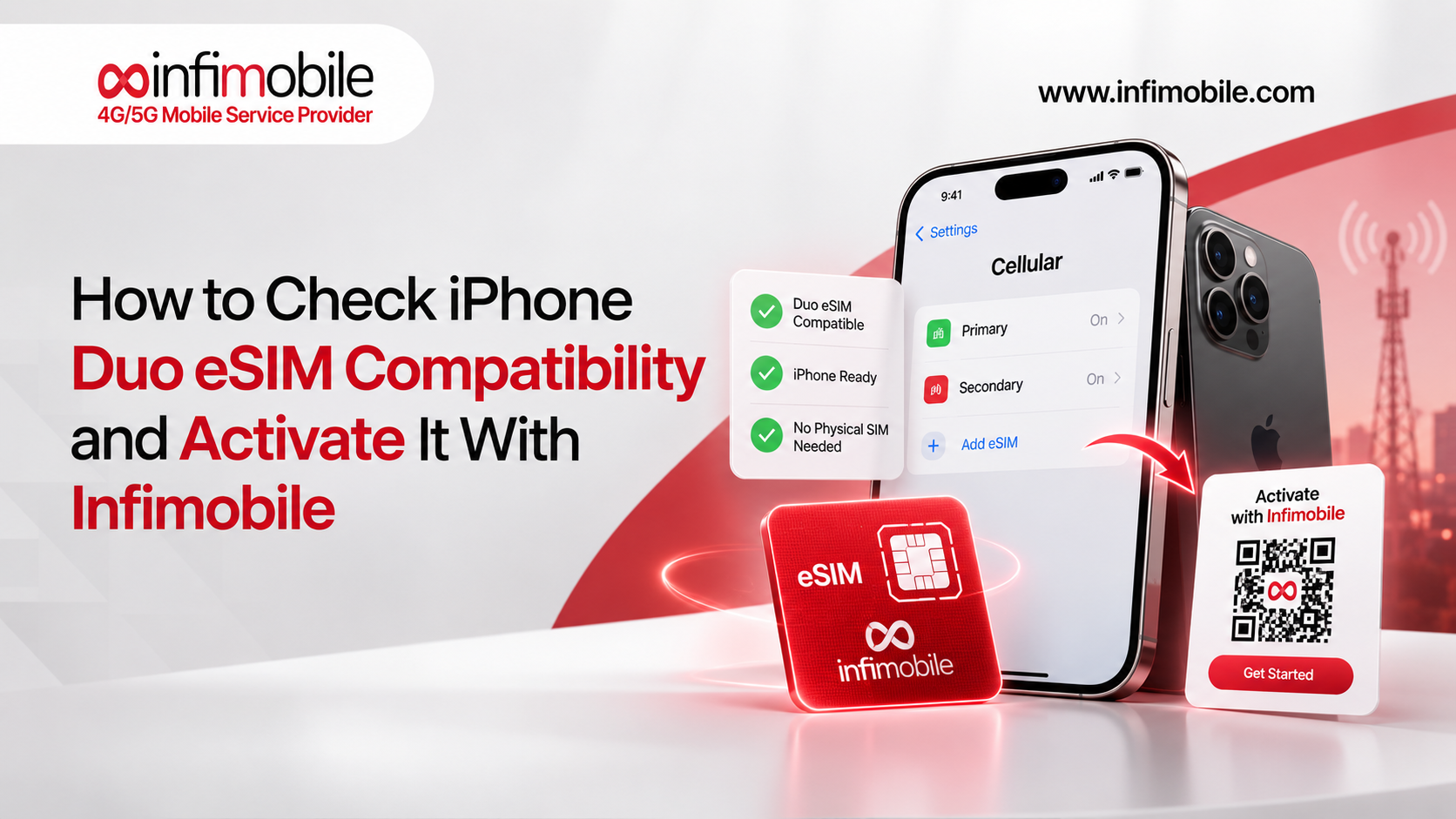
Coverage is only half the equation; your phone also needs to support the right technology. Infimobile requires an unlocked device that supports 5G or 4G LTE and is VoLTE-enabled (voice over LTE), which is standard on nearly all phones sold in the past several years. To check compatibility, dial *#06# on your phone to pull up your IMEI number, then enter it into the compatibility checker on Infimobile’s site.
A few device types currently fall outside supported compatibility: SIM-enabled smartwatches (including the Apple Watch), iPads, and standalone routers aren’t supported yet, though Infimobile has noted it’s actively working to expand device compatibility over time.
Frequently Asked Questions
It depends on the specific area. Both underlying networks have invested in rural Florida coverage in recent years, including storm-recovery investment in the Panhandle after Hurricane Michael, and you can generally expect reliable 4G LTE along highways and near small towns, with 5G becoming more common but less consistent than in the major metros. Checking your specific route or address ahead of time is the most reliable way to know what to expect.
Yes. During sign-up, you select which network to activate on. This matters in Florida specifically, since coverage strength between the two carriers can vary between South Florida, Central Florida, and the Panhandle, and picking the stronger option for your specific area can make a real difference.
Both T-Mobile and Verizon have made public investments in network resilience across Florida, including hardened cell sites and post-storm rebuilds in previously affected areas like the Panhandle. That said, no network is fully immune to outages during a major storm, especially in the hardest-hit coastal areas, so it’s worth having a backup plan like a portable charger and offline maps during hurricane season regardless of carrier.
5G is widely available across Miami, Tampa, Orlando, and Jacksonville, and it’s expanding steadily into smaller cities and rural counties as both underlying networks continue building out coverage. In the most remote parts of the state, including rural interior counties and stretches of the Panhandle, 4G LTE remains the more consistent option for now.
Use Infimobile’s coverage and compatibility checker at infimobile.com/compatible. It’s also worth cross-checking T-Mobile’s and Verizon’s own public coverage maps for your exact ZIP code, since your service quality depends on whichever network you select.
Florida is too long and too geographically varied for one blanket answer about coverage, but getting a real answer for your address is straightforward: check the coverage and compatibility checker at infimobile.com/compatible, compare T-Mobile’s and Verizon’s maps for your specific area, and pick the network that fits your routine, whether that’s a Miami commute, an Orlando theme-park visit, or a drive through the Panhandle. If you run into questions along the way, Infimobile’s support team is reachable by phone or email to help you make the right call before you switch.