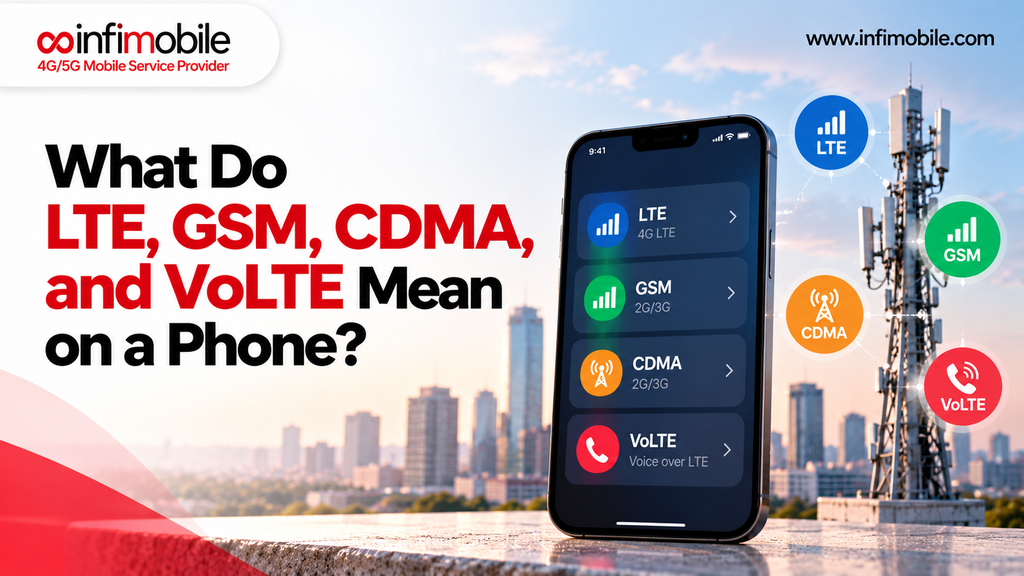
If you have ever opened your phone settings or a spec sheet, you have probably seen LTE, GSM, CDMA, and VoLTE listed side by side with no explanation. These four terms describe how a phone connects to a mobile network, and they come up whenever you buy a phone, switch carriers, or wonder why calls suddenly stopped working.
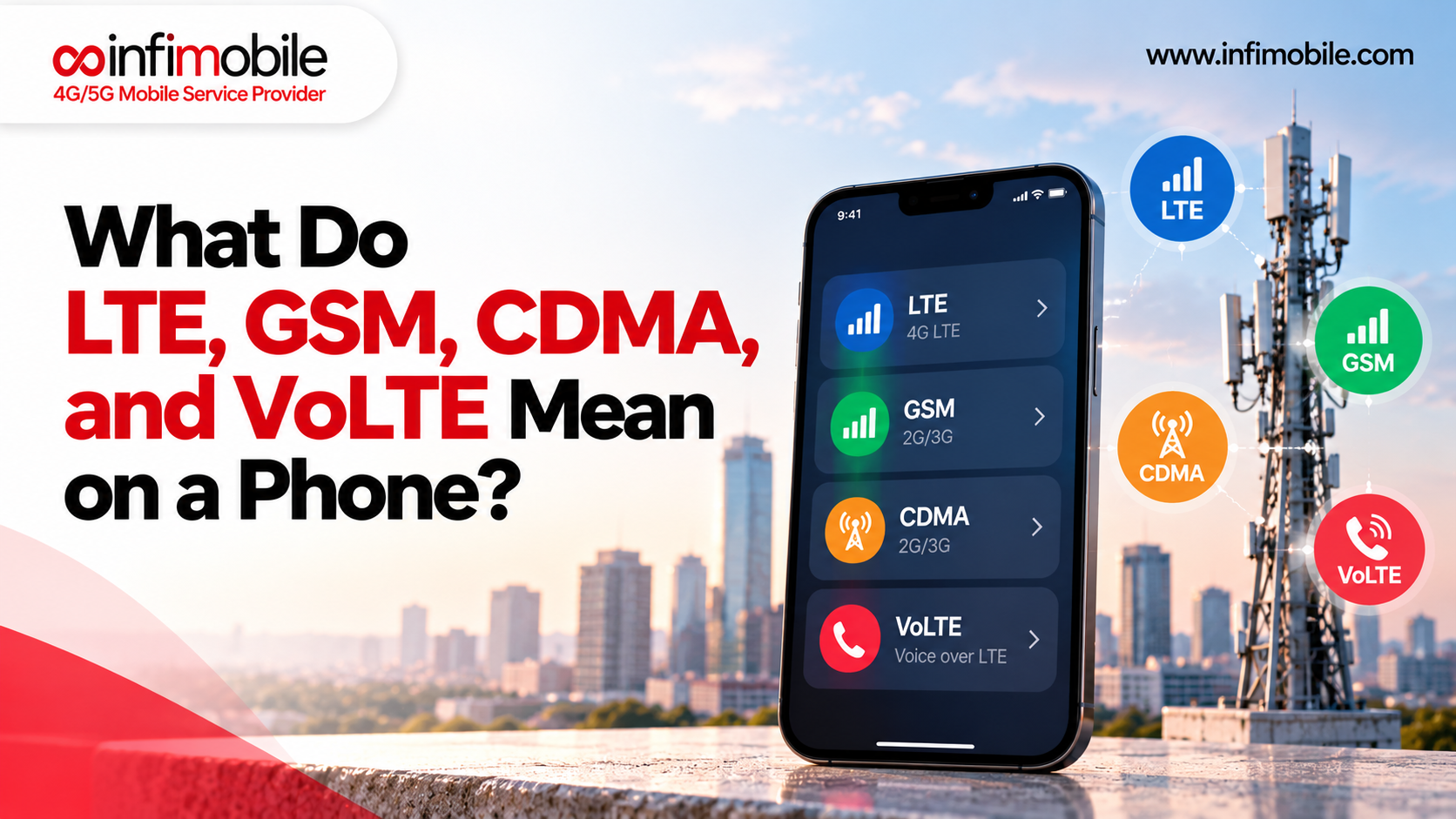
Here is the quick answer. GSM and CDMA are older technologies that carriers once used to run calls and texts. LTE is the 4G technology that carries your data today. VoLTE is the feature that lets voice calls travel over that LTE connection. This guide explains what LTE, GSM, CDMA, and VoLTE mean on a phone, how they differ, and what to check before you bring your phone to a new plan.
The Short Version: What Each Term Means
| Term | Stands For | What It Does | Still Matters Today? |
| GSM | Global System for Mobile Communications | Older SIM-based standard for calls, texts, and basic data | Mostly retired as a standalone network in the U.S. |
| CDMA | Code Division Multiple Access | Older standard used by Verizon and Sprint | Retired in the U.S. |
| LTE | Long Term Evolution | The 4G technology that carries data | Yes |
| VoLTE | Voice over LTE | Sends phone calls over the LTE network | Yes, and often required for calling |
A simple way to think about it: GSM and CDMA are the old roads, LTE is the highway most traffic uses now, and VoLTE is the lane that keeps your phone calls moving on that highway.
What Is GSM on a Phone?
GSM stands for Global System for Mobile Communications. It started in Europe in the early 1990s and became the most widely used mobile standard in the world. In the United States, AT&T and T-Mobile built their early networks on GSM, and later technologies such as 3G UMTS and HSPA grew out of the same family.
The feature most people remember about GSM is the SIM card. On a GSM phone, your account lives on a small removable card. Move that card into another compatible phone, and your number moves with it. That idea carried into every modern phone, including today’s eSIM, which is simply a SIM stored digitally inside the device.
In older phone listings, “GSM phone” usually meant a phone that worked with SIM-based carriers such as AT&T and T-Mobile. Today those legacy GSM networks have largely been switched off in the U.S., so the label matters far less than it used to.
What Is CDMA on a Phone?
CDMA stands for Code Division Multiple Access. Instead of giving each caller a separate slice of frequency or time, CDMA lets many callers share the same channel by tagging every conversation with a unique code. Qualcomm developed the technology, and Verizon and Sprint used it for their 2G and 3G networks in the U.S.
Older CDMA phones were tied to the carrier’s own records rather than to a removable SIM. That is why moving a CDMA phone to another carrier used to require the carrier’s approval, and it is where the old “locked to Verizon” reputation came from.
Sprint’s CDMA network was shut down in 2022 after the T-Mobile merger, and Verizon retired its 3G CDMA network at the end of 2022. Phones that depended on CDMA for calls lost service. If your phone is from the last several years, it runs on LTE or 5G, which makes CDMA more of a history lesson than a buying factor.
GSM vs. CDMA: Does the Difference Still Matter?
For most people buying or switching phones today, the answer is no. Here is why:
- Legacy networks are gone: The 2G and 3G networks that GSM and CDMA ran on have been retired by the major carriers, so a phone no longer needs to speak those languages.
- Modern phones use one system: Current smartphones handle calls, texts, and data over LTE and 5G, no matter which carrier built the network.
- SIM and eSIM replaced the old split: Most phones now accept a physical SIM, an eSIM, or both, which removes much of the old carrier-by-carrier lock-in.
- Voice moved to LTE: Because calls now travel over LTE through VoLTE, the question has shifted from “GSM or CDMA?” to “Does my phone support the right LTE bands and VoLTE?”
The one situation where the old labels still matter is an older phone. If a listing says “CDMA only” or “GSM only,” treat that as a warning sign and check compatibility before you buy.
What Does LTE Mean on a Phone?
LTE stands for Long Term Evolution. It is the standard behind what most people call 4G. When your status bar shows LTE or 4G, your phone is using this technology to load apps, stream video, and browse the web. Compared with 3G, LTE brought faster downloads, lower delay, and better handling of many users in one area.
LTE vs. 4G vs. 5G
On your phone screen, “LTE” and “4G” mean the same thing. Technically, early LTE fell short of the official 4G speed targets, but the industry adopted the 4G label anyway, and improved versions such as LTE-Advanced closed the gap.
5G is the newer generation, with higher peak speeds and lower delay in areas where it is available. Many 5G connections still lean on LTE for part of the connection, and your phone falls back to LTE when a 5G signal is weak or missing. That is why LTE remains the safety net behind most mobile service.
Why LTE Bands Matter
LTE works across different radio frequency bands, which are slices of the airwaves that carriers license. A phone needs to support the bands a carrier uses in your area. Two phones can both show LTE on the same network, yet one may get a stronger indoor signal or steadier speeds because it supports more of the right bands. This is why checking a phone’s compatibility is better than assuming that “it’s a 4G phone” is enough.
What Is VoLTE and Why Does It Matter?
VoLTE stands for Voice over LTE. It sends your phone calls as data over the LTE network, in a similar way to how a messaging app sends a voice note.
Early LTE networks were built for data only. When you made a call, many phones had to drop back to 3G or 2G to place it, a process called circuit-switched fallback. VoLTE removes that step by keeping the call on LTE from start to finish.
Here is what that means in daily use:
- Clearer sound: VoLTE supports HD Voice, which often makes calls sound fuller and less muffled.
- Faster call setup: The phone does not need to switch networks first, so calls usually connect more quickly.
- Data during calls: You can keep browsing or using maps while you talk, because the call and your data share the same LTE connection.
- Support for modern networks: With older networks retired, VoLTE is how voice calling works on current phones.
Why Some Phones Need VoLTE to Make Calls
Once carriers shut down their 3G networks, a phone without VoLTE had nowhere to fall back to for voice. Some older 4G phones kept working for text and data but could no longer place or receive regular calls. This also affects emergency calling, which is one reason carriers pushed customers to replace phones that could not support VoLTE.
VoLTE support depends on two things: the phone’s hardware and software, and the carrier’s approval of that model on its network. A phone can be LTE-capable and still not qualify.
VoLTE vs. Wi-Fi Calling
Wi-Fi calling sends calls over a Wi-Fi connection instead of the cellular network. It helps when you have weak signal at home or in a large building. VoLTE works over the cellular network itself. Many phones support both, and they work well together: Wi-Fi calling covers weak-signal spots, and VoLTE handles calls everywhere else.
How to Check What Your Phone Supports
Checking takes only a few minutes. Follow these steps:
- Find your phone’s exact model. Look in Settings under About Phone (or About on an iPhone). The model name and number help you search for official specifications.
- Look for LTE, 5G, and VoLTE options. Open your cellular or mobile network settings. You may see toggles or menus for 5G, LTE, VoLTE, or HD Voice. Menu names vary by brand and software version.
- Find your IMEI. Dial *#06# on the keypad. The 15-digit IMEI is your phone’s unique identifier, and carriers use it to confirm that a phone is compatible.
- Run the IMEI through a compatibility checker. Carriers usually offer a tool on their website. It tells you whether your phone works on their network and whether it supports calling features.
- Confirm the phone is unlocked. A locked phone only works with the carrier that sold it. Contact the original carrier if you are unsure.
- Update your software. Carrier settings and system updates can add or fix VoLTE support, so install any pending updates before you switch.
Common Problems and What Usually Causes Them
Most connection problems trace back to one of these causes:
- Calls fail, but data works: VoLTE may not be turned on, or the phone model may not be approved for VoLTE on that network.
- Phone shows LTE but feels slow: Network congestion, a weak signal indoors, or missing bands are the usual reasons, not a problem with the SIM itself.
- “No Service” after inserting a new SIM: The phone may be locked, may need a restart, or may need an update. Check the lock status first.
- Old phone labeled “CDMA only” or “3G only”: It may not connect to any current network, so verify compatibility before you buy or switch.
- Texts send, but calls do not connect: This pattern often points to missing VoLTE support or a setting that needs to be switched on.
What to Look for When Choosing a Plan for Your Phone
Because GSM and CDMA no longer determine whether a phone works, a few other points deserve your attention:
- Unlocked status: An unlocked phone gives you the freedom to move between carriers.
- VoLTE support: Confirm that your model supports VoLTE on the network you plan to use.
- LTE and 5G band support: More supported bands generally means more consistent coverage.
- eSIM or SIM compatibility: Check whether your phone takes a physical SIM, an eSIM, or both.
- Coverage in your area: The best phone cannot make up for a network with weak signal where you live and work.
How Infimobile Fits In
Infimobile is a digital-only prepaid wireless provider that runs on the Verizon and T-Mobile networks, and you choose one when you sign up. Plans include 4G LTE and 5G service, eSIM support, and Wi-Fi calling and texting, with no contracts.
For a prepaid provider like Infimobile, the practical questions are the ones covered above. Is your phone unlocked? Does it support the LTE and 5G bands of the network you pick? Does it support VoLTE? An older phone that was once labeled GSM or CDMA may or may not meet those requirements, so check the specific model rather than relying on the old label.
Before you switch, run your phone through the compatibility check on infimobile.com, then compare the available options on the Infimobile plans page. Plan details and prices change from time to time, so confirm the current terms there before you decide.
Frequently Asked Questions
Most smartphones made in recent years no longer fit neatly into either category, because they connect over LTE and 5G on every major U.S. network. If you want a definite answer, use your IMEI in a carrier compatibility checker. It confirms what a specific carrier supports, which is more useful than the old GSM or CDMA label.
It depends on the network. Some LTE-only phones can still use data and text but lose regular calling once voice traffic moves to VoLTE. If a phone lacks VoLTE approval on your carrier, you may need a different model.
Your phone may be outside 5G coverage, 5G may be turned off or set to a battery-saving mode in settings, or the phone may not support the 5G type your carrier uses. LTE is also the normal fallback when a 5G signal weakens indoors. Infimobile plans include both 4G LTE and 5G, so what you see on screen depends on your phone, settings, and location.
VoLTE is a feature of the phone and the carrier’s network, not of the SIM format. On a supported phone, a physical SIM and an eSIM can both be used for calling. What matters is that the phone model is supported and that the line is set up correctly on the network.
You can usually find the toggle, but switching it off may stop calls from working properly, since many networks now rely on VoLTE for voice. Leave it on unless a support agent asks you to turn it off for troubleshooting.
Final Thoughts
LTE, GSM, CDMA, and VoLTE are pieces of the same story. GSM and CDMA powered the early years of mobile service and have largely been retired. LTE carries your data today, with 5G building on top of it. VoLTE carries your calls over that same connection and is often what decides whether an older phone still works for voice.
When you choose a phone or a plan, focus on whether the phone is unlocked, supports the right LTE and 5G bands, and supports VoLTE. If you are ready to compare options, take a look at the Infimobile plans and run your phone through the compatibility check before you switch.